
Mushrooms occupy a position in human life that no other organism matches. They feed us and heal us, connect forest ecosystems, provide some of the most rigorously studied natural health compounds in modern science, and offer a path toward genuine self-sufficiency in food production that almost anyone can pursue from their kitchen counter.
This guide covers everything — whether you want to grow your first mushroom, forage safely in the wild, build a supplement protocol grounded in real science, or simply cook better with the mushrooms you already buy. Use the navigation below to go directly to what matters most to you right now.
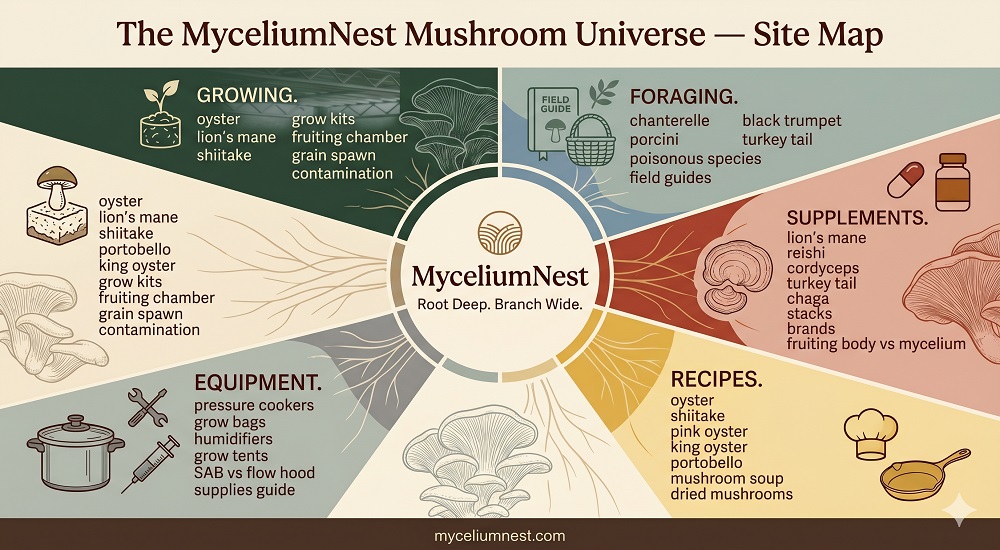
🌱Pillar 1: Growing Mushrooms at Home
Home mushroom cultivation is the fastest-growing niche in the self-sufficiency movement — and for good reason. An oyster mushroom grow block delivers harvest-ready fruit within 10–14 days of inoculation, produces 300–600g of premium mushrooms per flush, and can fruit two or three times before the substrate is exhausted. The cost per gram of home-grown oyster mushroom is approximately 1/10th of the retail price.
The learning curve is real but navigable. The single most important principle: every failure is contamination, and contamination is always preventable. Start with pasteurised straw and pearl oysters — the most forgiving combination in cultivation. Master the process before moving to sterilised hardwood substrates and more demanding species.
The 5 Most Rewarding Species for Home Cultivation
| Species | Difficulty | Days to First Harvest | Retail Value | Guide |
|---|---|---|---|---|
| Pearl Oyster | Very Easy ★☆☆☆☆ | 10–14 | $8–15/lb | Full Guide → |
| Lion’s Mane | Easy ★★☆☆☆ | 14–21 | $20–40/lb | Full Guide → |
| Shiitake | Medium ★★★☆☆ | 30–90 (logs) | $10–20/lb | Full Guide → |
| King Oyster | Medium ★★★☆☆ | 25–40 | $12–22/lb | Full Guide → |
| Portobello | Advanced ★★★★☆ | 35–60 | $5–12/lb | Full Guide → |
For a complete beginner orientation covering substrate, sterilisation, contamination prevention, and fruiting chamber management: Mushroom Growing for Beginners — The Complete Framework.
🌿Pillar 2: Wild Mushroom Foraging
Wild mushroom foraging is the discipline that most thoroughly changes your relationship with the natural world. Walking into a beech-oak forest in September with the knowledge to reliably find and identify hen of the woods, black trumpets, and chanterelles transforms you from a visitor in the ecosystem to a participant in it. That said, foraging has one absolute, non-negotiable rule that governs everything else:
You must be 100% certain of identification — confirmed by at least 4 independent physical features verified against a regional field guide — before eating any wild mushroom. Confidence is not certainty. 95% is not 100%. When in doubt, leave it out. Poison Control: 1-800-222-1222 — save this number before your first foray.
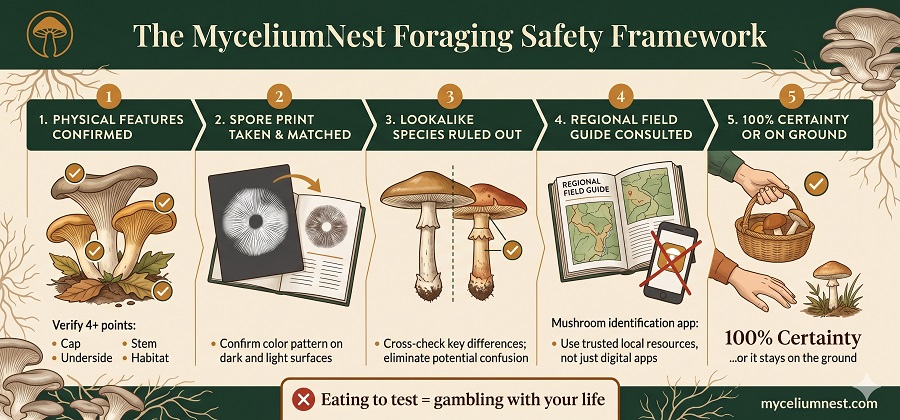
The Beginner’s 5 — Safe Starting Species
These five species are specifically selected for beginners: each has unmistakable features, no deadly lookalikes in North America, and covers three distinct seasons. Master these before adding any other species to your foraging list. For the complete safety briefing, dangerous mushrooms to know, and the multi-feature identification method every forager must use: Wild Mushroom Foraging for Beginners →
The Premium Wild Species
Once you’ve mastered the Beginner’s 5, these species represent some of the finest wild foods available:
The North American Mycological Association (namyco.org) maintains a directory of 90+ regional clubs with guided identification forays — the single fastest way to develop safe foraging confidence in your specific ecosystem. For the best field guides to carry into the woods: Best Mushroom Field Guides Ranked →
💊Pillar 3: Medicinal Mushroom Supplements
Functional mushrooms represent the most robustly evidenced category of natural health supplementation. Unlike many herbal supplements where benefit claims outrun the science, several mushroom species have decades of peer-reviewed clinical research behind them — including FDA-observed clinical trials, approved therapeutic use in Japan, and thousands of published studies in indexed scientific literature.
The 6 Most Studied Medicinal Mushrooms
| Species | Primary Research Area | Key Bioactive | Evidence Level | Guide |
|---|---|---|---|---|
| Lion’s Mane | Cognitive function, NGF synthesis | Hericenones, erinacines | Strong | Guide → |
| Turkey Tail | Immune modulation, gut microbiome | PSK, PSP (beta-glucans) | Strongest (400+ studies) | Guide → |
| Reishi | Adaptogenic stress response, sleep | Ganoderic acids (triterpenoids) | Strong | Guide → |
| Cordyceps | Athletic performance, ATP synthesis | Cordycepin, adenosine | Moderate | Guide → |
| Chaga | Antioxidant, anti-inflammatory | Betulinic acid, melanin | Moderate | Guide → |
| Maitake | Immune modulation, glucose | Beta 1,3/1,6-glucan (D-fraction) | Moderate-Strong | Species Guide → |
The Three Non-Negotiable Quality Standards
Before buying any mushroom supplement, verify these three things. If a product fails any one of them, move to the next brand regardless of price, packaging, or marketing claims:
For the complete brand comparison — including the Four Sigmatic vs Real Mushrooms head-to-head with price-per-milligram beta-glucan analysis — see our mushroom supplement brand comparison guide. For goal-based stacking: Best Mushroom Supplement Stacks →
🍳Pillar 4: Cooking With Mushrooms
Mushrooms are the most versatile ingredient in a conscious kitchen — functioning as main courses, umami boosters, stock bases, meat alternatives, and finishing seasonings simultaneously. The cooking principles that matter most are universal regardless of species:
The 5 Universal Mushroom Cooking Principles
- Dry before you cook. Wet mushrooms steam rather than brown. Pat dry, or allow to air-dry for 10–15 minutes before hitting a hot pan. The Maillard browning that creates deep mushroom flavour only happens above 140°C — steam keeps the temperature below this threshold.
- Hot pan, not overcrowded. A crowded pan drops the temperature below browning threshold. Cook in batches on high heat. The pan should be nearly smoking before the mushrooms go in.
- Don’t move them. Lay mushrooms in the pan and leave undisturbed for at least 2–3 minutes. Let the Maillard reaction develop a proper crust before you toss or flip.
- Use the soaking liquid from dried mushrooms. This is the most universally wasted ingredient in home cooking. Dried mushroom soaking liquid is concentrated mushroom stock — use it as pasta cooking water, risotto liquid, or sauce base. Full guide: Dried Mushroom Recipes →
- Save the stems. Mushroom stems contain the same flavour compounds as caps but with tougher texture. Collect and freeze them for stock. A bag of frozen shiitake stems makes extraordinary dashi. Never throw them away. See our mushroom soup guide for the double-mushroom stock method.
Species-by-Species Recipe Guides
🔧Pillar 5: Equipment & Supplies
Mushroom cultivation equipment follows a clear progression — and the most expensive mistake is buying at the wrong level. A flow hood purchased before you’ve mastered basic sterilisation is wasted money. A pressure cooker purchased at Level 1 instead of Level 3 is equally premature. Buy what your current skill level genuinely requires.
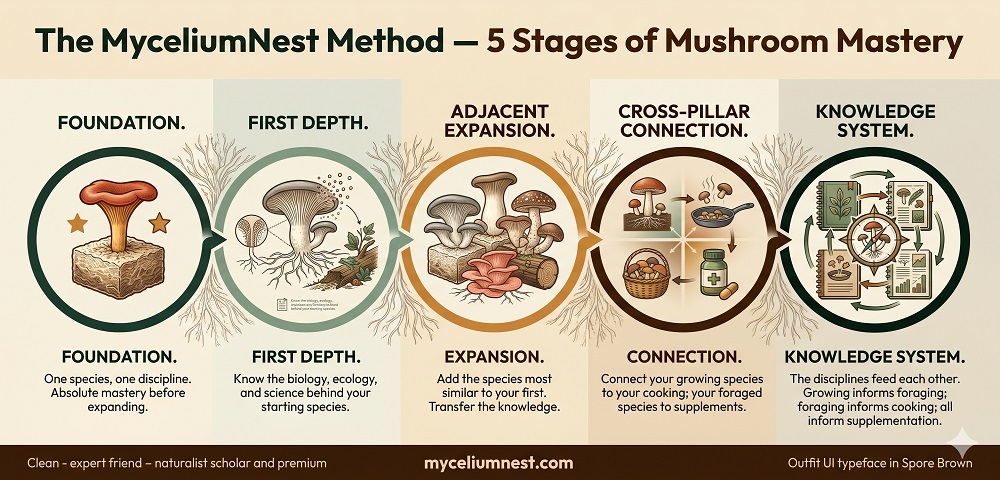
The MyceliumNest Method: How to Build Mushroom Knowledge That Compounds
After years of building content across all five pillars, we’ve identified a knowledge progression that produces better results than any other approach — whether your starting point is cultivation, foraging, supplementation, or cooking. We call it the MyceliumNest Method, and it is built around one principle: depth before breadth, always.
Frequently Asked Questions
What is the easiest mushroom to grow for a complete beginner?
Pearl oyster mushroom (Pleurotus ostreatus) on pasteurised straw is the most forgiving first grow available. It tolerates a wider range of temperatures and humidity than any other cultivated species, fruits quickly (10–14 days), and the contamination consequences of minor technique errors are less severe than with more demanding species. Start with a grow kit, then move to scratch growing. Our beginner’s growing guide covers the complete progression.
Which mushroom supplement should I start with?
Lion’s mane is the most accessible starting supplement for most people — the cognitive focus effects are often perceptible within 4–8 weeks of consistent daily use, providing early feedback that motivates continued use. For immune support specifically, turkey tail has the strongest research foundation of any mushroom species. For stress resilience and sleep quality, reishi is the most broadly applicable adaptogen. Our supplement stacks guide covers goal-based protocols.
Is it safe to eat wild mushrooms I find in the forest?
Only if you have confirmed identification using four or more independent physical features, verified against a regional field guide, with dangerous lookalikes specifically ruled out for each specimen. A photograph on a phone app, an online group confirmation, or a general resemblance to a photo in a book is not sufficient. The Death Cap is responsible for more fatal mushroom poisonings than any other species worldwide — it reportedly has a pleasant smell, mild taste, and no warning signs. Certainty, not confidence, is the standard. See our complete poisonous mushrooms guide before any foray.
What are the most nutritious mushrooms to eat regularly?
All mushrooms provide B vitamins, selenium, potassium, and dietary fibre. Shiitake is among the highest in vitamin D (when UV-exposed) and contains lentinan (a beta-glucan with immune research support). Oyster mushrooms are particularly high in protein relative to their caloric density. Maitake has the highest vitamin D potential of cultivated species when UV-exposed. The USDA FoodData Central database provides the complete nutritional profiles for every cultivated mushroom species.
How long does it take to become a confident mushroom forager?
Two to three seasons of consistent foraying with at least 20–30 confirmed identifications per season produces genuine confidence for 4–6 well-studied species. Attending multiple guided forays with an experienced mycologist or NAMA-affiliated society accelerates this significantly — a single guided foray is worth months of solo study. The goal is not to know 50 species with moderate confidence but to know 10 species with absolute certainty. Breadth of identification is far less valuable than depth of certainty.
This guide is updated periodically as new research and cultivation techniques emerge. MyceliumNest content is independently produced and reflects direct practitioner experience. Some articles contain affiliate links — commission rates never influence rankings or recommendations. See our full disclosure and about page.