Porcini Mushroom Identification: Find Boletus edulis & Avoid Toxic Lookalikes

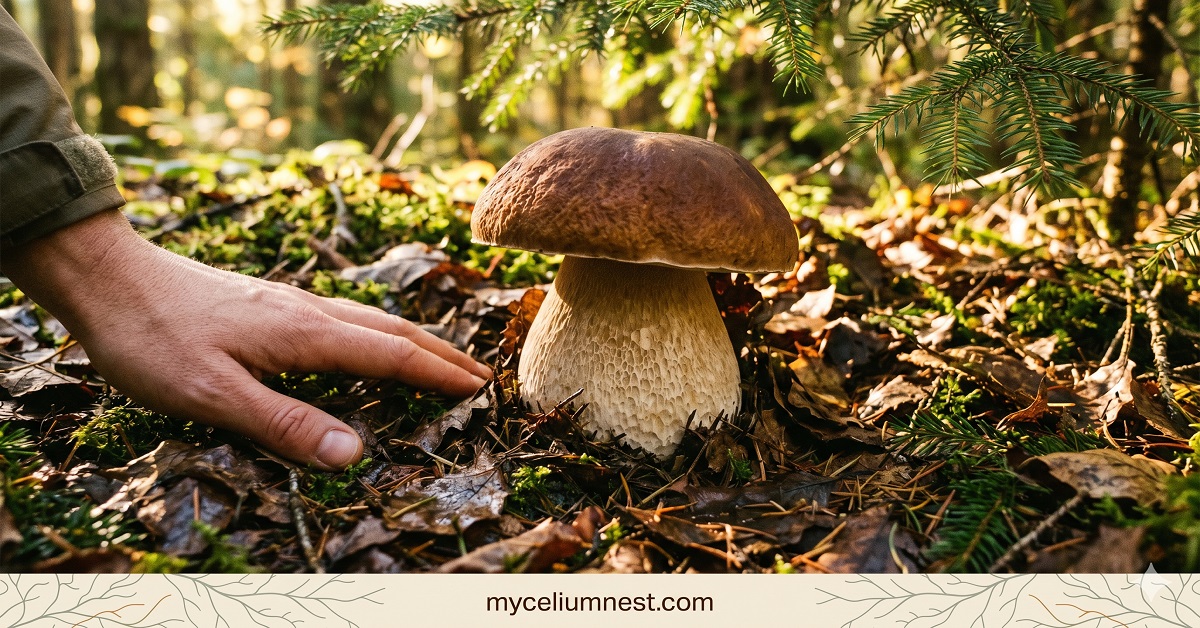
Porcini Mushroom Identification: Porcini (Boletus edulis and its close relatives) sell for $40–80 per pound fresh and up to $300 per pound dried — making a productive porcini location one of the most valuable foraging discoveries available to any wild food enthusiast. With the right knowledge, they are findable, unmistakably identifiable, and — once you have your system — reliably productive across years.
- The Porcini Complex: Four Species, One Name
- Complete Porcini Identification: 5 Definitive Features
- The Red-Staining Test: The Bolete Safety Check
- Habitat and Elevation: Where Porcini Actually Grow
- Dangerous and Non-Dangerous Lookalikes
- Harvest Timing, Cleaning & Preservation
- Frequently Asked Questions
The Porcini Complex: Four Species, One Name
When experienced foragers say “porcini,” they are not referring to a single species — they are referring to a closely related group of four Boletus species that are virtually identical in appearance, flavour, and culinary quality. Understanding this complex is important because your field guide may list the species you find under a different name than you expect:
| Species | Common Name | Primary Habitat | Cap Colour |
|---|---|---|---|
| Boletus edulis | King Bolete / Porcini / Cep | Spruce, pine, fir — mountain forests | Chestnut-brown to tawny, paler at margin |
| Boletus pinophilus | Pine Bolete / Pinewood King | Pine forests, often sandy soils | Darker reddish-brown to almost purple-brown |
| Boletus aereus | Dark Cep / Bronze Bolete | Oak forests, Mediterranean and warmer climates | Very dark brown to almost black |
| Boletus reticulatus | Summer Cep / Summer Porcini | Mixed hardwood forests, appears earlier in season | Pale tan to light brown, often paler than edulis |
All four species are equally desirable as food. The identification features described below apply to all members of the complex — if you can identify one, you can identify all four.
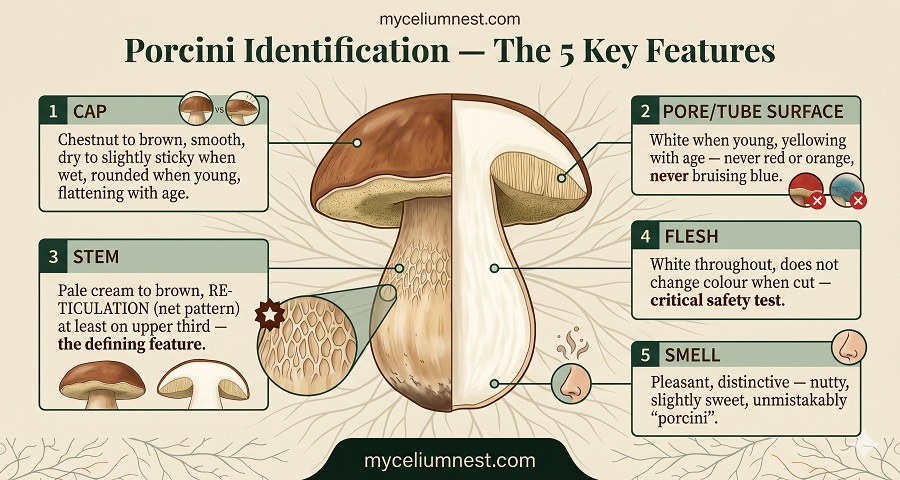
Complete Porcini Identification: 5 Definitive Features
The Red-Staining Test: The Bolete Safety Check
This is the most important safety protocol for anyone foraging boletes. Several toxic bolete species produce striking red colouration — either in the pore surface, in the stem, or when the flesh is exposed to air. The rule is absolute:
Habitat and Elevation: Where Porcini Actually Grow
Porcini are mycorrhizal — they form a symbiotic relationship with the roots of specific tree species and cannot fruit without their tree partner. This ecological fact is your most powerful search tool: find the right trees at the right elevation in the right season and porcini become predictable.
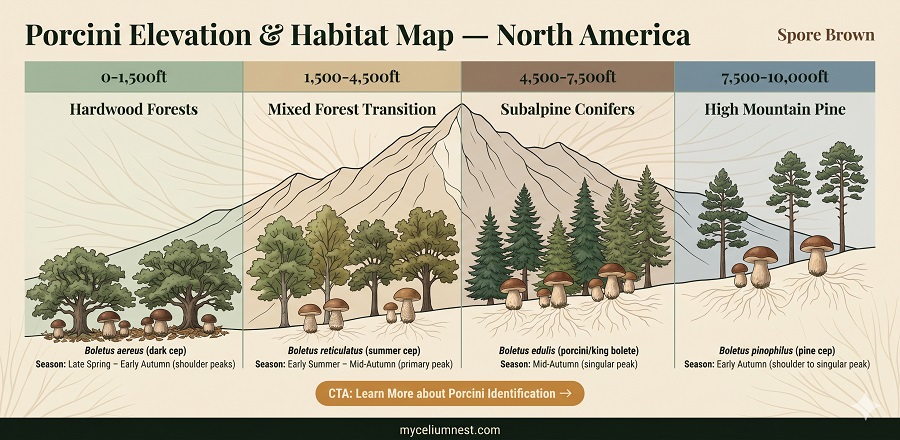
The Fruiting Trigger: Soil Temperature, Rain Sequence & the 48-Hour Window
Understanding porcini fruiting triggers converts casual foraging (“let’s go look”) into systematic timing (“conditions are right — go now”). These triggers are the knowledge that separates foragers who find porcini consistently from those who find them occasionally by luck.
Porcini mycelia initiate fruiting body development when soil temperature reaches approximately 48–58°F (9–14°C) at a depth of 5–10cm. This is significantly cooler than air temperature — forest soil at altitude may be in the fruiting range even when air temperatures feel warm to the touch.
Practical measurement: An inexpensive soil thermometer ($8–12) pushed into the forest floor gives you the precise data point. Check the soil temperature at your target elevation location the morning after significant rain. Readings in the 50–57°F range with recent soil moisture = go foraging within the next 48 hours.
Dangerous and Non-Dangerous Lookalikes
| Species | Danger Level | Key Distinguishing Feature |
|---|---|---|
| Rubroboletus satanas (Satanic Bolete) | ☠ TOXIC | Red pores, red stem base, flesh blues intensely when cut. Also much paler cap (grey-white). Unmistakable if you check pore colour. |
| Boletus luridiformis (Scarletina Bolete) | ⚠ Toxic raw | Orange-red pores, flesh blues intensely and rapidly when cut. Never consume raw; some are toxic even cooked. |
| Tylopilus felleus (Bitter Bolete) | Not toxic but inedible | Pink-tinged pores (not white/yellow), extremely bitter taste even in small amounts, dark reticulation on stem. One bite ruins an entire pot. |
| Suillus species (Slippery Jack) | Not dangerous | Slimy or sticky cap, ring on stem, no reticulation. Edible but inferior quality. Associated exclusively with conifers (2–3 needle pines specifically). |
Harvest Timing, Cleaning & Preservation
Timing: Harvest porcini at the “button” stage — when the cap is fully rounded and the pore surface is still white or cream. At this stage the flesh is firmest, the flavour most concentrated, and maggot infestation (a near-universal feature of mature porcini) is minimal. Larger mature specimens are still edible but often require more aggressive cleaning to remove maggot tunnels in the stem.
The maggot reality: Most porcini contain mushroom fly larvae (maggots) that enter through the stem base and tunnel upward as the mushroom matures. This is normal and does not make the mushroom unsafe — it simply means you need to slice specimens and check for tunnels. Lightly infested porcini can be used after removing the affected sections. Heavily infested specimens (stem entirely tunnelled) are best returned to the forest floor to complete their ecological role.
Preservation — Drying Is King: Porcini intensify dramatically in flavour when dried. A quality dehydrator at 55°C for 6–8 hours produces dried porcini superior to any commercial product. Slice 5mm thick before drying. Store in airtight jars in a dark, cool location. Dried porcini rehydrate beautifully in warm water and the soaking liquid is itself a rich stock. One pound of fresh porcini produces approximately 1.5–2 ounces of dried — making proper drying storage the most economical way to preserve large harvests.
For guidance on building your foraging knowledge systematically, the North American Mycological Association (namyco.org) hosts annual forays and workshops in porcini habitat regions. For your foundational field guide selection before attempting porcini, see our field guide rankings.
Frequently Asked Questions
Can I grow porcini at home?
Not in the traditional sense. Porcini are ectomycorrhizal — they require a living tree host and cannot be cultivated on substrate alone. Research into porcini inoculation of young trees exists but has not produced reliable home cultivation results. Several companies sell “porcini cultivation kits” that have not been shown to actually produce porcini fruit bodies — these are generally misleading marketing. The only way to reliably obtain porcini is to forage them or purchase them from foragers and specialty food vendors.
Are the porcini sold at grocery stores the same as wild porcini?
Dried porcini sold in grocery stores are wild-foraged — typically from Eastern Europe (Poland, Romania, Bulgaria) or China. Fresh porcini sold in specialty stores are also wild-foraged. No commercial cultivation of true porcini exists at any scale. The quality of grocery store dried porcini varies enormously — the best are imported from Poland or Italy and have been dried at appropriate temperature; cheaper products from China are often over-dried or poorly graded. Wild porcini you dry yourself from fresh-foraged specimens will consistently outperform commercial dried products in flavour concentration.
Do porcini appear in the same spot every year?
Generally yes — the mycorrhizal relationship between the porcini mycelium and its host trees is long-lived and stable. A productive porcini location will typically fruit annually for as long as the host trees and mycelium remain healthy, which can be decades. Weather significantly affects timing and abundance — a drought year may produce nothing; a perfect moisture-temperature year may produce extraordinary quantities. Mark every productive location precisely with GPS and note the specific trigger conditions (recent rainfall, temperatures) each time you find a productive flush. Over 3–4 years of records you will be able to predict productive periods with reasonable accuracy.
Always verify identifications with a regional field guide and experienced forager. See our full disclosure.