Morel Mushroom Identification: How to Find Them & Avoid False Morels
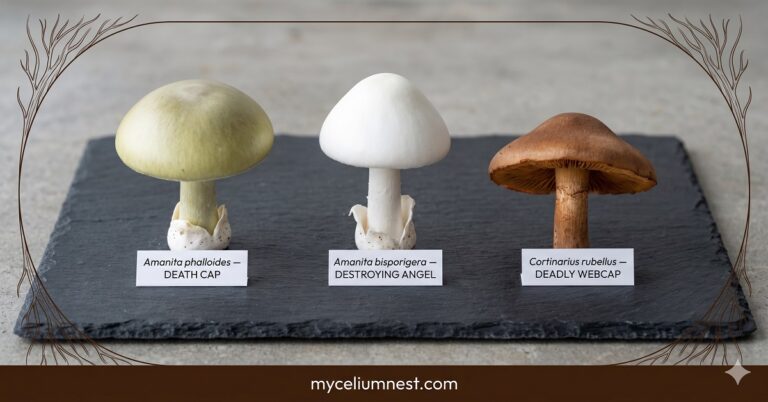
This guide is for educational purposes only. Never consume any wild mushroom identified solely from an online article. Always verify your identification using at least two independent field guides and, ideally, an experienced local forager or mycologist. False morels (Gyromitra species) contain gyromitrin — a compound that can cause fatal poisoning. When in doubt, do not eat it.

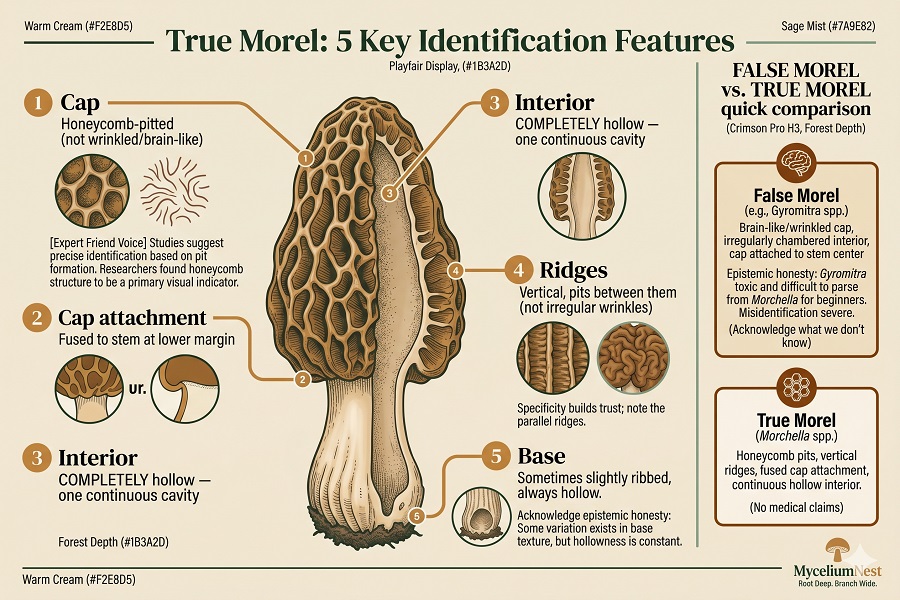
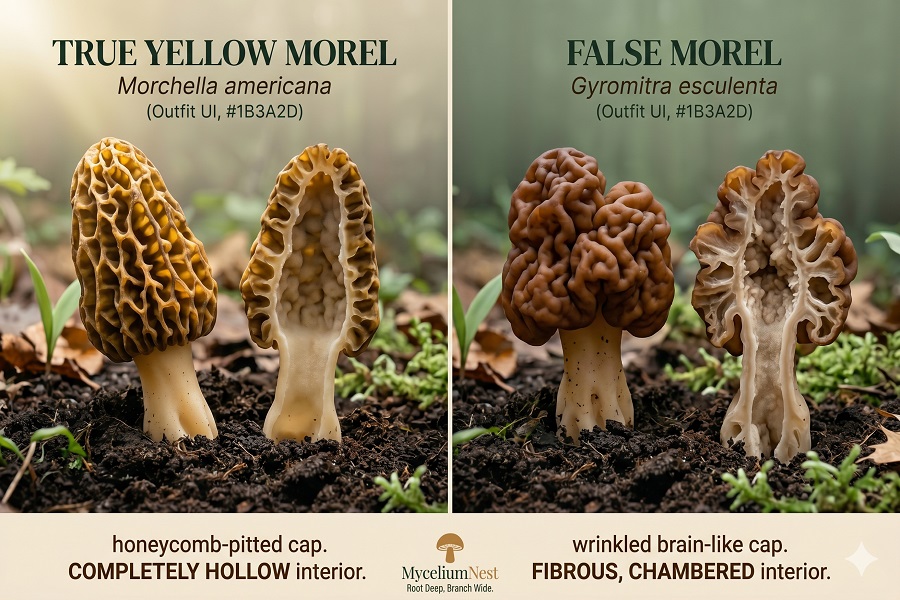
True morels have a completely hollow interior from cap tip to stem base, a cap fused to the stem at its lower margin (not hanging freely), and a honeycomb-pitted surface — not wrinkled or brain-like. These three features together distinguish true morels from all dangerous look-alikes.
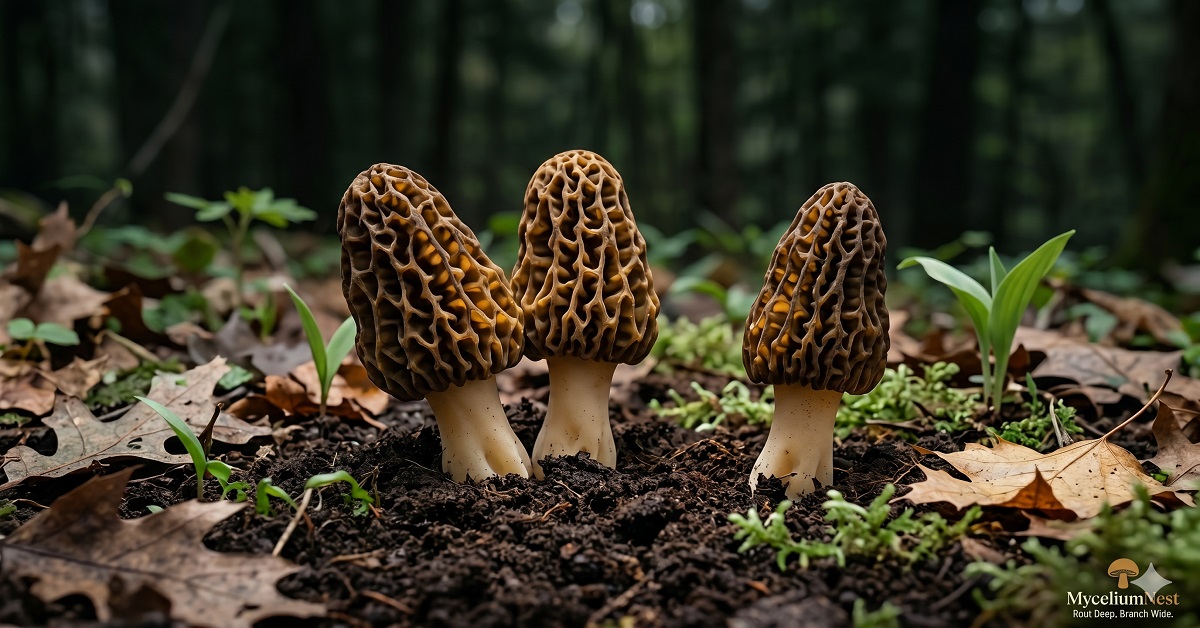
Morel mushrooms are the holy grail of spring foraging — extraordinary in flavour, notoriously difficult to find, and available for a tantalisingly short seasonal window of just 2–4 weeks per year. Few natural experiences rival the elation of finding your first cluster of yellow morels among the leaf litter of an elm grove in April.
But morels also have look-alikes that can cause serious illness or death. This guide covers every aspect of morel mushroom identification — the definitive features of true morels, the dangerous false morels, exactly where and when to find them, and the safety rules that every forager must follow.
What Are Morel Mushrooms?
True morels belong to the genus Morchella — a group of ascomycete fungi (sac fungi) rather than basidiomycetes (the “true” mushrooms like oysters and shiitake). They’re found throughout temperate North America, Europe, and Asia, and are among the most commercially valuable wild mushrooms in the world — fresh morels sell for $30–$60 per pound at farmers markets and upwards of $500 per pound when dried.
Taxonomically, the North American morel complex has been substantially revised in recent decades. DNA sequencing has revealed that what foragers once called “yellow morel” is actually a complex of several distinct species — all edible, all equally delicious, all identified by the same field characteristics covered below.
The 5-Point Morel Identification Guide
Feature 1: The Honeycomb Cap
A true morel’s cap is covered in a distinctive network of pits and ridges that create a honeycomb or lattice pattern. The ridges are vertical and regular; the pits between them are the spore-bearing surfaces (asci). This is the morel’s most visually distinctive feature and should be identifiable at a glance — the cap looks like a sea sponge or a perfectly regular lattice, not like a wrinkled brain.
Critical distinction from false morels: False morels (Gyromitra species) have a cap that is wrinkled, lobed, or brain-like — but NOT pitted. If the cap looks wrinkled rather than pitted, it is not a true morel.
Feature 2: Cap Fused to Stem
On a true morel, the cap is attached to the stem along its lower edge — it does not hang freely or overhang the stem like a skirt. Run your finger along where the cap meets the stem; on a true morel, they are fused together.
Distinction: On many false morels (Gyromitra, Verpa), the cap hangs freely from the stem like a thimble on a finger — attached only at the top, with the sides hanging free. This is a definitive disqualifier.
Feature 3: Completely Hollow Interior (The Cut Test)
This is the single most reliable distinguishing test. Cut the morel in half from cap tip to stem base. A true morel will reveal a single, completely hollow cavity — cap and stem are hollow and continuous, with no internal chambers, fibers, or cottony material whatsoever.
Critical: Always perform the cut test. A false morel may be partially hollow but will have internal fibers, partial walls, or a cottony texture inside. Any obstruction or division in the interior cavity = suspect species.
Feature 4: Stem Characteristics
True morel stems are usually white to cream-coloured, slightly ribbed or granular in texture, hollow, and broader at the base. The stem length varies by species — yellow morels typically have short, stout stems; black morels often have longer, more slender stems.
Feature 5: Smell and Habitat Correlation
True morels have a distinctly pleasant, earthy-mushroomy aroma — slightly nutty, never sour, never unpleasant. Combined with habitat (see below), smell helps confirm identification. A mushroom with the visual features of a morel that smells sour, chemical, or strongly unpleasant warrants extra caution.
True Morel Species of North America
False Morels: What to Avoid & Why
Gyromitra species (false morels) contain gyromitrin, which converts to monomethylhydrazine (a component of rocket fuel) in the human body. Symptoms appear 6–12 hours after ingestion and include severe vomiting, diarrhoea, haemolytic anaemia, liver failure, and in severe cases, death. Some Gyromitra species are occasionally eaten in Eastern Europe after prolonged parboiling and drying, but this is not recommended and is not safe as general practice.
Gyromitra esculenta (Beefsteak Mushroom / False Morel)
The most dangerous look-alike. Key differences from true morels:
- Cap is wrinkled, lobed, and brain-like — not honeycomb-pitted
- Cap may be partially attached to the stem but hangs partially free at the sides
- Interior is not completely hollow — has internal chambers and fibrous tissue
- Often reddish-brown to chocolate brown in colour
- Frequently appears alongside true morels in spring — do not assume that because you found true morels nearby, all similar-looking mushrooms in the area are also safe
Verpa bohemica (Wrinkled Thimble-Cap)
Partially edible but sometimes causes illness in large quantities. Key distinguishing feature: the cap hangs free from the stem like a thimble — attached only at the very top center, with the sides hanging freely. True morels are fused along the lower cap margin.
Where to Find Morel Mushrooms
The Four Essential Morel Habitats
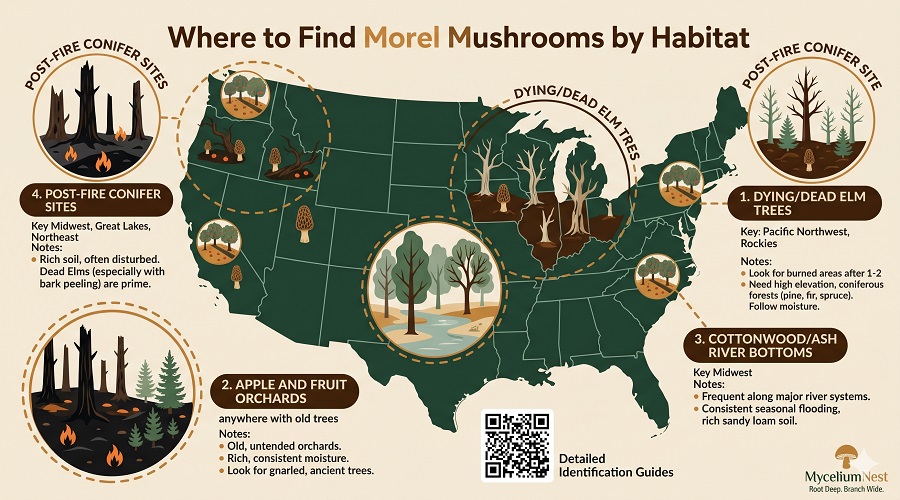
1. Dying and Dead Elm Trees
This is the most reliable morel habitat in the eastern two-thirds of North America. Dutch elm disease has left millions of dead and dying elms across the Midwest and Northeast — and morels, particularly yellow morels, have an extraordinarily strong mycorrhizal-like association with dying elms. Look for elms with loose, shaggy bark that is beginning to fall away. The mushrooms typically emerge within 20 feet of the tree base.
Indicator Tree Identification: Finding the Right Trees in the Field
Morels don’t appear randomly — they appear in specific relationships with specific trees. Learning to identify the right tree species before leaves emerge (morel season often peaks when trees are just budding) is the skill that separates consistently successful foragers from occasional lucky ones.
2. Old Apple and Fruit Orchards
Abandoned orchards with old, gnarled apple or pear trees are classic morel hunting grounds, particularly in the Appalachian region. The combination of disturbed soil, specific tree species, and organic matter creates ideal conditions. Old orchards that haven’t been sprayed for decades are the best locations.
3. Cottonwood and Ash River Bottoms
Rich, moist river bottom land with cottonwood, ash, and sycamore trees produces exceptional morel flushes in the Midwest. The rich alluvial soil, moisture, and canopy structure create ideal fruiting conditions. Look along the elevated edges of floodplain areas — morels rarely fruit in the lowest, wettest zones.
4. Post-Fire Conifer Sites
The year after a forest fire, morels — particularly M. tomentosa and burn-site specialists — can appear in enormous numbers on disturbed, ash-enriched soil. This phenomenon is best known in the Pacific Northwest and Northern Rockies. The trigger appears to be a combination of soil temperature change, pH alteration from ash, and reduced competition from other fungi.
Morel Season: When to Look by Region
The soil temperature rule: Morels fruit when soil temperature reaches 50–55°F (10–13°C) at a depth of 2 inches. An inexpensive soil thermometer — available on Amazon for under $15 — removes the guesswork entirely and dramatically improves your success rate.
Harvesting, Cleaning & Storing
How to Harvest Without Damaging the Mycelium
The great debate among morel foragers: cut the stem or pull the whole mushroom? Current mycological consensus slightly favours cutting at the base — this avoids disturbing the mycelial network in the soil and may marginally improve the site’s productivity in future years. Use a small pocket knife or mushroom knife. Either way, use a mesh bag rather than a plastic bag to carry your harvest — the mesh allows spores to disperse as you walk, potentially seeding new sites.
Cleaning Morels
Morels’ honeycomb surface traps soil, insects, and debris. Submerge briefly in cold salted water for 10–15 minutes — small insects will float to the surface. Gently agitate and rinse. Do not soak for extended periods; morels absorb water quickly and become waterlogged. Pat dry with a cloth before cooking.
Storage
- Fresh: 3–5 days in a paper bag in the refrigerator. Never airtight — they need to breathe
- Dried: The preferred preservation method. Dry at 40–50°C in a food dehydrator until completely brittle. Dried morels reconstitute beautifully in water or stock and have an intensified, deeper flavour than fresh. Store in an airtight jar away from light; last indefinitely
- Sautéed: Cook in butter until golden, then freeze — maintains flavour better than freezing raw
Frequently Asked Questions
Can you grow morel mushrooms at home?
Morels are notoriously difficult to cultivate — their life cycle is complex and not fully understood, involving both saprotrophic and mycorrhizal growth stages. Commercial cultivation has been achieved but is extremely technically demanding and not practical for home growers. Several outdoor morel cultivation kits are sold (typically inoculated outdoor garden patches) but with highly variable results. Foraging from wild sites remains the primary way to obtain fresh morels.
Are morels safe to eat raw?
No — morels contain small amounts of hydrazine compounds that are destroyed by thorough cooking. Eating raw or undercooked morels can cause gastrointestinal distress in many people. Always cook morels fully — sautéing until golden and completely cooked through is sufficient. Never consume raw or only lightly heated morels.
What is the best field guide for morel identification?
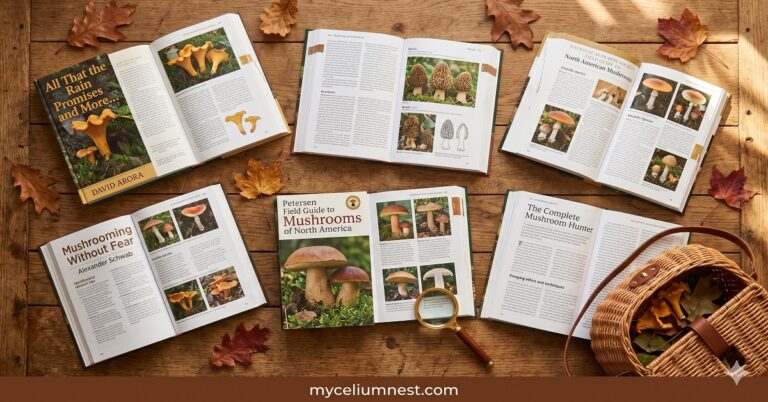
David Arora’s All That the Rain Promises is the most field-portable and accessible guide for North American foragers, covering morels clearly. For deeper taxonomic detail, Arora’s Mushrooms Demystified is the authoritative reference. For regional specificity, the National Audubon Society Field Guide to Mushrooms covers North American morels well. Using two guides together for any identification is strongly recommended. See our complete field guide rankings for links and detailed reviews.
How do I find morels — any tips for beginners?
Join your local mycological society (find one through NAMA at namyco.org) and attend a morel foray with experienced foragers in your first season. Nothing replaces learning in-person from someone who knows the specific habitat signatures of your region. Other practical tips: track soil temperature rather than calendar date; look from lower elevations first as the season progresses upslope; return to productive sites every year; and look slightly uphill from where you found them last season as the season advances.
⚠ Never eat any wild mushroom identified solely from this or any online source. Always verify with multiple independent sources and consult experienced local foragers. This article contains Amazon affiliate links — see our disclosure.