Best Pressure Cooker for Mushroom Cultivation (2026): 5 Models Tested & Ranked

The Presto 23-Quart Pressure Canner is the best pressure cooker for most home cultivators — it reaches and holds 15 PSI reliably, fits 10 quart jars per run, costs under $90, and is built to last decades. For advanced growers processing large batches, the All American 941 (41-Quart) is the professional-grade upgrade that never needs a gasket replacement.
A pressure cooker is the single most important equipment investment in home mushroom cultivation. Without it, supplemented hardwood substrates, grain spawn, and BRF jars cannot be sterilised to the 121°C / 15 PSI required to eliminate heat-resistant bacterial endospores — the primary cause of contamination in nutrient-rich substrates.
You can grow oyster mushrooms on pasteurised straw without one. For everything else — grain spawn, lion’s mane blocks, shiitake substrate, PF Tek jars — a pressure cooker is non-negotiable. This guide helps you choose the right model for your scale and budget, based on real cultivation experience.
What Actually Matters in a Mycology Pressure Cooker
Purchasing a pressure cooker for mushroom cultivation is different from buying one for cooking. The requirements are specific:
1. Must Reach and Maintain 15 PSI (Not Just “High Pressure”)
The sterilisation target is 121°C (250°F), which requires 15 PSI. Many consumer “instant pot” style electric pressure cookers only reach 11–12 PSI — adequate for cooking beans, not adequate for killing heat-resistant bacterial endospores (Bacillus species) in mushroom substrate. This is the single most important criterion and the reason many beginners experience high contamination rates despite following correct sterilisation procedures — they’re using an electric pressure cooker that never reaches the required temperature.
2. Adequate Capacity for Your Scale
A 16-quart pressure cooker can fit approximately 5–6 quart jars per run. A 23-quart fits 10–12 quart jars. A 41-quart fits 16–20 quart jars. For most home growers producing 5–10 inoculated jars per batch, a 23-quart is the sweet spot — large enough to sterilise a meaningful batch in one run, small enough to manage safely on a standard stovetop.
3. Stovetop (Not Electric) for True Sterilisation
As noted above, electric pressure cookers (Instant Pot, Ninja Foodi, etc.) do not typically reach 15 PSI. Stovetop pressure canners — designed for home canning — are what most experienced growers use. They are simple, reliable, and built for extended high-pressure operation.
4. Durability for Repeated High-Heat Cycling
A sterilisation run for mushroom cultivation involves bringing the cooker to full pressure and holding it for 2–2.5 hours — much longer than a typical cooking application. Over time, gaskets degrade and pressure readings can drift on dial gauge models. Weighted gauge models require no calibration. All-metal construction (All American models) eliminates the gasket degradation issue entirely.
Weighted Gauge vs. Dial Gauge: Which Is Better for Mycology?
Top 5 Pressure Cookers for Mushroom Cultivation
⚠ What NOT to Buy: Electric Pressure Cookers
Instant Pot, Ninja Foodi, and other electric multi-cookers are not suitable for mushroom sterilisation. Most reach only 11–12 PSI (approximately 115°C / 239°F) — insufficient to kill heat-resistant Bacillus endospores, which require 121°C / 15 PSI for reliable elimination.
Using an electric pressure cooker for mycology sterilisation is the most common cause of unexplained high contamination rates among beginners who are otherwise following correct technique. The investment in a proper stovetop pressure canner solves this immediately.
Full Comparison Table
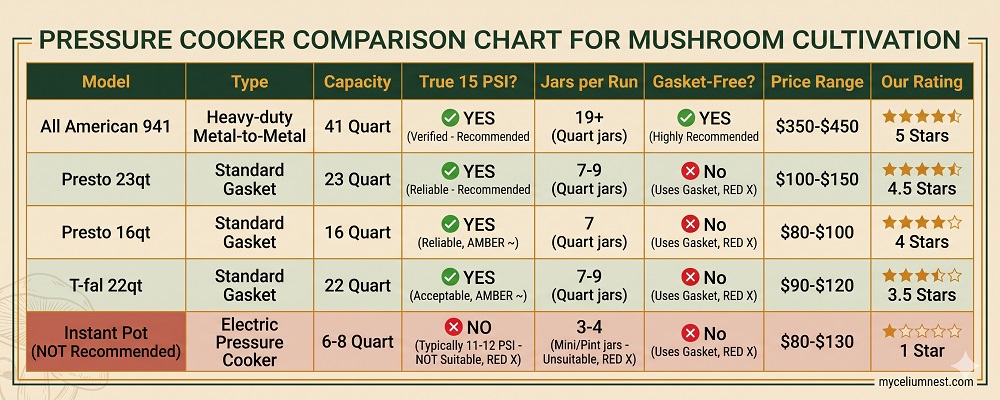
| Model | Max PSI | Capacity | Gauge Type | Induction Safe | Price | Best For |
|---|---|---|---|---|---|---|
| Presto 23-Quart | 15 PSI | 23 quarts | Weighted gauge | No (stovetop only) | $90–110 | Home cultivation, best overall |
| All American 921 | 15 PSI | 21.5 quarts | Weighted gauge | No (stovetop only) | $300–350 | Metal-to-metal seal, long-term durability |
| Presto 16-Quart | 15 PSI | 16 quarts | Weighted gauge | No (stovetop only) | $70–85 | Small batches, single-jar runs |
| Instant Pot Max | 12 PSI | 6 quarts | Digital dial gauge | Yes, electric | $150–180 | Not recommended — insufficient PSI |
How to Use a Pressure Cooker for Mushroom Sterilisation
Standard Sterilisation Protocol
This protocol applies to grain spawn jars, supplemented hardwood bags, and BRF cakes. For plain straw oyster mushroom substrate, pasteurisation (no pressure cooker needed) is sufficient — see our oyster mushroom substrate guide.
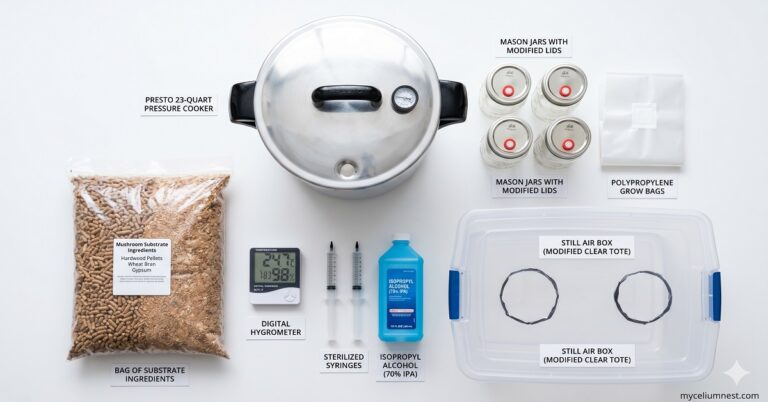
- Prepare jars or bags. Fill to appropriate levels (leaving headspace for jars). For jars: loosely cover with foil over polyfill lids to prevent water condensation entering. For bags: fold over the top — do not seal airtight during sterilisation.
- Add water to the pressure cooker. 2–3 inches (5–7cm) of water in the base. Place a canning rack, trivet, or folded towel to elevate jars from direct contact with the base.
- Load jars or bags. They can touch each other but should not be tightly packed. For bags, ensure they stand upright or lean against each other — not lying flat, which can block steam distribution.
- Bring to pressure on high heat. Lock the lid. Heat on high until the weighted gauge begins rocking steadily (for Presto) or the dial reads 15 PSI. Reduce heat to the minimum that maintains steady pressure.
- Sterilise for the required duration:
- Half-pint BRF jars: 60–90 minutes
- Quart grain jars: 2–2.5 hours
- Supplemented hardwood bags (1–2kg): 2.5–3 hours
- Allow natural pressure release. Turn off heat. Do not force-cool or use quick release. Allow the cooker to depressurise completely and cool to room temperature — minimum 8 hours, ideally overnight — before opening or inoculating.
Critical: Never inoculate warm jars or bags. Substrate must be fully cool before introducing spawn — warm substrate kills mycelium on contact and creates the perfect warm sterile environment for bacterial survivors to dominate unopposed.
Your pressure cooker is your single most powerful contamination prevention tool — more impactful than your inoculation technique, your still air box, or your spawn source. A cooker that genuinely reaches and holds 15 PSI eliminates bacterial contamination at the sterilisation stage before it can ever compete with your mycelium. For the complete picture of every contamination type and how to prevent each one, our mushroom contamination guide covers the full prevention system.
For the complete inoculation process that follows sterilisation, see our PF Tek guide and grain spawn guide. For the contamination issues that arise even with proper sterilisation, our contamination guide covers every scenario.
High-Altitude Growing: Why Your Sterilisation May Be Failing Without You Knowing
If you live above 1,500 feet (460 metres) elevation and experience persistent contamination despite following correct sterilisation protocols — correct PSI, correct duration, correct moisture — altitude may be the cause. This is the most common undiagnosed contamination source for growers in mountainous regions, and virtually no cultivation guide addresses it.
The Physics: Why Altitude Changes Everything
At sea level, water boils at 100°C (212°F). At 15 PSI in a sealed pressure cooker at sea level, the internal temperature reaches 121°C (250°F) — the sterilisation target. But atmospheric pressure decreases with altitude. This means water boils at progressively lower temperatures as you go higher — and the temperature inside a pressure cooker at a given gauge PSI is correspondingly lower than at sea level.
The practical consequence: a grower in Denver (5,280 ft / 1,609m) running their Presto 23-Quart at “15 PSI” is achieving an internal temperature closer to 117–118°C — not 121°C. That 3–4°C difference is the difference between killing heat-resistant Bacillus endospores and leaving them alive to dominate your substrate.
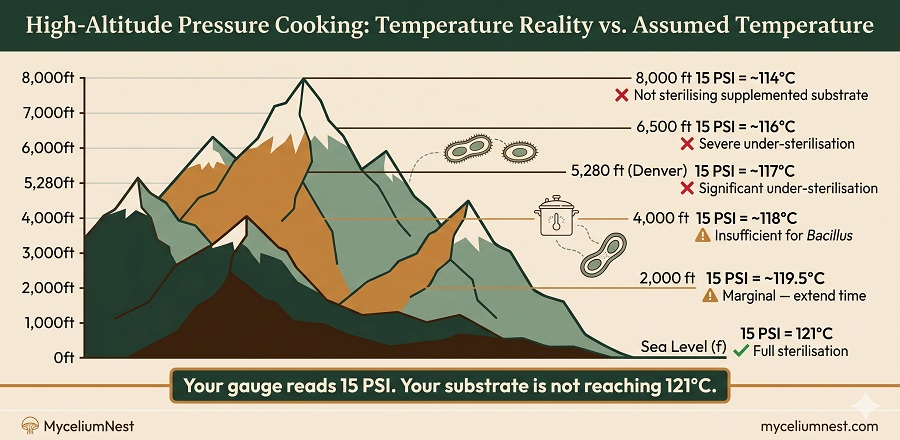
| Elevation | Example Locations | Temp at 15 PSI | Risk Level | Recommended Adjustment |
|---|---|---|---|---|
| 0–1,000 ft (0–305m) |
Coastal US, NYC, London, Lagos | 120–121°C | ✓ None | Standard protocol. No changes needed. |
| 1,000–2,500 ft (305–762m) |
Nashville, Atlanta, Johannesburg | 119–120°C | ⚠ Low | Add 15 minutes to standard sterilisation time as a precaution. |
| 2,500–4,000 ft (762–1,219m) |
Albuquerque, Salt Lake City, Nairobi | 117–119°C | ⚠ Moderate | Add 30 min to sterilisation time. Grain: 3 hours minimum. Supplemented blocks: 3.5 hours. |
| 4,000–6,000 ft (1,219–1,829m) |
Denver, Colorado Springs, Bogotá | 115–117°C | ✗ High | Add 45–60 min to sterilisation time AND increase PSI to 17–18 PSI if using a dial gauge cooker. Weighted gauge users: extend time by 60 minutes only. |
| 6,000–8,000 ft (1,829–2,438m) |
Flagstaff AZ, Cusco Peru, Addis Ababa | 113–115°C | ✗ Very High | Add 90 min to sterilisation time AND increase to 17–19 PSI. Strongly consider an All American dial gauge cooker for altitude control. Consider double-sterilisation for supplemented substrate. |
| Above 8,000 ft (2,438m+) |
High Rockies, Andes, Ethiopian Highlands | <113°C | ✗ Severe | Standard weighted gauge cookers may be insufficient. Use a dial gauge cooker set to 18–20 PSI. Double-sterilise all supplemented substrate. For plain straw (oyster): pasteurisation is unaffected by altitude — heat to 82°C by thermometer, not by time. |
Practical High-Altitude Solutions
You cannot increase PSI above the fixed weight — your only adjustment is time. Add the minutes specified in the table above. This works up to approximately 5,000 ft. Above this, upgrading to a dial gauge cooker (All American) gives you PSI control that compensates for altitude.
You can compensate by increasing the gauge reading. As a rule of thumb: add approximately 1 PSI for every 1,500 ft above sea level. At 4,500 ft, target 18 PSI instead of 15 PSI. Have your dial gauge calibrated annually — altitude compensation only works if the gauge reads accurately.
The altitude contamination diagnosis: If you live above 3,000 ft and experience consistent bacterial contamination (pink, yellow, or sour-smelling grain) despite correct sterilisation time at 15 PSI, altitude is almost certainly a contributing factor. Before assuming your technique is wrong, try one batch with an extended sterilisation time (+45 minutes) and see whether contamination drops. The result is diagnostic.
The 5-Point Pressure Cooker Maintenance Checklist
A pressure cooker used for mushroom cultivation is subject to far more thermal cycling than one used for occasional cooking. A typical cultivation operation runs 2–4 sterilisation cycles per month — each lasting 2.5–3 hours at full pressure. This is the equivalent of 5–10 years of normal kitchen use in a single year of growing. Proper maintenance prevents two categories of failure: contamination from compromised seals and safety hazards from blocked vents.
Run this checklist before every third sterilisation run (approximately monthly for most growers):
Frequently Asked Questions
Can I use my Instant Pot to sterilise grain jars?
No — this is one of the most important things to understand before investing in cultivation equipment. Most Instant Pot models and similar electric pressure cookers reach approximately 11–12 PSI (about 115–116°C / 239–241°F) — not the 121°C / 15 PSI required for true sterilisation. The difference of 5–6°C is the difference between killing heat-resistant bacterial endospores (Bacillus species) and leaving them alive to contaminate your substrate. Many beginners spend months troubleshooting contamination caused by this single equipment issue. Invest in a proper stovetop pressure canner.How long does a pressure cooker last for mycology use?
With proper maintenance, a Presto pressure canner should last 10–20 years. The only consumable part is the rubber gasket (sealing ring), which should be inspected before each use and replaced when it shows cracking, deformation, or hardening — typically every 2–4 years depending on use frequency. Replacement gaskets cost $8–15 and are readily available from Presto or on Amazon. An All American cooker with its metal-to-metal seal has no gasket to replace and can genuinely last 30–50+ years with basic care.What size pressure cooker do I need for grow bags?
For standard 5-pound mushroom grow bags (approximately 2kg of substrate), a 23-quart pressure canner can typically fit 2–3 bags standing upright per run. For higher-volume production using 5-pound bags, the All American 941 (41-quart) fits 4–6 bags per run and is the more practical choice. Ensure bags are loosely packed and not completely sealed during sterilisation — steam must circulate freely around and through the bags. Our mushroom growing bags guide covers which bag types and sizes work best in each cooker model.Do I need a pressure cooker for oyster mushrooms?
No — oyster mushrooms on plain straw or unsupplemented hardwood fuel pellets can be grown using hot water pasteurisation at 65–82°C without a pressure cooker. A large stockpot and a thermometer is sufficient. You only need a pressure cooker for nutrient-rich, supplemented substrates (master’s mix, supplemented hardwood, grain spawn) where the higher nutrient content makes sterilisation — not just pasteurisation — necessary. See our oyster mushroom growing guide for the no-pressure-cooker method.Should I buy the Presto 23-Quart or the All American?
For most home growers: start with the Presto 23-Quart. At under $90, it delivers everything you need and will serve you well for years. Upgrade to an All American when one or more of the following applies: you’re running 10+ jars per batch regularly, you’re tired of gasket maintenance, you’re planning to grow mushrooms seriously long-term (5+ years), or you want the absolute peace of mind that comes with a cooker that has been built the same way for 80+ years. Both are legitimate long-term choices — the Presto just has a lower barrier to entry.
Disclosure: This article contains Amazon affiliate links. We purchased all equipment independently for testing. Commission rates do not influence rankings. See our full disclosure.