Fruiting Body vs Mycelium on Grain: The Mushroom Supplement Truth You Need to Know

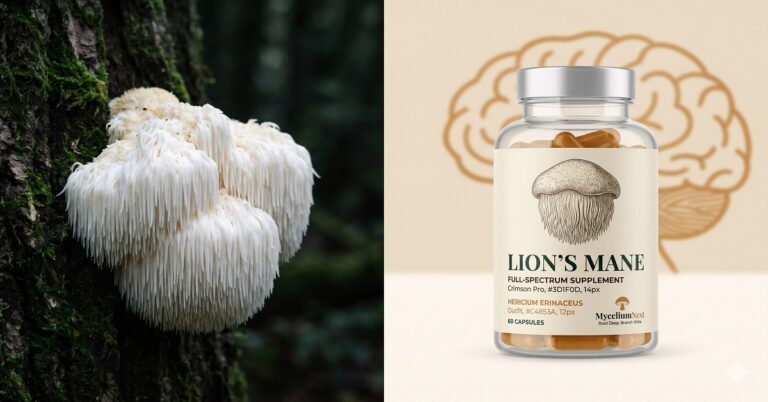
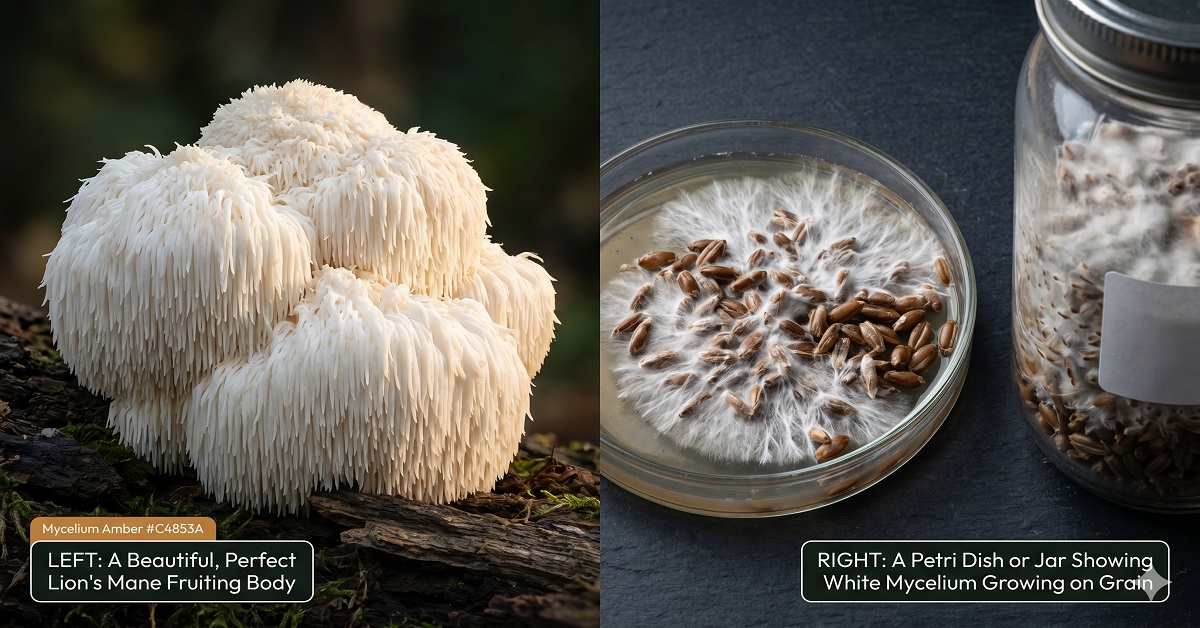
Fruiting bodies are the actual mushrooms — the part with the highest concentration of bioactive compounds (hericenones, beta-glucans, triterpenes). Mycelium on grain is the root-like vegetative body grown on a grain substrate that is never separated from the grain — meaning many “mycelium” supplements contain 50–80% starch from the grain, not mushroom. This starch registers as “polysaccharides” on lab tests, creating misleading potency claims.
The functional mushroom supplement market is a $50 billion global industry. It is also — frankly — one of the most deceptive supplement categories sold to consumers, because the central quality distinction (fruiting body vs. mycelium on grain) is not required to be disclosed on US supplement labels, is not regulated by the FDA, and is systematically obscured by marketing language designed to confuse rather than inform.
This guide explains the biology clearly, shows you exactly what to look for on any label, and cites the independent laboratory data that reveals how dramatic the quality gap between products actually is. If you take mushroom supplements — lion’s mane, reishi, cordyceps, turkey tail, or any other species — this is the most important article you will read before your next purchase.
- The Biology: What Fruiting Body and Mycelium Actually Are
- The Grain Problem: Why Mycelium Products Are Often Mostly Starch
- What the Independent Lab Data Shows
- The Polysaccharide Deception: Why the Label Lies
- How to Read Any Mushroom Supplement Label in 60 Seconds
- Which Brands Pass & Which Fail
- Frequently Asked Questions
The Biology: What Fruiting Body and Mycelium Actually Are
To understand why the fruiting body vs. mycelium distinction matters so profoundly for supplements, you need to understand what each part of a fungus actually is and does.
The Fruiting Body
The fruiting body is the mushroom — the part you see growing from a log, the forest floor, or a substrate block. It is the reproductive structure of the fungus, analogous to a fruit on a tree. The fruiting body exists for one purpose: to produce and disperse spores.
To accomplish this, the fruiting body concentrates the highest densities of the bioactive compounds that make medicinal mushrooms pharmacologically interesting:
- Beta-glucans: The primary immunomodulatory polysaccharides, found in the cell walls of the fruiting body’s chitin structure
- Hericenones (lion’s mane): The terpenoid compounds found specifically in fruiting bodies that have shown NGF-stimulating potential in research. Read the full science in our does lion’s mane work guide.
- Triterpenes (reishi): The ganoderic acids responsible for reishi’s bitter taste and biological activity, concentrated in fruiting bodies
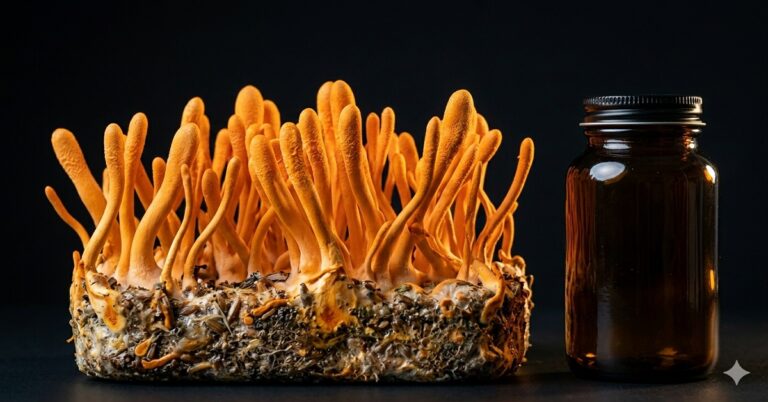
- Cordycepin (cordyceps): The primary bioactive compound in cordyceps, concentrated in fruiting tissue
The Mycelium
The mycelium is the vegetative body of the fungus — the network of thread-like hyphae that spreads through substrate, digesting and absorbing nutrients. In nature, mycelium lives within wood, soil, or decaying matter. It is not the mushroom — it is the organism that produces mushrooms.
Mycelium does contain bioactive compounds, including erinacines (lion’s mane) and some beta-glucans. Mycelium-based products are not inherently worthless. The problem is the grain.
The Grain Problem: Why Mycelium Products Are Often Mostly Starch
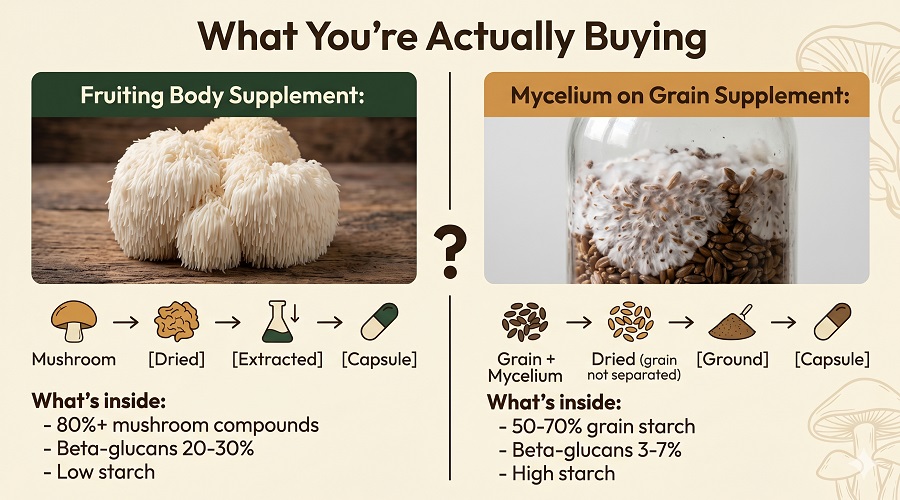
In commercial mycelium production for supplements, the mycelium is grown on a grain substrate — typically rice, oats, or rye. When the mycelium has colonised the grain, the entire mixture — mycelium and grain together — is dried and ground into powder. The mycelium is never separated from the grain substrate it grew on.
This is not a manufacturing shortcut. It is biologically impossible to economically separate mycelium from grain at scale. The mycelial threads are interwoven with and inside the grain kernels at a microscopic level. So every “mycelium” supplement capsule you take contains a mixture of:
- Some actual mycelium (variable proportion — depends on how densely colonised the grain became)
- Residual grain substrate — typically 50–80% of the total powder weight
- Grain starch, proteins, and other grain compounds
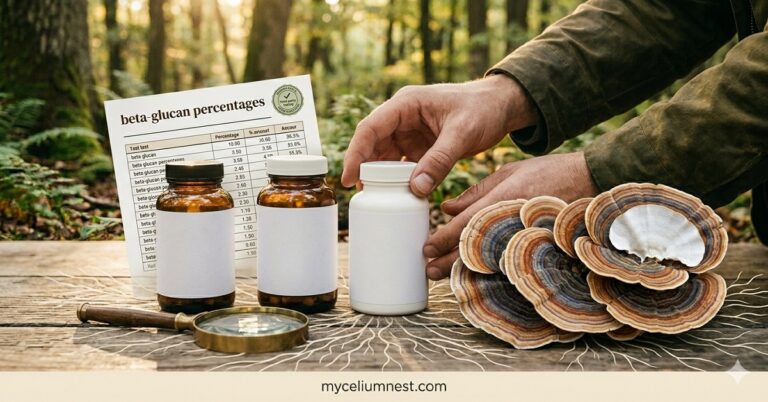
A 2020 analysis published in the journal Scientific Reports tested 19 commercial mushroom supplements. The study found that products made from mycelium on grain contained on average only 6% beta-glucans — compared to an average of 23% beta-glucans in fruiting body extracts. Several mycelium-on-grain products contained more starch than a serving of bread. Consumers were paying premium supplement prices for what was, in effect, expensive grain flour.
What the Independent Lab Data Shows
Real Mushrooms — one of the most transparent companies in the functional mushroom space — commissioned independent laboratory testing of their products alongside competing products. The results, published on their website and available for public review, reveal the scale of quality variation:
The Polysaccharide Deception: Why the Label Lies
Here is where the marketing becomes actively misleading. Many mycelium-on-grain supplements list “Polysaccharides: 30–40%” on their label. This sounds impressive — more than a fruiting body extract listing “Beta-Glucans: 25%”. It is not.
The Critical Difference Between Polysaccharides and Beta-Glucans
- Specific structural polysaccharides from mushroom cell walls
- The compound studied in clinical research for immune modulation
- Present in both fruiting bodies and mycelium (in different concentrations)
- Cannot be derived from grain — grain contains alpha-glucans (starch), not beta-glucans
- A high beta-glucan % guarantees actual mushroom content
- A broader category that includes ALL complex carbohydrates
- Grain starch is a polysaccharide (alpha-glucan)
- A “30% polysaccharides” label can mean 25% grain starch + 5% actual beta-glucans
- Polysaccharide % on a mycelium-on-grain product tells you almost nothing about mushroom potency
- Requires lab testing to determine what percentage is actually beta-glucan
The rule: Always look for “Beta-Glucans” specifically on the supplement label — not just “polysaccharides.” If a company lists only polysaccharides without specifying beta-glucan content, ask yourself what they are hiding. Companies with genuine fruiting body products are proud to specify beta-glucan content because it is their strongest selling point.
How to Read Any Mushroom Supplement Label in 60 Seconds
Apply this five-step check to any mushroom supplement label before purchasing:
Which Brands Pass & Which Fail
Brands That Use 100% Fruiting Body (Recommended)
Brands That Use Mycelium on Grain (Approach With Caution)
We will not name specific brands negatively by name in this article as formulations change and we cannot continuously verify current product compositions. Instead, use the five-step label check above on any brand not listed in our recommended section. If a brand fails two or more criteria, the product quality is almost certainly below the standard needed for meaningful supplementation at a typical serving size.
For our complete species-by-species supplement rankings with detailed brand evaluations, see:
- Best Lion’s Mane Supplement — 7 Brands Ranked
- Best Reishi Mushroom Supplement
- Best Cordyceps Supplement
- Best Turkey Tail Supplement
Frequently Asked Questions
Is mycelium on grain completely worthless?
Not completely worthless — a well-colonised mycelium product does contain bioactive compounds, including erinacines in lion’s mane mycelium. However, the effective dose of these compounds per capsule is dramatically lower than in fruiting body extracts because the majority of the product is grain starch. You would need to take 3–5× more mycelium-on-grain capsules to approximate the same beta-glucan intake as one serving of a quality fruiting body extract — and the cost per effective dose typically ends up higher, not lower.Why do so many large brands use mycelium on grain if it’s lower quality?
Economics. Mycelium on grain is dramatically cheaper to produce than fruiting body extract. Fruiting bodies must be grown on logs or hardwood blocks for months, then harvested, dried, and extracted — a labour and time-intensive process. Mycelium on grain grows in liquid culture tanks in 7–14 days with no substrate removal required. The cost difference at scale is enormous. When margins are prioritised over quality and consumers cannot easily distinguish the difference, the economic incentive for mycelium-on-grain production is clear.What does “full spectrum” mean on a mushroom supplement label?
“Full spectrum” is marketing language with no regulatory definition. It typically means the product contains both mycelium and fruiting body — or in many cases, just mycelium on grain with a small amount of fruiting body added. Without specific beta-glucan content listed and a COA to back it up, “full spectrum” tells you nothing meaningful about potency. Treat it as a neutral term that requires investigation, not a quality indicator.Does the distinction matter if I’m just taking mushroom supplements for general wellness?
If your goal is general wellness and you’re taking a low dose, the distinction matters less. A low-quality supplement at a low dose and a high-quality supplement at a low dose may produce similar (limited) results. However, if you’re taking mushroom supplements for a specific purpose — cognitive support, immune function, adaptogenic support — the quality of the product determines whether you’re consuming an effective or an ineffective dose per capsule. Paying $40 for an effective product is better value than paying $25 for an ineffective one.
Disclosure: This article contains affiliate links. Commission rates never influence our recommendations. See our full disclosure. This is not medical advice.