Turkey Tail Mushroom Identification: The Definitive Pore Test & False Turkey Tail Guide

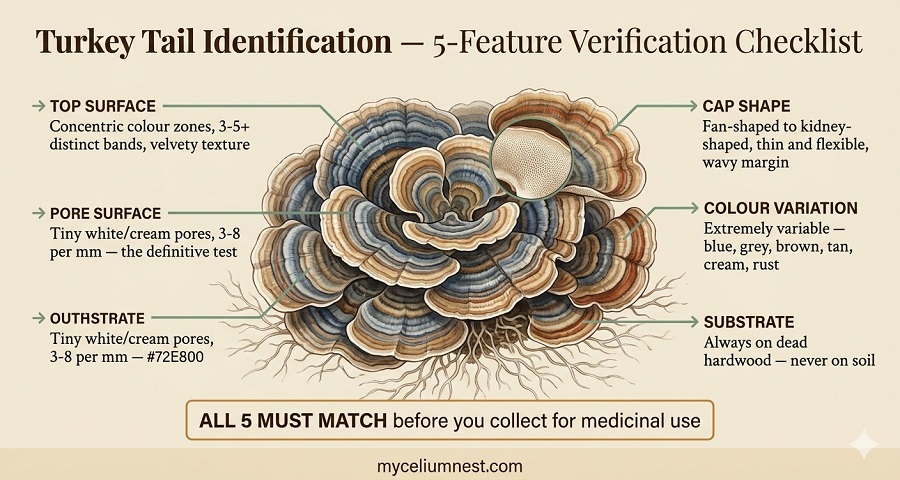
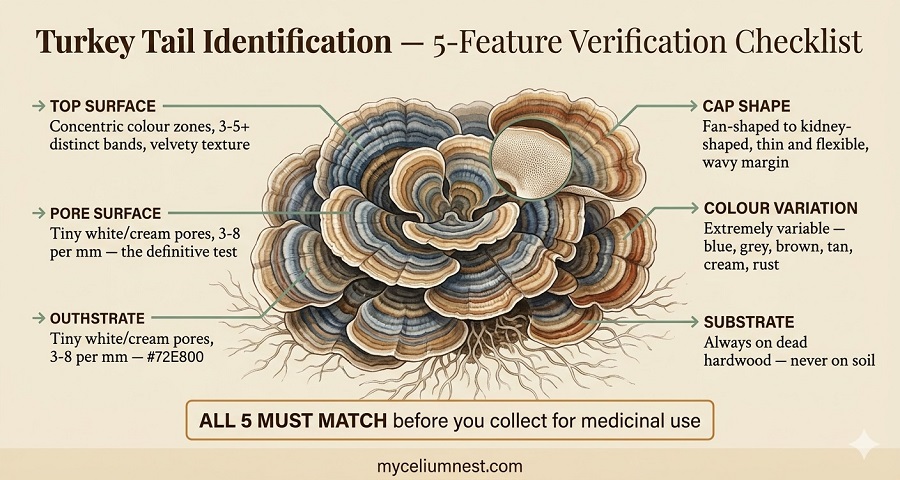
Turkey tail mushroom identification: Turn any suspected turkey tail specimen over and look at the underside. If you see tiny white or cream pores (3–8 per mm), it is turkey tail or a closely related Trametes species — all safe. If the underside is smooth, wrinkled, or shows any other texture, it is a lookalike. This single test eliminates 100% of dangerous misidentifications. Everything else in this guide deepens your knowledge; the pore test is the only check you cannot skip.
Complete Turkey Tail Identification: All 5 Features
Turkey tail (Trametes versicolor) is one of the most abundant and ecologically important fungi in temperate forests — growing on dead and dying hardwood year-round across North America, Europe, Asia, and beyond. Despite its ubiquity, its identification requires methodical verification because several lookalikes exist that are visually similar but lack the medicinal compounds that make true turkey tail valuable.
False Turkey Tail: The #1 Lookalike Explained
Stereum ostrea (False Turkey Tail) is the most common misidentification for turkey tail — and understanding what makes them different is the most important lookalike knowledge any turkey tail forager can have.
- Underside: White/cream PORES (3–8 per mm)
- Pore surface feels slightly rough/granular
- Cap is thin and flexible
- Contains PSK and PSP polysaccharides (medicinal)
- Colour zones often include blue-grey tones
- Underside: SMOOTH or slightly wrinkled — NO pores
- Smooth surface feels like suede or leather
- Cap may be slightly stiffer
- Does not contain the same medicinal polysaccharides
- Often has orange-brown tones underneath
Is False Turkey Tail dangerous? No — Stereum ostrea is not toxic. But it does not contain PSK and PSP polysaccharides that give true turkey tail its documented immune-supporting properties. Collecting false turkey tail for medicinal use means collecting something that looks similar but lacks the bioactive compounds you’re foraging for. The pore test protects both your safety and the integrity of your medicinal harvest.
Foraging for Medicinal Quality: What the Science Says
Turkey tail is one of the most researched medicinal mushrooms in the world. PSK (polysaccharide-K) and PSP (polysaccharide-peptide) — both derived from Trametes versicolor — have been the subject of extensive clinical research. A peer-reviewed review published in ISRN Oncology documented the immune-modulating properties of PSK across multiple clinical trials, with applications in adjuvant cancer therapy particularly studied in Japan and China.
Substrate Safety Warning: Where NOT to Forage Turkey Tail
Turkey tail is a powerful wood decomposer — and that biological capability means it also bioaccumulates compounds present in its substrate. What is in the wood enters the mushroom. For foragers using turkey tail for medicinal tea or tinctures, substrate selection is not merely a quality issue — it is a safety issue.
- Established forest hardwood logs — oak, beech, maple, birch — fallen in forest interior, far from roads and structures
- Distance from roads: Minimum 100 metres, ideally 200+ metres from any paved surface
- No structural wood indicators: Natural bark present, irregular log shape, no cut ends with straight saw marks, no visible treatment chemicals
- Healthy forest ecosystem: Presence of other woodland fungi alongside turkey tail indicates an uncontaminated substrate environment
For the full research review and supplement recommendations, see our turkey tail supplement guide. The peer-reviewed literature on PSK/PSP is available via PubMed: PMID 23435603 provides a comprehensive review of clinical evidence for Trametes versicolor polysaccharides.
For highest medicinal quality when foraging:
- Collect young, fresh specimens — the outer growing margin is pale and cream. Older specimens have higher contamination from other fungi and bacteria.
- Harvest from living wood decay — specimens actively growing on recently dead wood have higher compound concentrations than those on very old, weathered logs.
- Avoid specimens with obvious pest damage — beetle galleries and slug trails indicate specimen age and compound degradation.
- Process quickly — dry at 55°C immediately after harvest to arrest degradation and concentrate medicinal compounds.
Frequently Asked Questions
Can I eat turkey tail raw?
Turkey tail is too tough and chewy to eat as a food mushroom in the traditional culinary sense. It is used medicinally — either simmered as a tea or decoction, dried and powdered for capsules, or extracted using hot water and alcohol dual extraction. The beta-glucans that provide its medicinal value are released through hot water extraction; drinking turkey tail tea is the most accessible home preparation method. Simmer dried turkey tail in water for 20–40 minutes and drink as a daily tea.
How much turkey tail can I forage sustainably?
Turkey tail is extremely abundant and grows prolifically on dead hardwood throughout its range — it is one of the few species where sustainability concerns are minimal for personal-use foraging. A reasonable harvest practice is to take no more than 50% of the visible specimens from any given log, leaving the remainder to continue sporulating and providing habitat for insects and other fungi that depend on turkey tail decomposition activity. Do not strip entire logs — both for ecological reasons and because leaving visible turkey tail helps you mark productive logs for future harvests.
Now that you can identify genuine Trametes versicolor, the next question is: for consistent medicinal dosing, how do quality supplements compare to home-brewed turkey tail tea?
Best Turkey Tail Supplement Guide (2025) — PSK, Beta-Glucans & Brand Rankings →Always verify identifications with a regional field guide before use. This article contains Amazon affiliate links. See our full disclosure.