Poisonous Mushrooms to Avoid: The 8 Most Dangerous Species (With Exact ID Features)

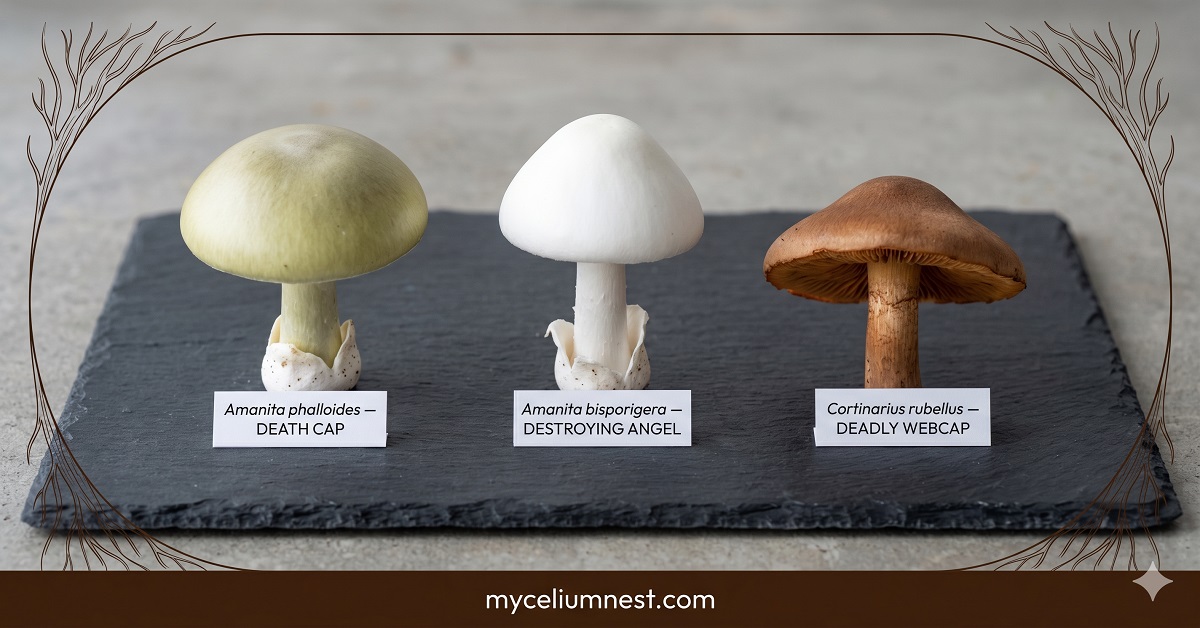
Four species cause over 90% of fatal mushroom poisonings worldwide: Death Cap (Amanita phalloides), Destroying Angel (Amanita bisporigera), Autumn Skullcap (Galerina marginata), and Deadly Webcap (Cortinarius rubellus). Understanding these four species — their appearance, their toxins, and their lookalikes — is the most important safety knowledge any forager can carry.
How Mushroom Toxins Work — and Why Some Kill So Slowly
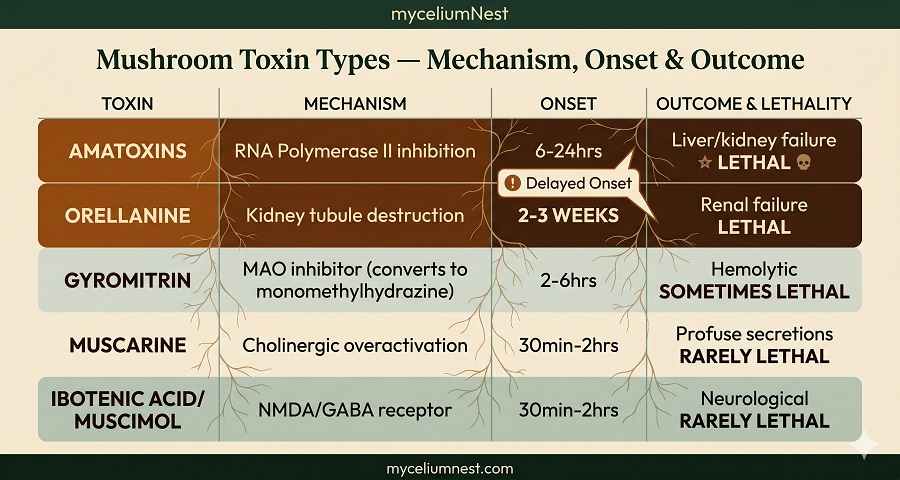
Mushroom toxins are not a single category — they are dozens of distinct chemical classes with completely different mechanisms, onset times, and outcomes. Understanding the toxin categories explains why some poisonings are immediately apparent and treatable, while others are silently lethal:
| Toxin | Symptom Onset | Mechanism | Risk Level | Species |
|---|---|---|---|---|
| Amatoxins | 6–24 hours (delayed) | Inhibits RNA Polymerase II — halts protein synthesis in liver and kidney cells | ☠ LETHAL | Amanita phalloides, A. bisporigera, Galerina marginata |
| Orellanine | 2–3 WEEKS | Progressive kidney tubule destruction — diagnosis often missed | ☠ LETHAL | Cortinarius rubellus, C. orellanus |
| Gyromitrin | 2–6 hours | Converts to monomethylhydrazine (rocket fuel component) in body | ⚠ Sometimes lethal | Gyromitra esculenta (False Morel) |
| Muscarine | 30 min–2 hrs | Cholinergic overactivation (SLUDGE syndrome) | Serious, rarely lethal | Clitocybe, Inocybe species |
| Ibotenic/Muscimol | 30 min–2 hrs | Neurological — hallucinations, delirium | Rarely lethal | Amanita muscaria, A. pantherina |
Why delayed onset is the most dangerous characteristic: With amatoxin poisoning, a victim feels completely normal for 6–24 hours after consuming a lethal dose. When gastrointestinal symptoms finally appear (vomiting, diarrhoea), they may subside after 24 hours — creating a false recovery period. By the time liver failure symptoms emerge (day 3–5), irreversible damage has occurred. This timeline is why mushroom poisoning deaths are disproportionately common despite relatively few people being poisoned annually.
The Deadly Four: Species Responsible for 90% of Fatal Mushroom Poisonings
The Most Dangerous Misidentifications
What to Do If You Eat a Poisonous Mushroom
Emergency Protocol — Act Immediately
- Call Poison Control immediately: 1-800-222-1222 (US) — do not wait for symptoms. Tell them: the time of ingestion, approximate quantity consumed, and any specimen you retained.
- Keep a sample of the mushroom — or photograph it extensively (cap top, cap underside, stem, base). Identification of the consumed species determines the treatment protocol. A retained specimen saves lives.
- Do not induce vomiting unless specifically instructed by Poison Control or a physician. Vomiting can cause additional harm depending on the toxin involved.
- Go to an emergency room immediately if directed by Poison Control or if any symptoms develop. Tell the emergency physicians that mushroom ingestion is suspected and provide your Poison Control case reference number.
- Do not assume you are safe if you feel normal after several hours — particularly with amatoxin-containing species where the symptom-free window is 6–24 hours.
The Risk of Internet Identifications: Why a Facebook “Like” Is Not Safe
One of the most significant emerging causes of mushroom poisoning incidents is not ignorance of dangerous species — it is misplaced trust in crowd-sourced social media identifications. This section exists because the pattern is well-documented and the risk is severe.
A beginner finds a mushroom, takes a photo on their phone, posts it to a Facebook group or Reddit community asking “Is this edible?”. Within minutes, dozens of responses arrive, some saying “looks like chanterelle to me!” or “that’s definitely a puffball, enjoy!” A few cautious voices may say “hard to tell from a photo” — but the enthusiastic confirmations get more likes and feel more authoritative.
The fundamental problem: None of those responders can smell the mushroom. None can feel its texture. None can see the spore print, the gill attachment, the volva at the base, the habitat context, or perform any of the multi-sensory features that actual identification requires. They are responding to a phone photograph taken in imperfect light from a single angle — a fraction of the information needed for safe identification.
Why Online Photo Identification Cannot Be Safe
- Learning species names and general characteristics for study
- Getting ideas about what a specimen might be — to then investigate with a field guide
- Sharing finds after confirmed expert identification
- Finding local foraging groups, forays, and in-person events
- Make final eat/don’t eat decisions on any wild mushroom
- Confirm an identification before consuming
- Substitute for field guide verification and spore print analysis
- Bypass in-person expert confirmation for any Amanita-adjacent species
The standard that actually protects you: A regional field guide, a spore print on white paper, a hand lens examination of gill/pore structure, and — when in doubt — in-person confirmation from a qualified mycologist or NAMA-affiliated society member. These are the tools that save lives. Social media likes are not. Poison Control: 1-800-222-1222 — save it in your phone before your first foray.
Frequently Asked Questions
Can cooking a poisonous mushroom make it safe?
For amatoxins (the deadliest category), cooking has no effect — the toxins are heat-stable and survive any normal cooking temperature. For some other toxins, cooking can reduce or eliminate the toxic compound — gyromitrin (in false morels) is partially reduced by thorough boiling with ventilation, though this is never a reliable safety method. The only safe approach is correct identification before consumption. Cooking does not make an unknown mushroom safe.
Are there any reliable “toxicity tests” I can do on an unknown mushroom?
No — all folk tests are myths. The “silver spoon test,” “peeling test,” “cooking with garlic or onion,” “if animals eat it it’s safe” — none of these have any scientific validity. Some of the most deadly mushrooms pass every folk test. The only reliable safety test is correct multi-feature botanical identification verified against a field guide by someone with mycological knowledge.
Can I touch a poisonous mushroom safely?
Yes — mushroom toxins are not absorbed through intact skin. Handling poisonous mushrooms is safe as long as you wash your hands thoroughly before eating or touching your face, mouth, or eyes afterward. Children and immunocompromised individuals should still avoid prolonged contact, but brief examination of a specimen is not dangerous for healthy adults. Never rub your eyes while examining any mushroom.
This guide is for educational purposes only. Never consume any wild mushroom without verified expert identification. In any suspected poisoning emergency, call Poison Control at 1-800-222-1222 immediately. See our full disclosure.