Wild Mushroom Foraging for Beginners: The Only Safe Starting Guide

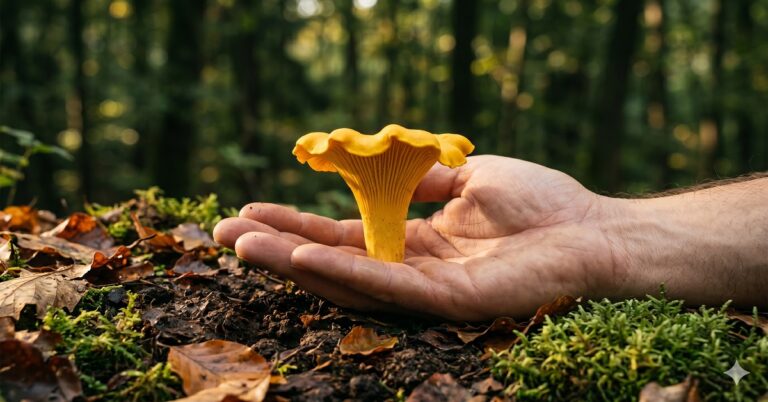
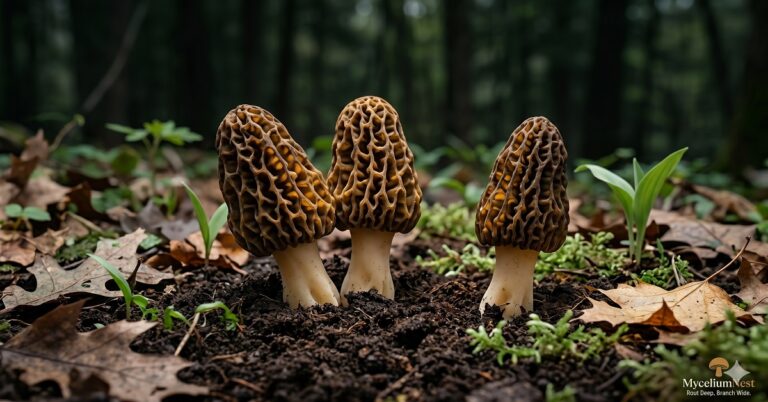
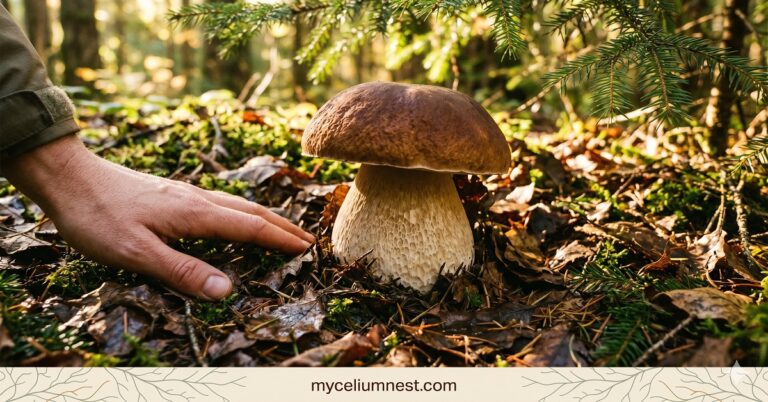
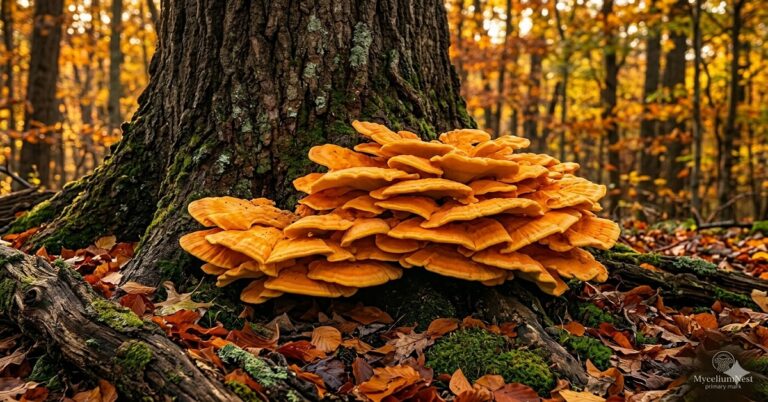
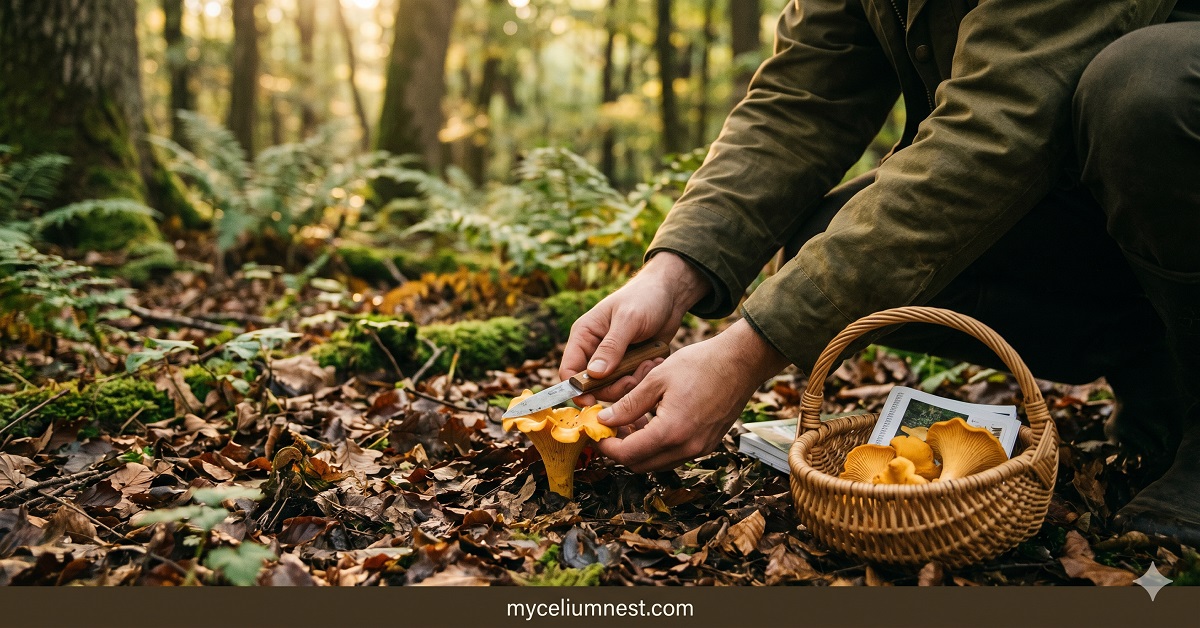
Start with five species only: chanterelles, chicken of the woods, hen of the woods (maitake), giant puffballs, and morels. These five have distinctive identification features, no deadly lookalikes in North America, and cover three seasons of foraging. Master these before adding a single new species. The foragers who get hurt are the ones who rush to expand their species list before building an unshakeable identification foundation.
Wild mushroom foraging for beginners is one of the most rewarding ways to connect with the natural world — and one of the most unforgiving hobbies to approach carelessly. The difference between a safe, lifelong foraging practice and a dangerous one comes down to a single principle: absolute certainty before you eat anything.
This guide does not teach you to identify every edible mushroom in the woods. It teaches you to build the foundation — the observational skills, the safety framework, and the beginner’s species selection — that makes every subsequent identification skill you develop genuinely safe to apply. Read this before you read anything else.
- Why Wild Mushroom Foraging Is Worth Learning
- The Forager’s Safety Framework: The Rules Experts Actually Follow
- The Beginner’s Five: Your Only Species List for Year One
- How to Identify a Mushroom: The Multi-Feature Method
- The Foraging Seasonal Calendar
- Essential Foraging Gear
- The Fastest Way to Learn: Join a Foraging Community
- Frequently Asked Questions
Why Wild Mushroom Foraging Is Worth Learning
A single successful chanterelle foray changes the way you walk through a forest permanently. You stop seeing the woods as a backdrop and start seeing it as a landscape filled with information — tree species, soil moisture, elevation, decay stages, seasonal markers — that all point to where fungi are fruiting. Foraging makes you a reader of ecosystems.
Beyond the experiential richness, wild foraging delivers something cultivation cannot: species diversity and flavour complexity that grocery stores will never stock. Chanterelles, porcini, morels, black trumpets, hedgehog mushrooms — these are premium culinary ingredients that sell for $30–80 per pound at farmers markets, available free to anyone with the knowledge and patience to find them.
The Forager’s Safety Framework: The Rules Experts Actually Follow
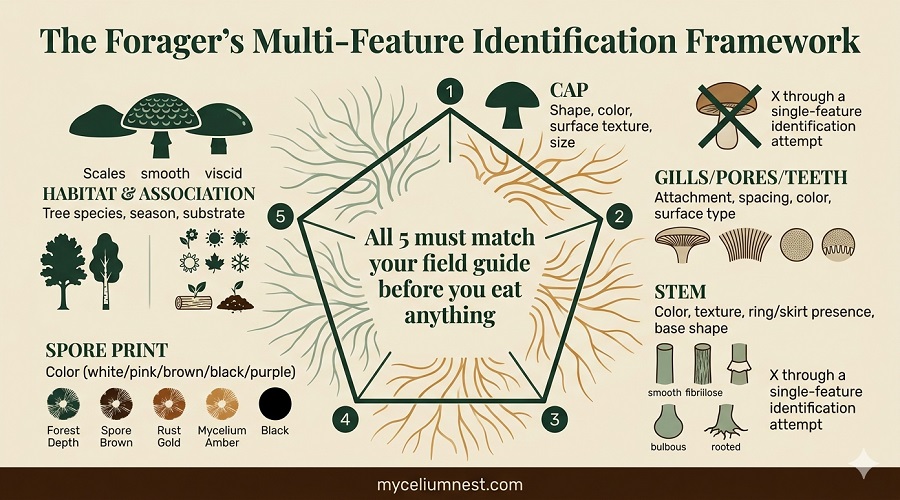
Experienced mycologists don’t rely on confidence or instinct — they rely on systematic multi-feature verification. Every identification involves checking a minimum of four to five independent physical characteristics before any specimen is considered identified. Here is the framework they use:
The Beginner’s Five: Your Only Species List for Year One
The following five species are specifically selected for beginners because each has: unmistakable physical features, distinctive habitat associations, and no deadly lookalikes in North America. Master these five before adding any other species to your foraging list. This constraint feels limiting — it is meant to. The constraint keeps you safe while you build the identification discipline that makes all future foraging safe.
Season: Late summer–early autumn. Lookalike check: Always slice vertically before eating — the interior must be pure solid white throughout with no outline of developing gills or a figure inside. Any outline indicates an immature Amanita button — deadly. A pure white interior is the definitive confirmation.
How to Identify a Mushroom: The Multi-Feature Method
Every professional forager works through the same systematic process for every new specimen. The steps below apply to any mushroom — not just the Beginner’s Five:
- Observe before you touch. Note the growing position (ground, wood, base of tree, open meadow). The substrate tells you what tree or organic matter is below the surface — critical habitat information. Photograph from multiple angles: top, side, and underneath.
- Assess the cap. Colour, surface texture (dry, slimy, fibrous, scaly), shape (convex, flat, funnel-shaped), and diameter. Check whether the colour is uniform or variable across the cap surface.
- Examine the underside. True gills (blade-like), false gills (forking ridges like chanterelles), pores (sponge-like), teeth (hedgehog mushroom), or smooth (puffballs). This single character eliminates most misidentifications.
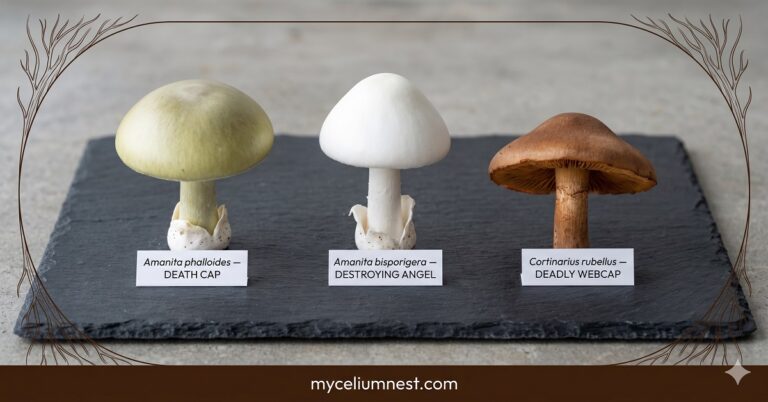
- Check the stem. Ring present or absent? Volva (cup at base) present or absent? The volva is the critical Amanita indicator — always dig the mushroom base to check. White colour throughout or colour-banded?
- Take a spore print. Remove the cap and place gill-side down on white paper for 2–4 hours. White/cream, pink, brown, or black spore prints are a definitive genus-level identifier. Carry paper squares in your basket for this.
- Cross-reference against your field guide. Every feature must match. If any feature doesn’t match, the mushroom does not go into your basket.
The Foraging Seasonal Calendar
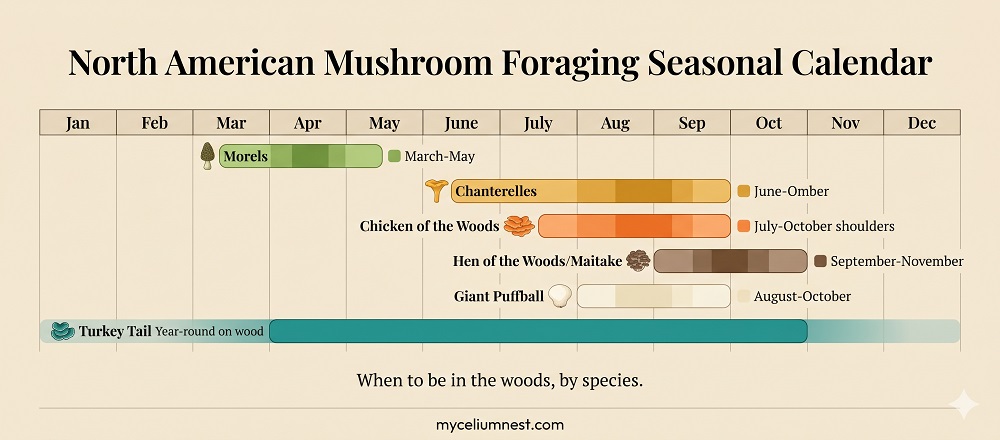
| Species | Season | Peak Window | Habitat Trigger |
|---|---|---|---|
| Morels | Spring | March–May | Soil temps 50–60°F, near dying elms and orchards, after first warm rains |
| Giant Puffballs | Late Summer | July–September | Meadows, field edges, disturbed ground after heavy summer rain |
| Chanterelles | Summer–Autumn | June–October | Moist hardwood/mixed forest after sustained rainfall, mycorrhizal with oaks and beeches |
| Chicken of the Woods | Summer–Autumn | July–October | Weakened or recently dead oaks, cherries, and other hardwoods |
| Hen of the Woods | Late Summer–Autumn | September–November | Base of mature oaks, often the same tree each year — mark your trees |
| Turkey Tail | Year-round | Any season | Decomposing hardwood logs and stumps, best fresh growth found in autumn and spring |
Essential Foraging Gear
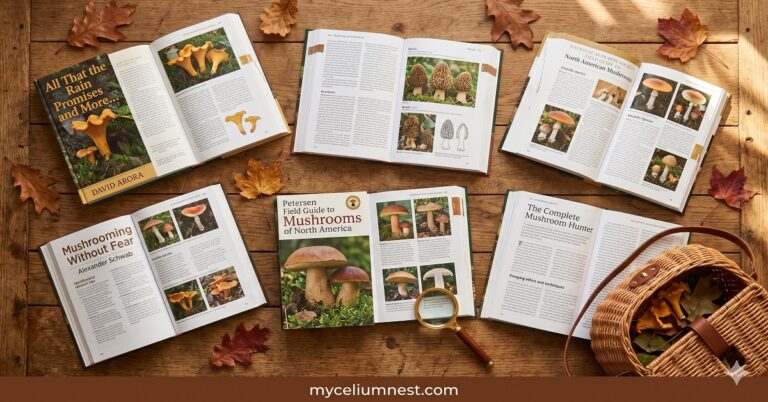
- Regional field guide (see our field guide recommendations)
- Wicker or mesh basket — spores spread through holes, continuing the mushroom’s lifecycle
- Small folding knife with blade and brush
- White paper squares for spore prints
- Hand lens (10× loupe) for close feature inspection
- Camera or phone with macro lens capability for documentation photos
- Small trowel for exposing mushroom bases (essential for Amanita volva checks)
- Paper bags for separate species storage — never mix unidentified species
- GPS app for logging productive locations
- Second field guide — always cross-reference
The Fastest Way to Learn: Join a Mycological Society
No guide — including this one — substitutes for in-person foraging with an experienced mycologist. The North American Mycological Association (namyco.org) is the premier federation of North American mushroom societies, with over 90 affiliated clubs across the US, Canada, and Mexico. Their annual forays bring together amateur and professional mycologists for guided identification walks, expert Q&A sessions, and identification workshops.
Finding your local affiliated society and attending a single guided foray teaches you more in one day than months of solo study. The community also provides access to local experts who can confirm identifications, recommend regional field guides, and share productive foraging locations within your ecosystem.
For dangerous mushrooms to know and avoid before your first foray, our poisonous mushrooms guide covers every deadly species with identification features and lookalike comparisons.
Frequently Asked Questions
Is it safe to use mushroom identification apps?
Apps like iNaturalist and Shroomify can be useful for narrowing down possibilities and connecting with the online mycological community, but they must never be used as your sole identification method. AI image recognition has a meaningful error rate for mushroom identification, and these apps cannot assess smell, texture, spore print colour, or habitat context — all of which are essential identification features. Use apps to generate hypotheses; use your field guide and spore print to confirm them.
Can I go foraging in a national park or public land?
Rules vary significantly by jurisdiction. Many US National Forests allow personal-use collection (typically 2 gallons per day) without a permit. National Parks generally prohibit collection of any natural materials including fungi. State and county parks have varying rules. Always check with the specific land management agency before foraging. Private land requires explicit permission from the landowner. When in doubt, contact the local ranger station or park office — they will give you the current regulations for that specific land unit.
How do I clean and store foraged mushrooms?
Brush foraged mushrooms with a dry or barely damp brush to remove debris — never soak them in water (mushrooms are 85–90% water and absorb moisture rapidly, becoming waterlogged and slimy). Store loosely in a paper bag in the refrigerator — not an airtight container, which causes condensation and rapid deterioration. Most foraged mushrooms keep 3–7 days refrigerated. Chanterelles and hen of the woods keep best; morels and puffballs should be used within 2 days of collection.
Always verify identifications with a regional field guide and experienced forager before consuming any wild mushroom. See our full disclosure.