Chicken of the Woods Identification: The Complete Forager’s Guide
Never consume any wild mushroom based solely on this or any single online guide. Always verify identification using at least two independent field guides. Some individuals experience allergic reactions to chicken of the woods — always try a small amount when eating for the first time, even after confident identification.

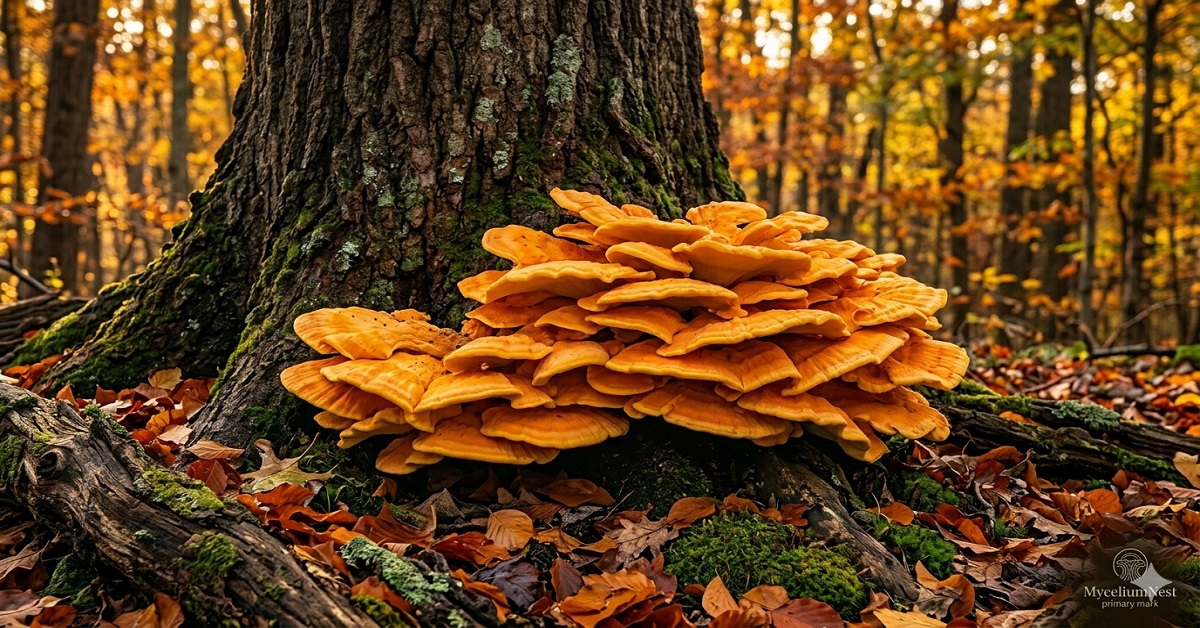
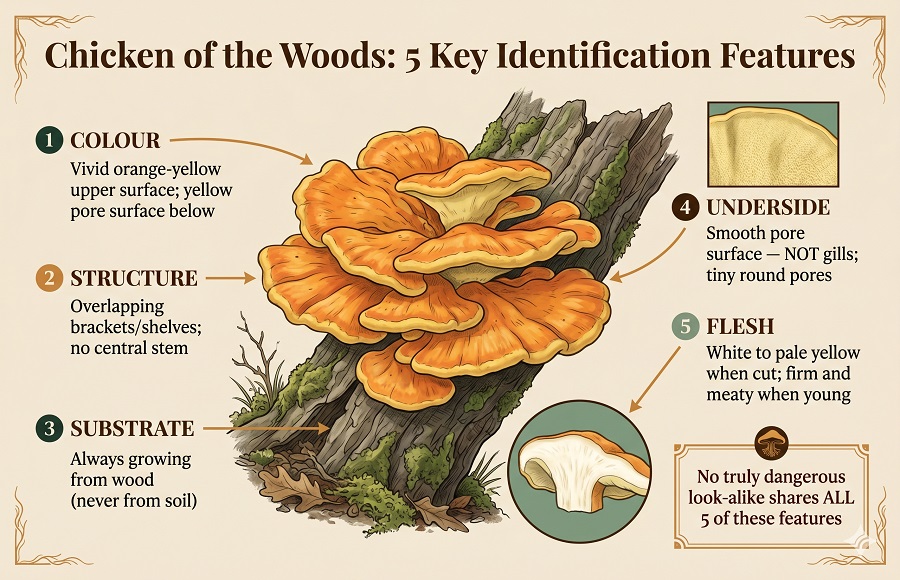
Chicken of the woods is one of the most beginner-friendly wild mushrooms to identify: vivid orange-yellow overlapping brackets growing directly from wood (no stem), smooth pore surface on the underside (no gills), white to pale yellow interior flesh, and a distinctive chicken-like smell and texture when raw. There are no truly dangerous look-alikes that share all these features simultaneously.
Chicken of the woods (Laetiporus sulphureus and related species) is arguably the most beginner-accessible edible wild mushroom in North America. It is large — often spanning 1–3 feet across — brilliantly coloured in unmistakable orange and yellow, grows directly from wood rather than from soil, and has no truly dangerous look-alikes that share all its key identification features at once.
It is also genuinely delicious: the young, tender edges of a fresh chicken of the woods have a texture and flavour so similar to chicken breast that experienced foragers have used it as a meat substitute in stir-fries, sandwiches, and pasta dishes for generations. The name is not marketing — it is genuinely apt.
What Is Chicken of the Woods?
Chicken of the woods is a polypore fungus — meaning it produces spores through pores on the underside of its fruiting body rather than through gills. It belongs to the genus Laetiporus, which includes several North American species (more on this below). It is a wood-rotting saprotrophic fungus that decomposes the heartwood of living and dead hardwood trees, causing a distinctive brown cubic rot.
In ecological terms, chicken of the woods plays a significant role in forest nutrient cycling — breaking down tough lignin and cellulose in tree heartwood and returning those nutrients to the forest ecosystem. The mushroom you see is the reproductive structure of a mycelium network that may have been growing inside the tree for years before fruiting.
The 5-Point Chicken of the Woods Identification Guide
Feature 1: The Colour — Impossible to Miss
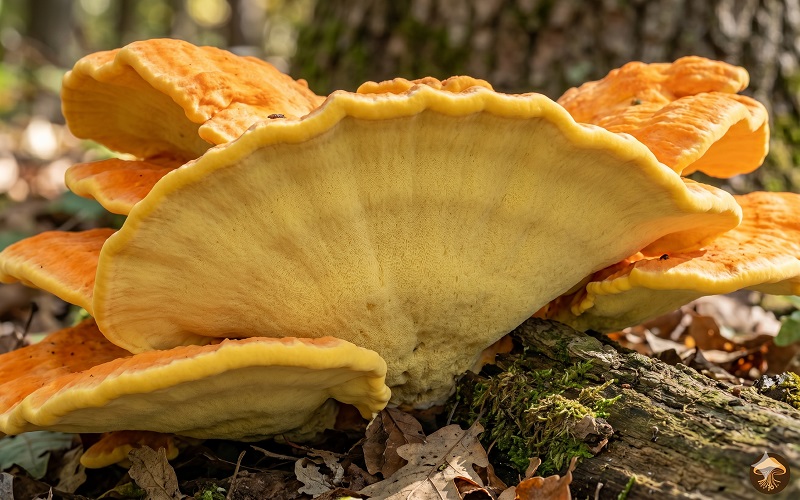
Young, fresh chicken of the woods is one of the most vividly coloured mushrooms in North American forests. The upper surface of the brackets ranges from vivid orange to orange-red at the outer growing edge, fading toward salmon or pale orange toward the centre. The lower surface (pore surface) is bright yellow to pale sulphur yellow.
As the mushroom ages, the colours fade — older specimens become pale tan or whitish and the flesh hardens to a chalky, unpalatable texture. Always harvest young, brightly coloured specimens with tender outer edges. If the colour is faded and the flesh breaks with a dry snap rather than a moist tear, it’s past its prime.
Feature 2: Overlapping Bracket Structure
Chicken of the woods grows in overlapping, fan-shaped to tongue-shaped brackets or “shelves.” These brackets emerge directly from wood with no true central stem — they are laterally attached to the substrate. Individual brackets are typically 2–30cm across; the entire fruiting body cluster can span 30–90cm (1–3 feet) and weigh several kilograms.
The bracket surface is smooth to slightly felty when young, becoming tougher and more fibrous with age. Young brackets have a distinctly wavy, irregular outer edge as they actively grow.
Feature 3: Always Growing from Wood
Chicken of the woods grows exclusively from wood — either from the trunk of a living tree, from a dead stump, from partially buried wood, or from the base of a dying tree. It never grows from soil alone. If you see what appears to be chicken of the woods growing from bare ground with no visible wood connection, it is either growing from buried wood (dig carefully — you’ll find it) or it is not chicken of the woods.
Feature 4: Pore Surface (Not Gills)
Flip a bracket over and examine the underside. You will see a smooth, spongy surface covered in tiny round pores — not the knife-blade thin gills of typical mushrooms. This pore surface is what makes chicken of the woods a polypore. Run your thumbnail across it: it should feel like very fine suede or a slightly spongy surface. You can see individual pores with a hand lens but they appear as a fine, evenly textured surface to the naked eye.
This single feature eliminates virtually all genuinely dangerous look-alikes, none of which are orange polypores growing from wood.
Feature 5: White to Pale Yellow Interior Flesh
Snap or cut a young bracket. The interior flesh should be white to very pale cream or yellow, firm and moist — genuinely resembling chicken breast in texture. The flesh should tear with some resistance, not crumble or feel dry. The distinctive smell is mild and pleasant — somewhat chicken-like, slightly mushroomy.
Chicken of the Woods Species in North America
DNA analysis has revealed that what North American foragers once called Laetiporus sulphureus is actually a complex of multiple species with somewhat different host tree preferences and geographic distributions. The good news: all are edible and identified by the same characteristics.
Look-Alikes: What Could Be Confused
The good news about chicken of the woods identification: there are no truly dangerous look-alikes in North America that share all its defining features simultaneously. The orange colour, polypore pore structure, and wood-growing habit together create an identification framework that is extremely difficult to confuse with dangerous species.
Jack-o’-Lantern Mushroom (Omphalotus olearius) — Poisonous but Distinct
The most commonly cited “look-alike” is the jack-o’-lantern. However, the resemblance is superficial: jack-o’-lanterns are orange but have true gills (not pores), grow from soil or buried wood in dense clusters, and have bright orange (not white) interior flesh. The key distinguishing test: check the underside. Gills = not chicken of the woods. Pores = potentially chicken of the woods. See our chanterelle identification guide for more on distinguishing gills from other structures.
Giant Polypores (Meripilus giganteus, Grifola frondosa)
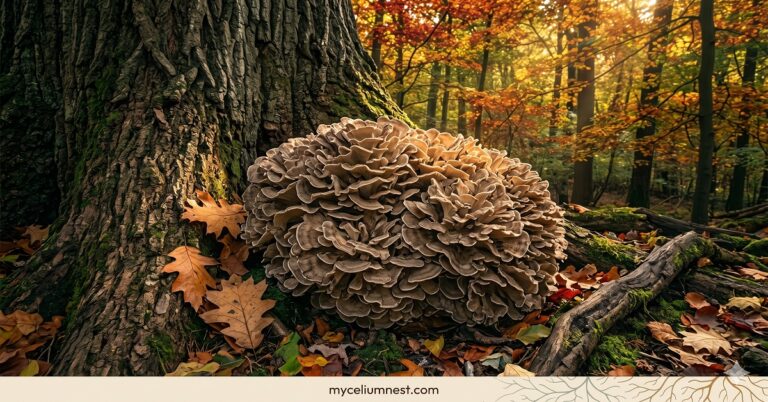
Some other bracket fungi might be mistaken for chicken of the woods at a distance. Meripilus giganteus (giant polypore) is brown-buff, not orange. Grifola frondosa (hen of the woods / maitake) has grey-brown, overlapping brackets from the base of oaks — also not orange. If it’s genuinely orange or orange-yellow, these species are ruled out. See our hen of the woods guide for maitake identification details.
Where and When to Find Chicken of the Woods
Best Host Trees
- Oak (Quercus spp.): The #1 host tree in the eastern US. Large, mature oaks — particularly those with any previous storm damage or disease — are the most reliable sites. Return to the same tree year after year.
- Cherry (Prunus spp.): Wild cherry trees are excellent hosts, particularly in the Appalachians. Often produces very large, tender fruiting bodies.
- Locust (Robinia pseudoacacia): Black locust produces particularly large chicken of the woods specimens, often weighing 5–10+ lbs per cluster.
- Beech (Fagus grandifolia): Less common but productive. Look for recently fallen or wind-damaged beech in hardwood forests.
Season
Chicken of the woods is a perennial — the same tree will fruit repeatedly over multiple years, sometimes from the same location. Mark GPS coordinates of any productive tree. After the first fruiting, check the same spot every 2–3 weeks during season and return to the same tree in subsequent years.
Harvesting, Cooking & Storage
How to Harvest
Use a sharp knife to cut the brackets from the wood substrate — cutting at the very base where the bracket meets the tree. Harvest only the youngest, most brightly coloured outer portions. Leave the older, paler inner brackets to continue releasing spores and — perhaps — to regrow next season. Avoid harvesting the entire cluster in one cut.
Bring a basket or paper bag. The brackets, especially large ones, can be heavy (a full cluster can exceed 10 lbs) and should be transported in a way that allows airflow.
Cooking Chicken of the Woods
Always cook chicken of the woods thoroughly — it should never be eaten raw. Young, tender outer portions have a genuinely chicken-like texture and absorb flavours exceptionally well. Preparation methods:
- Sautéed: Slice into 1cm strips and sauté in butter or olive oil until golden. Season simply with salt, pepper, garlic, and thyme. Extraordinary as a side dish.
- Breaded and pan-fried: Young brackets, sliced and breaded in seasoned flour and egg wash, then pan-fried — genuinely indistinguishable from fried chicken to many tasters.
- Pasta and risotto: Sautéed and added to cream-based pasta or risotto, where the meaty texture holds up beautifully.
Storage
- Fresh: 5–7 days in a paper bag in the refrigerator
- Frozen: Sauté in butter until just cooked, cool, and freeze flat on a tray before bagging. Stores for 6 months with good texture retention.
- Dried: Slice thinly and dry at 40–50°C until brittle. Excellent rehydrated in stocks and braises.
Is Chicken of the Woods Safe to Eat? Understanding the Reactions
Chicken of the woods is generally considered a good edible mushroom for most people. However, it is one of the more commonly reported mushrooms for causing adverse reactions — and those reactions are species, host-tree, age, and individual-sensitivity dependent. Here is what you need to know:
- Cooking eliminates most reaction risk: Raw or undercooked chicken of the woods causes the vast majority of adverse reactions. Always cook thoroughly.
- First time, small amount: Even after confident identification, eat a small portion (2–3 tablespoons cooked) on your first experience and wait 24 hours. Individual sensitivities are common.
- Host tree matters: Specimens from conifer hosts (L. conifericola and L. gilbertsonii on eucalyptus) have a higher reaction rate than those from oak, cherry, and locust. Some individuals can eat hardwood-host specimens without issue but react to conifer-host specimens.
- Age of the mushroom: Old, pale, hard specimens are more likely to cause reactions and are not worth eating. Harvest only fresh, brightly coloured, tender-edged specimens.
Frequently Asked Questions
Does chicken of the woods grow back in the same spot?
Yes. Chicken of the woods is perennial — the mycelium network inside the tree can continue producing fruiting bodies for years. Once you find a productive tree, it’s likely to fruit again in subsequent seasons, often at the same location or nearby. The frequency and size of fruiting depends on the tree’s health, moisture availability, and ambient temperature. Mark your spots — they are valuable repeating resources.
How much does chicken of the woods weigh?
Individual fruiting bodies range from a few hundred grams (small, young specimens) to over 10kg (15–20+ lbs) for large, mature clusters on old oak trees. The largest specimens we have personally encountered weighed approximately 7kg. More typical first finds for the season run 500g–3kg. Large specimens are worth the weight — even a 3kg cluster provides many meals and freezes exceptionally well.
Can you eat chicken of the woods every day?
There is no established reason why moderate daily consumption of well-cooked chicken of the woods is harmful for individuals without known sensitivities. However, as with any food, variety is prudent. Some foragers have reported developing a sensitivity with repeated large meals after initially tolerating the species well — suggesting that moderate portions and rotation with other foods is sensible practice.
What’s the best field guide for chicken of the woods?
David Arora’s Mushrooms Demystified covers Laetiporus comprehensively. For a more portable field guide, All That the Rain Promises and More by Arora includes excellent photographs. For regional specificity, the National Audubon Society Field Guide to Mushrooms is a reliable supplement. See our complete field guide review for ranked recommendations. A good field guide is available on Amazon here.
⚠ Never eat any wild mushroom identified solely from this guide. Always use multiple independent sources and consult experienced local foragers. This article contains Amazon affiliate links — see our disclosure.