Hen of the Woods (Maitake) Identification: Find, Verify & Harvest Like an Expert

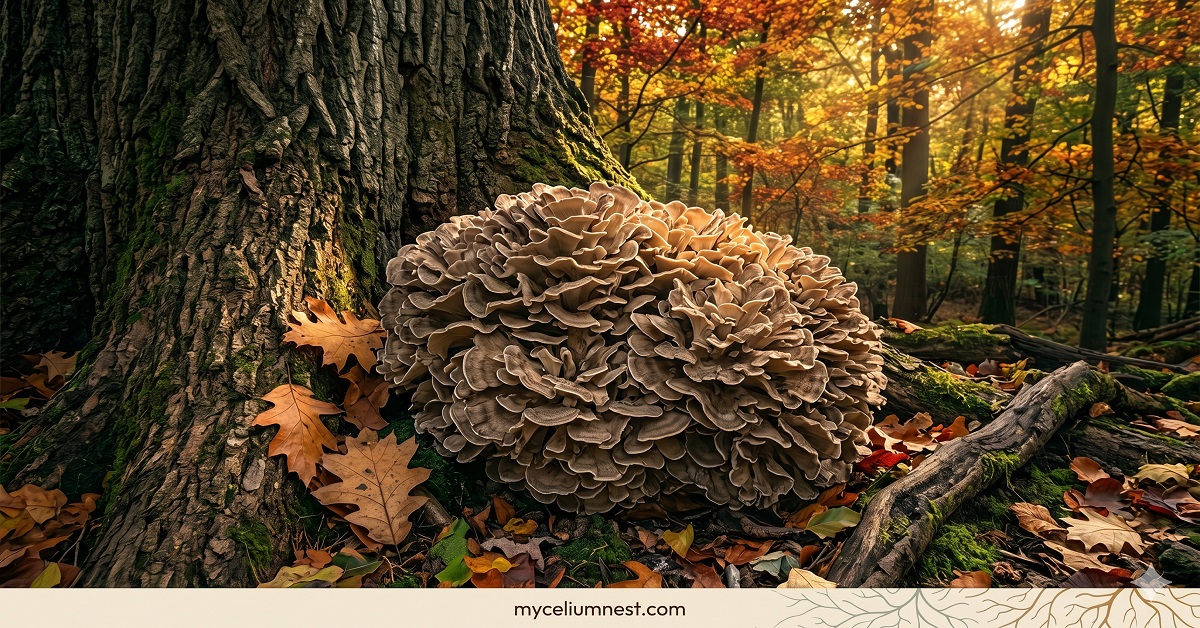
Hen of the woods (maitake) identification: Hen of the woods (Grifola frondosa) — known as maitake (“dancing mushroom”) in Japan — is one of the most satisfying species in foraging: unmistakably identifiable, no deadly lookalikes, and capable of producing specimens weighing 2–20 pounds from a single tree base. One productive oak tree found in autumn can fill your freezer and stock your medicine cabinet simultaneously — maitake is among the most studied medicinal mushroom species in modern science.
- The 4-Feature Hen of the Woods Identification Method
- Lookalikes: Berkeley’s Polypore and Others
- The Oak Association: Why Maitake Needs Specific Trees
- How to Find Maitake: The Systematic Approach
- Harvest Timing: When Maitake Is at Its Peak
- Cleaning, Cooking & Preserving Maitake
- Frequently Asked Questions
The 4-Feature Hen of the Woods Identification Method
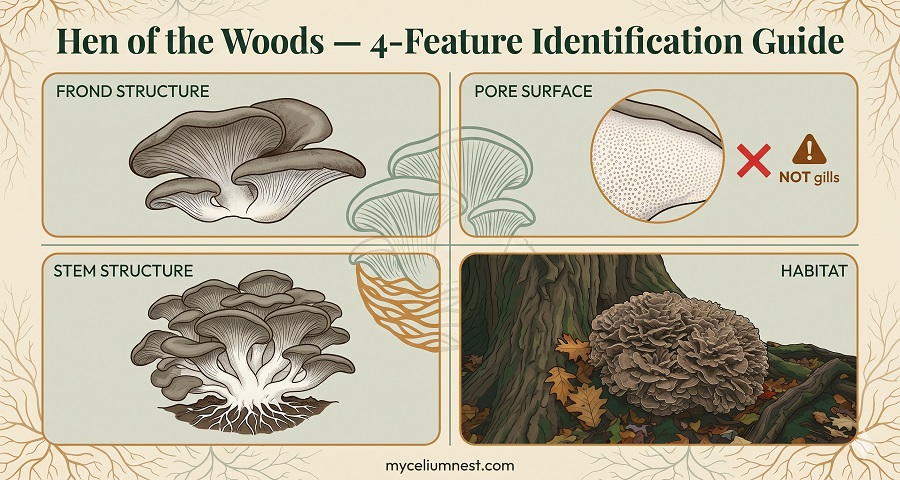
Hen of the woods is one of the more forgiving species to identify because its key features are distinctive and consistent — but it still requires multi-feature verification before eating. Here are the four non-negotiable identification checkpoints:
Lookalikes: Berkeley’s Polypore and Umbrella Polypore
Hen of the woods has no dangerous lookalikes in North America — but it does have several similar-looking polypores that are worth knowing to avoid confusion and embarrassment with fellow foragers:
| Species | Looks Like | Key Differences | Edible? |
|---|---|---|---|
| Bondarzewia berkeleyi (Berkeley’s Polypore) | Large rosette of pale cream fronds from oak base | Much paler (cream-white), larger pores (1–2 per mm), bitter taste, larger individual fronds (to 25cm) | Yes when young — bitter, best slow-cooked |
| Polyporus umbellatus (Umbrella Polypore) | Multiple small caps from central branching stem | Individual caps much smaller (2–6cm), tan/grey, each cap clearly individual not overlapping in rosette form | Yes — excellent edible |
| Old/Dry Grifola | Previous year’s spent maitake remnant on same tree | Dark brown-black, dried and hard, no white flesh, fronds brittle and papery — past edibility | No — past harvest stage |
The Oak Association: Why Maitake Needs Specific Trees
Maitake is a white-rot wood decay fungus — it attacks and decomposes the cellulose and lignin of hardwood root systems. Its ecological relationship with oaks is not random: it preferentially attacks oaks and chestnuts whose root systems are weakened by age, injury, drought stress, or disease. You won’t find maitake on healthy young oaks — you’ll find it at the base of old, majestic oaks in the 60–150+ year age range.
The critical insight for foragers: once maitake colonises a tree’s root system, it typically returns to the same location year after year, continuing to fruit from the same mycelial network as long as the tree provides substrate. A single productive oak is a multi-year food source. Mark every tree you find with GPS coordinates in a mapping app. Return to the same trees in mid-September through November annually.
How to Find Maitake: The Systematic Search Method
- Target the right forest type. Eastern oak-hickory forests are prime maitake habitat. Mature mixed hardwood forests with significant oak populations across the Midwest and Eastern US produce the most consistent maitake populations. In the west, maitake is less common but found in specific oak woodland pockets.
- Find the oldest oaks. Look for trees with diameter at breast height (DBH) of 50cm or greater — trees that are clearly 60+ years old. These are the trees with the root systems large and old enough to provide multi-year substrate for a large maitake colony.
- Look for stressed trees, not dead ones. Maitake prefers trees that are alive but declining — wounded oaks, oaks near lightning strike sites, oaks at the edge of construction disturbance, oaks losing bark sections. A completely dead oak supports different (still interesting) fungi. A living, slightly stressed oak is maitake territory.
- Get low and look for the “ruffled skirt.” From 30+ metres away, maitake can be invisible — it blends with leaf litter and deadwood at tree bases. Get down to ground level and look horizontally along the forest floor toward oak bases. The overlapping grey-brown fronds are often visible from 10–15 metres at ground level when invisible from standing height.
- Time your search for late September–November. In the Eastern US, maitake fruits most prolifically after the first cool nights of autumn (overnight lows under 10°C) following a period of summer rainfall. The week after a significant rain event in late September or October is often peak production timing.
Harvest Timing: When Maitake Is at Its Peak
Maitake quality degrades significantly with age and environmental exposure. The difference between freshly harvested young maitake and a week-old weathered specimen is dramatic — in texture, flavour, medicinal compound concentration, and shelf life.
Cleaning, Cooking & Preserving Maitake
Cleaning: Separate fronds from the central stem base and check for insects — maitake often hosts beetles and earwigs in the inner frond spaces. Brush with a dry pastry brush; avoid water if cooking fresh. The tough inner stem base can be simmered to make stock but is not pleasant to eat directly.
The Salt-Water Flush: Removing Insects Without Damaging the Mushroom
The “bug problem” is the #1 kitchen complaint about wild maitake. Beetles, earwigs, and fly larvae nest in the overlapping frond spaces — particularly in the inner dense sections near the central stem — and are not always visible until you begin separating the fronds. Here is the method that professional forager-cooks use:
Cooking: Maitake takes high heat beautifully — the firm fronds hold their shape in a hot pan. Sauté in butter over high heat until golden-brown and slightly crispy at the edges. The flavour is earthy, complex, and slightly peppery — genuinely one of the best culinary wild mushrooms. Excellent in risotto, pasta, ramen, stir-fry, and as a meat substitute.
Preserving: Sauté briefly, cool, and freeze in portions — maitake freezes exceptionally well with minimal texture loss. Alternatively, dry at 55°C in a dehydrator until fully desiccated and store in airtight jars. Dried maitake has significantly higher beta-glucan concentration per gram than fresh — useful for those interested in the medicinal properties. For the science behind maitake supplementation, see our mushroom supplement guides.
The mycological community that can help you find and verify your first maitake foray: the North American Mycological Association (namyco.org) maintains a directory of regional forays where experienced mycologists guide species identification in your local ecosystem.
Frequently Asked Questions
How much does wild maitake sell for?
Wild maitake commands $20–40 per pound at farmers markets and specialty grocery stores in the Eastern US. A large specimen weighing 10 pounds is worth $200–400 at retail price — making productive maitake trees extraordinarily valuable to both foragers selling at market and those stocking their own kitchens. Japanese premium wild maitake (from Akita Prefecture) sells for considerably more in Asian specialty markets due to its association with the specific terroir that produces the most medicinally potent specimens.
Will harvesting maitake kill the tree?
No — harvesting the fruiting body does not harm the mycelial network attacking the root system, and it does not accelerate the tree’s decline. The maitake mycelium will continue its wood decay process regardless of whether you harvest the fruiting body. However, the tree’s health is already compromised by the fungal colonisation — maitake on an oak indicates that tree is in decline, though that decline may take years or decades to manifest as death. Harvest your maitake with no guilt; the tree relationship predates your discovery by decades.
Can I grow maitake at home?
Yes, though maitake is one of the more challenging species for home cultivation — it requires very specific substrate conditions (hardwood sawdust supplemented), a cold fruiting trigger (4–10°C), and produces slowly. Commercially it is grown on supplemented sawdust blocks, but production cycles are long (3–6 months to fruiting). For home growers interested in medicinal maitake without the cultivation complexity, high-quality dried wild maitake or supplement products are a more practical option. Our cultivation guides focus on faster-fruiting species like oyster and lion’s mane for home production.
Always verify identifications with a regional field guide and experienced forager before consuming any wild mushroom. See our full disclosure.