Best Mushroom Field Guides (2025): Ranked by Region, Accuracy & Lookalike Coverage

Your field guide is your single most important piece of foraging equipment — more important than your basket, your knife, or your app. The wrong guide can get you killed. A guide that covers species outside your region, uses poor-quality photographs, or omits dangerous lookalike comparisons creates a false confidence that is genuinely dangerous. Choose your field guide with the same care you choose your species.
What Makes a Field Guide Genuinely Good — and What Makes One Dangerous
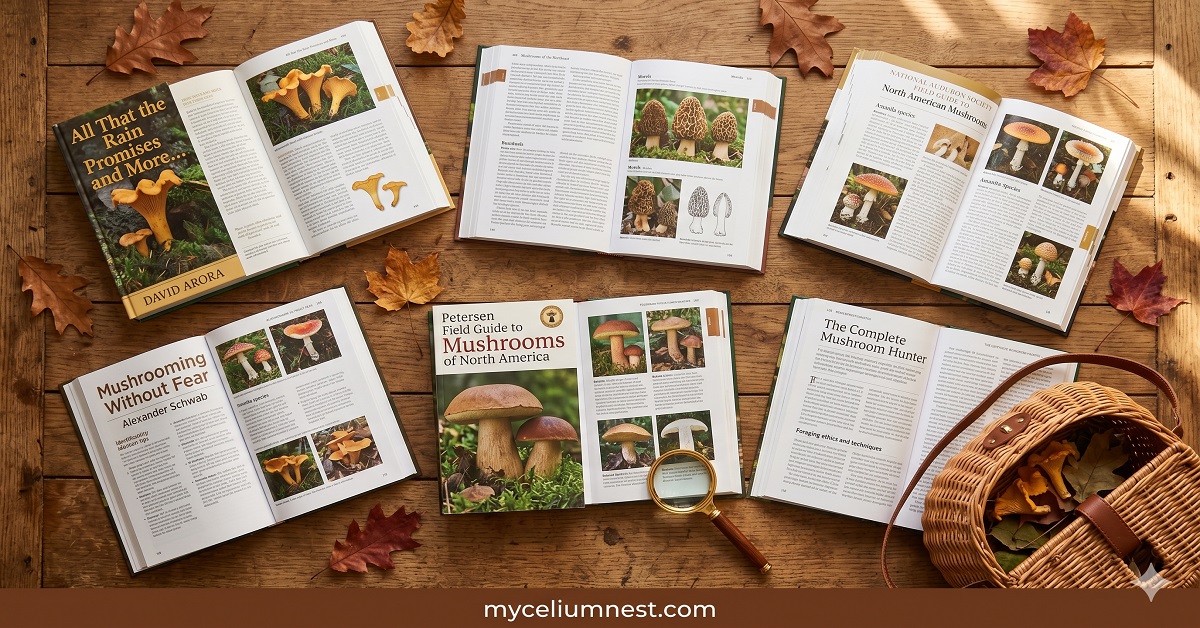
Most mushroom books on the market are adequate. A few are exceptional. Some are genuinely dangerous. Here is the evaluation framework we use:
- Photographs taken in natural habitat (not studio)
- Multiple photos per species showing different developmental stages
- Explicit lookalike comparisons with dangerous species
- Regional specificity — covering your actual ecosystem
- Spore print colours specified for every edible species
- Habitat and season information for each species
- Show only one photograph per species (colour varies enormously in fungi)
- Cover species outside your region without clearly noting this
- Use illustrations instead of photographs as primary identification images
- Omit lookalike species or describe them in one-line notes
- Rank species by “edibility stars” without providing full ID features
- Were written before 2000 (taxonomy has changed significantly)
Best National North American Field Guides
Best Regional Field Guides by Area
| Region | Best Primary Guide | Best Secondary Guide |
|---|---|---|
| Pacific Northwest | Trudell & Ammirati — Mushrooms of the Pacific Northwest | Bessette — Mushrooms of the Pacific Northwest |
| Eastern US & Midwest | Kuo & Methven — Mushrooms of the Midwest | Bessette — Mushrooms of Northeastern North America |
| Southeast US | Bessette, Roody & Bessette — Mushrooms of the Southeastern US | Lincoff — Audubon Field Guide (as supplementary) |
| Rocky Mountains & Southwest | Evenson — Mushrooms of Colorado and the Southern Rocky Mountains | Trudell & Ammirati (for methodology) |
| Canada | Schalkwijk-Barendsen — Mushrooms of Western Canada | Kuo — regional guide for your specific province ecosystem |
Best UK & European Field Guides
Digital Apps vs Physical Guides: The Honest Verdict
- iNaturalist — community ID confirmation, huge database
- Seek — on-device species recognition, privacy-preserving
- Shroomify — dedicated mushroom identification app with guided keys
- Useful for logging find locations and photographs
- Cannot assess smell, texture, or spore print colour
- AI image recognition error rates remain significant for fungi
- No battery required to open a field guide in the woods
- Field guides include regional habitat context apps cannot provide
The Critical Warning: Why AI Identification Apps Are Dangerous as Primary Tools
This section is the most important in this guide. The proliferation of AI mushroom identification apps — marketed with confidence ratings (“92% match — edible!”) and millions of downloads — has produced a new category of foraging accident. These apps are not a safer version of a field guide. They are a fundamentally different tool that, when misunderstood, creates false confidence that leads to poisoning.
- Generating a shortlist of possibilities to then investigate with a field guide
- Logging and photographing finds for community discussion
- Learning species names associated with visual patterns — as a memorisation aid, not an ID tool
- Submitting observations to iNaturalist for community confirmation (not solo ID)
- Make final edibility determinations on any wild mushroom
- Confirm an identification without field guide cross-reference
- Identify species from photographs taken by others
- Substitute for in-person expert verification
The standard that protects you: A hand lens, a regional field guide, a spore print, and 4+ confirmed features. These tools assess what actually matters — the complete physical profile of the organism in front of you. An AI app assesses what a camera can capture, which is a small and insufficient fraction of that information. The field guide stack remains irreplaceable for safe foraging.
The NAMA publishes its own curated recommended reading list at namyco.org/publications — the most authoritative source for vetted field guide recommendations by qualified mycologists. For a complete introduction to safe foraging before your first outing with any guide, read our beginner’s foraging guide first.
Frequently Asked Questions
Do I need both a national and a regional guide?
Yes — this is the recommendation of virtually every experienced forager and mycological society. A regional guide gives you accuracy for your ecosystem; a national guide gives you broader context, lookalike species from adjacent regions that may occur in yours, and methodology. Use the regional guide as primary identification reference; the national guide as cross-reference and supplementary reading. If you can only buy one, buy the regional guide for your specific area.
How often should I update my field guide?
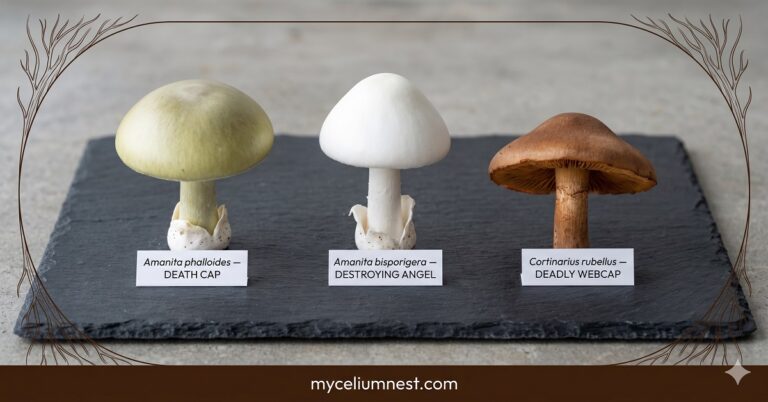
Fungal taxonomy changes significantly as DNA analysis revises species relationships. A guide from 2005 may use genus and species names that have since changed, or may fail to distinguish cryptic species (visually identical but genetically distinct, sometimes with different safety profiles) that have since been separated. Check for newer editions of your existing guides every 5–7 years. The most critical updates affect the Amanita genus (which includes the most dangerous species) and the Cortinarius genus (the deadly webcaps)
Rankings are based on direct field use across multiple regions. This article contains Amazon affiliate links — commission rates do not influence rankings. See our full disclosure.