Why Isn’t My Mushroom Growing? The Complete Troubleshooting Guide

Mushroom Growing Troubleshooting : Almost every cultivation problem has a completely different cause and fix depending on which stage of the grow you’re in — spawn, bulk substrate colonization, pinning, or fruiting. The single biggest mistake beginners make is applying a fruiting-stage fix (like increasing humidity) to a spawn-stage problem (like stalled colonization), which does nothing and sometimes makes things worse. Find your stage below, then find your symptom.
- Find Your Stage: The 4-Stage Diagnostic Framework
- Spawn Stage Problems (Grain Jars, Liquid Culture)
- Bulk Substrate Colonization Problems
- Pinning Stage Problems — Why Won’t It Pin?
- Fruiting Stage Problems (Leggy Stems, Cracking Caps)
- Contamination Quick Reference — What’s Growing in There?
- Normal vs Not Normal — Stop Panicking Over These
- Frequently Asked Questions
Find Your Stage: The 4-Stage Diagnostic Framework
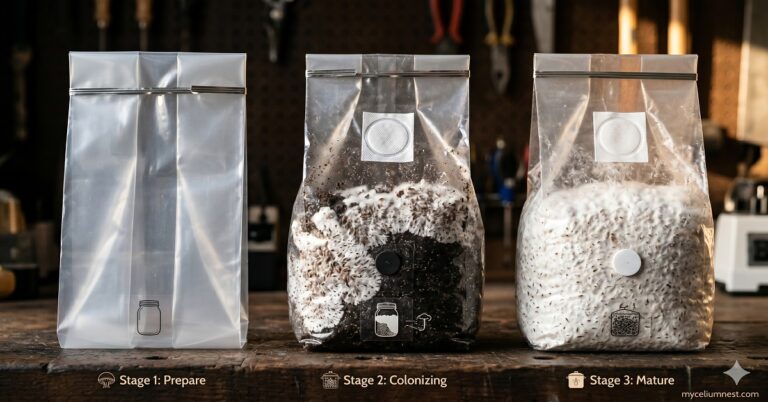
Every mushroom grow moves through four distinct stages, and each one has its own failure modes. Before reading further, identify exactly where you are:

New to the whole process? Our complete beginner’s framework walks through all four stages from scratch before problems arise. For grain spawn specifically, see our grain spawn guide and liquid culture guide.
Spawn Stage Problems
Before troubleshooting anything else, run through this checklist — most spawn-stage contamination traces back to one of these four:
- Are you using a Still Air Box or flow hood for every inoculation?
- Did you flame-sterilize your inoculation needle until red-hot between every single jar?
- Did you wipe down gloves, tools, and work surfaces with 70% isopropyl alcohol immediately before starting?
- Is your pressure cooker reaching and holding a true 15 PSI for the full 90 minutes?
| Symptom | Likely Cause | Fix |
|---|---|---|
| Green mold appearing on grain | Trichoderma contamination — usually from unsterile technique or incomplete sterilization | Discard immediately. Do not attempt to salvage. Review your sterile technique setup and confirm your pressure cooker is holding 15 PSI for the full 90 minutes |
| No visible growth after 5–7 days | Weak/old spawn source, temperature too low, or under-hydrated grain | Check ambient temp is 21–27°C (70–80°F). If no growth by day 10 with correct temp, the culture is likely non-viable — start fresh |
| Sour or rotten smell from jar | Bacterial “wet spot” — almost always from over-hydrated grain or inadequate sterilization | Discard. Do not open near your other jars — this smell is distinct from the neutral, slightly mushroomy smell of healthy colonization |
| Colonization is very slow (weeks, not days) | Temperature too low, or grain hydration slightly off (too wet slows oxygen exchange, too dry stresses mycelium) | Move jars to a warmer spot (top of a fridge or near — not on — a heat mat). Confirm grain has a matte, not glossy-wet, surface appearance |
| Yellow liquid pooling in jar | Often completely normal — see the Guttation entry in our Normal vs Not Normal section below | Do not discard automatically — check colour, smell, and mycelium health first |
Bulk Substrate Colonization Problems
| Symptom | Likely Cause | Fix |
|---|---|---|
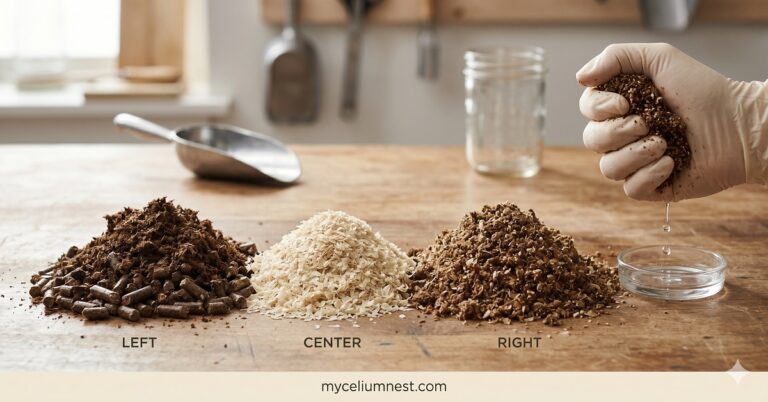
| Mycelium not spreading past the grain spawn | Substrate too wet or too dry, spawn ratio too low, or competing contamination | Substrate should hold together in a squeezed clump with no dripping water. See our Master Mix formula for correct hydration ratios |
| Fast-growing grey fuzzy patches spreading faster than your mycelium | Cobweb mold (Dactylium) — grows visibly faster than healthy mycelium, has a distinct grey, thin, web-like texture | If caught very early and isolated to a small spot, spray directly with undiluted 3% hydrogen peroxide (standard drugstore strength — do not dilute). The mold visibly “melts” on contact. If spreading beyond a small patch, discard the block |
| Sour smell from the bag/tub | Bacterial contamination from standing water or over-pasteurization moisture retention | Discard — bacterial wet spot in bulk substrate does not resolve on its own and will outcompete your mycelium |
| Colonization stalled halfway through the substrate | Temperature drop, insufficient spawn ratio (too little grain spawn per volume of substrate), or substrate compacted too densely | Confirm ambient temp is stable 21–24°C. A 1:4 to 1:5 spawn-to-substrate ratio by volume is the reliable range for most species |
Pinning Stage Problems — Why Won’t It Pin?
Why Is My Fully Colonized Substrate Not Pinning?

This is the single most common cultivation frustration: a fully, solidly colonized substrate — completely white, healthy-looking — that simply refuses to form pins. There are five main causes, and they’re worth checking in this order because they’re ranked by how often each one is actually the culprit:
What Are Mushroom Aborts and Why Do They Shrivel?
This is a different problem from no pins at all — it usually means the pinning trigger worked, but conditions collapsed immediately after. The most common cause is a sudden humidity crash or a CO₂ spike from insufficient FAE right as the delicate young pins were most vulnerable. Small pins have far less moisture reserve than mature mushrooms and can desiccate within hours of a humidity drop.
Pins formed, then shrivelled and died (“aborted”): This is a different problem from no pins at all — it usually means the pinning trigger worked, but conditions collapsed immediately after. The most common cause is a sudden humidity crash or a CO₂ spike from insufficient FAE right as the delicate young pins were most vulnerable. Small pins have far less moisture reserve than mature mushrooms and can desiccate within hours of a humidity drop.
Fruiting Stage Problems
| Symptom | Likely Cause | Fix |
|---|---|---|
| Long, thin “leggy” stems with tiny caps | Insufficient FAE — classic CO₂ excess symptom. The mushroom stretches, searching for fresh air | Increase fanning frequency or improve passive ventilation immediately. This is almost always a FAE problem, not a humidity or light problem |
| Caps drying out or cracking | Humidity too low, or airflow directed straight at developing caps | Raise RH toward 90%+, redirect any fan airflow away from direct cap contact, mist more frequently in smaller amounts rather than one heavy soak |
| Growth is very slow / small yield overall | Insufficient light cycle, weak genetics, substrate nearing exhaustion, or low-grade competing contamination | Confirm 12-hour indirect light cycle. If this is a second or third flush, reduced yield is often normal — see our oyster growing guide for flush-by-flush yield expectations |
| Mushrooms feel watery or mushy after harvest | Over-misted, or harvested slightly past peak maturity | Reduce direct misting onto mushroom surfaces (mist the air/walls, not the caps directly) and harvest earlier in the cap development cycle |
For a complete species-by-species reference on the exact temperature, humidity, and FAE targets that prevent most of these problems before they start, see our Mushroom Fruiting Conditions Guide. If you’re managing multiple blocks and want automated humidity control rather than manual troubleshooting, our grow tent guide covers the full automation setup.
Contamination Quick Reference — What’s Growing in There?

| Contaminant | Appearance | Growth Speed | Action |
|---|---|---|---|
| Green mold (Trichoderma) | Bright green patches, white fuzzy border, musty smell | Fast — visible within 2–4 days | Discard immediately |
| Cobweb mold (Dactylium) | Grey, thin, web-like, glossy sheen | Very fast — visibly faster than mycelium | Isolate/treat if caught early, discard if spreading |
| Black mold (Aspergillus spp.) | Fuzzy black spots, sometimes powdery | Moderate | Discard immediately, avoid inhaling — dispose outdoors |
| Pink/orange mold (Fusarium/Neurospora) | Pink or orange powdery patches | Fast | Discard immediately |
| Bacterial wet spot | Slimy texture, tan/yellow pooling liquid, sour smell | Immediate — present from early stage | Discard immediately |
Normal vs Not Normal — Stop Panicking Over These
A significant share of “help, is this contamination?” panic comes from completely normal mycelial behaviour that simply looks alarming to someone who hasn’t seen it before. Here are the most commonly misidentified normal phenomena:
Penn State Extension’s mushroom cultivation research resources provide additional agronomic detail on common contaminant identification if you want a second reference point beyond this guide.
Frequently Asked Questions
My substrate is fully white and colonized but nothing is happening. How long should I wait before assuming it’s a problem?
Give it 5–7 days after full colonization before troubleshooting, since some species have a natural rest period between colonization and pinning. If you’re past that window with no pin activity, work through the five pinning-stage causes in order (FAE, humidity, temperature drop, light, surface moisture) — insufficient FAE is the cause in the large majority of cases.
Can I save a block that has a small spot of contamination?
It depends entirely on which contaminant and how early you catch it. Cobweb mold caught within the first day or two, isolated to a small area, can sometimes be halted with a direct application of diluted hydrogen peroxide or a light dusting of cinnamon (which has mild antifungal properties). Green mold, black mold, and bacterial wet spot should never be treated or salvaged — by the time they’re visible, they’re already established and will outcompete your mycelium. When in doubt, discard rather than risk a failed grow and a contaminated grow space.
Why did my mushrooms pin fine on the first flush but the second flush is weak or not happening?
This is usually normal, not a problem. Each flush draws down the nutrient reserves in the substrate, so second and third flushes are naturally smaller than the first. If the second flush isn’t happening at all, try a “dunk and roll” — briefly submerging the block in cool water for a few hours and rolling it in dry substrate — which can rehydrate and shock the block into a second pinning cycle. If yield has dropped to near nothing by the third flush, the substrate is likely exhausted, which is expected and not a failure.
How do I tell the difference between healthy mycelium and early-stage contamination if they’re both white?
Texture and growth pattern are more reliable than colour at this early stage. Healthy mycelium grows outward in a relatively even, spreading pattern with a consistent fluffy or rope-like texture. Contamination — even white contaminants like some bacterial forms — often appears as a distinct patch with a different texture than the surrounding mycelium (glossier, slimier, or more tightly matted), sometimes with a sour or off smell that healthy mycelium doesn’t have. When genuinely uncertain, isolating the jar or bag from your other grows for a few extra days to watch how the patch develops is the safest approach.
This article contains Amazon affiliate links. See our full disclosure.