Mushroom Fruiting Conditions: Temperature, Humidity & FAE Guide for Every Species

Most edible mushrooms fruit best at 15–22°C (59–72°F), 85–95% relative humidity, with fresh air exchange 4–6 times daily and indirect light for 12 hours. These four variables — temperature, humidity, CO₂/FAE, and light — together determine whether your colonised block produces an abundant flush or pins reluctantly and poorly.
The most common reason a fully colonised mushroom block fails to produce — or produces poorly — is not spawn quality, not substrate choice, and not contamination. It is incorrect fruiting conditions. A block that colonised perfectly can abort its pins, produce tiny misshapen fruit bodies, or refuse to initiate altogether when temperature, humidity, CO₂, or light are outside the species-appropriate range.
This guide is the comprehensive species-by-species reference for mushroom fruiting conditions — built to work alongside our individual growing guides for oyster mushrooms, lion’s mane, and shiitake.
The Four Fruiting Variables Explained
Mushrooms don’t fruit at random. In nature, fruiting is triggered by environmental shifts that signal the mycelium that conditions are right for reproduction — the production of spore-bearing fruit bodies. In cultivation, we replicate and control these signals. The four variables that matter are:
1. Temperature
Temperature functions as both a fruiting trigger and a development regulator. Most cultivated species require a temperature drop from incubation to fruiting — typically 5–10°C lower than the incubation temperature — as one of the primary signals for pinning initiation. Once fruit bodies have formed, temperature then controls development speed and the density/thickness of the resulting caps.
2. Relative Humidity (RH)
Mushrooms are 85–95% water by fresh weight. They need high ambient humidity during development to prevent desiccation of the delicate developing pins and expanding caps. Humidity that is too low causes pin abort, cap cracking, and premature browning of developing fruit bodies. Humidity that is too high (above 97%) creates surface moisture that promotes bacterial blotch and slows spore dispersal.
3. Fresh Air Exchange (FAE) / CO₂ Levels
In nature, mushrooms grow in open-air environments with constant atmospheric CO₂ levels (~400 ppm). In a closed fruiting chamber, CO₂ produced by the metabolically active mycelium accumulates rapidly. Elevated CO₂ causes mushrooms to grow long and thin — reaching for oxygen — instead of the compact, dense forms that are commercially and gastronomically desirable. FAE flushes accumulated CO₂ and replenishes oxygen without dropping humidity below the safe range.
4. Light
Mushrooms do not photosynthesize — light is not an energy source for fungi. However, light functions as a directional and morphological cue. Fruit bodies orient their growth toward light sources, which in nature ensures spores disperse effectively. In cultivation, indirect light helps produce properly oriented, visually appealing fruit bodies. Complete darkness during fruiting often produces irregular, distorted growth.
Master Species Fruiting Conditions Table
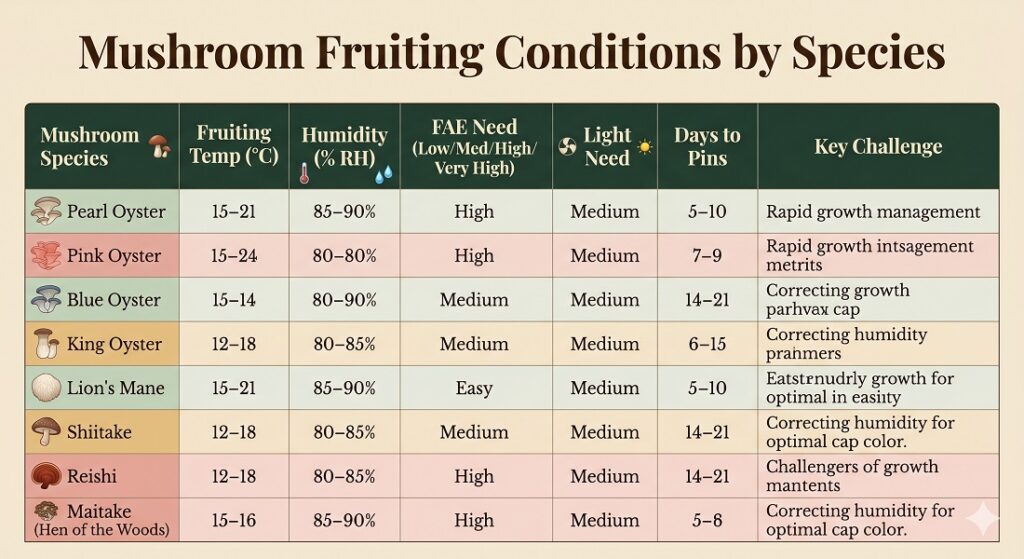
| Species | Fruiting Temp | Humidity (RH) | FAE Need | Light | Days to First Pin | Key Challenge |
|---|---|---|---|---|---|---|
| Pearl Oyster | 15–22°C | 85–95% | High | Indirect, 12h | 3–7 days | Long stems if CO₂ too high |
| Pink Oyster | 18–30°C | 85–95% | High | Indirect, 12h | 3–6 days | Very short shelf life; harvest early |
| Blue Oyster | 10–18°C | 85–95% | High | Indirect, 12h | 5–10 days | Needs cooler temp; fades to grey at warmth |
| King Oyster | 10–18°C | 85–95% | Low–Med | Indirect, 12h | 7–14 days | Needs cold trigger; slow development |
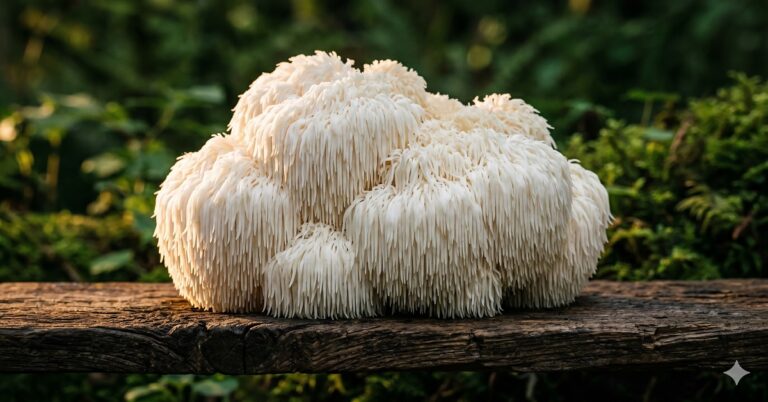
| Lion’s Mane | 18–22°C | 85–95% | Very High | Indirect, 12h | 5–10 days | Icicle spines if CO₂ too high; brown tips if RH too low |
| Shiitake | 12–21°C | 80–90% | Moderate | Indirect, 12h | 10–14 days after cold shock | Requires cold-water shock between flushes; slower |
| Reishi | 21–27°C | 85–95% | Moderate | Indirect, 12h | 14–21 days | Antler stage precedes cap; long development time |
| Maitake (Hen of the Woods) | 15–20°C | 85–95% | Moderate | Indirect, 12h | 14–28 days | Very slow developer; advanced cultivation |
Temperature: The Pinning Trigger
The Temperature Drop Method
The most reliable way to initiate pinning in stubborn blocks is a deliberate temperature drop. After achieving full colonisation at 22–24°C, move the block to an environment 5–10°C cooler. This temperature differential mimics the natural autumn temperature drop that signals fungi to reproduce before conditions become unfavourable.
Practical Temperature Drop Strategies
- Refrigerator method: Place fully colonised blocks in the refrigerator (4–7°C) for 12–24 hours, then return to room temperature fruiting conditions. Effective for most species.
- Room movement: If you incubated in a warm room (24°C), move to a cool basement, garage, or spare room (15–18°C). The natural temperature differential triggers pinning without additional equipment.
- Night temperature: In spring and autumn, opening a window at night to allow natural temperature fluctuation can be sufficient to trigger stubborn blocks.
Temperature’s Effect on Fruit Body Quality
Humidity: Getting It Right Without Guessing
The single most important tool in your fruiting chamber is a digital hygrometer. Growing without one is like baking without an oven thermometer — you might get lucky, but you’re essentially guessing. A quality digital hygrometer and thermometer combo is available on Amazon for $12–18 and is the single highest-ROI purchase you can make for your growing setup.
The Humidity Window by Growth Stage
Optimal humidity is not static throughout the fruiting cycle — it varies by development stage:
Choosing a Humidity Method
For small setups (1–3 blocks), manual misting 2–4 times daily is effective. For larger setups or multiple species, an automated ultrasonic humidifier connected to an Inkbird humidity controller eliminates the most labour-intensive aspect of fruiting chamber management. Our detailed best humidifier for mushroom growing guide covers every option from manual misting to fully automated systems.
Fresh Air Exchange (FAE): The Most Overlooked Variable
Fresh air exchange is consistently the most neglected fruiting variable among home growers — and its effect is dramatic. Carbon dioxide produced by the metabolically active mycelium accumulates in any enclosed fruiting space. At CO₂ levels above 1,000–2,000 ppm, mushrooms respond by growing elongated stems and small caps, allocating resources to height (reaching for oxygen) rather than reproductive tissue.
Species-Specific CO₂ Sensitivity
Produces icicle-like drooping spines instead of compact globes at elevated CO₂. Needs near-fresh-air conditions. FAE every 1–2 hours ideal.
Produces long, thin stems with small caps. FAE 3–4 times daily typically sufficient. Visible cap development is a good CO₂ indicator.
More CO₂ tolerant than oysters. Some growers deliberately restrict FAE slightly for reishi to produce the fan-shaped fruiting body style.
FAE Methods by Setup
- Manual fanning: Open the fruiting chamber lid and wave gently for 10–15 seconds, 3–4 times daily. Simple and effective for small setups.
- Passive FAE: Holes drilled in the fruiting chamber allow CO₂ (heavier than air) to sink out through lower holes while fresh air enters through upper holes. The SGFC design takes advantage of this principle.
- Automated fan + timer: A small 4-inch clip fan on a programmable timer (30 seconds every 2–4 hours) provides consistent, low-disturbance FAE for larger operations. Point the fan at the chamber wall, not directly at blocks.
For the specific fruiting chamber designs that best manage FAE passively and actively, see our complete fruiting chamber guide.
Light: Direction, Not Energy
One of the most persistent myths in home mushroom cultivation is that grow lights improve yields. They do not. Mushrooms don’t photosynthesize — they derive all energy from the substrate. Light serves two specific functions:
- Orientation: Fruit bodies grow toward light. A consistent light source from one direction produces upright, well-oriented mushrooms. Without light, growth is often irregular and sideways.
- Timing cue: In some species, light/dark cycles help regulate the circadian rhythms of fruiting initiation. 12 hours on / 12 hours off is the standard recommendation.
Practical Light Setup
A single LED strip light (any colour temperature — mushrooms are not sensitive to spectrum in the way plants are) on a 12-hour timer provides entirely adequate light for any home fruiting setup. Natural ambient light from a window is also perfectly sufficient. Avoid: direct intense light (raises temperature, dries out surface), complete darkness during fruiting (irregular growth), and expensive grow lights (wasted money for mushrooms).
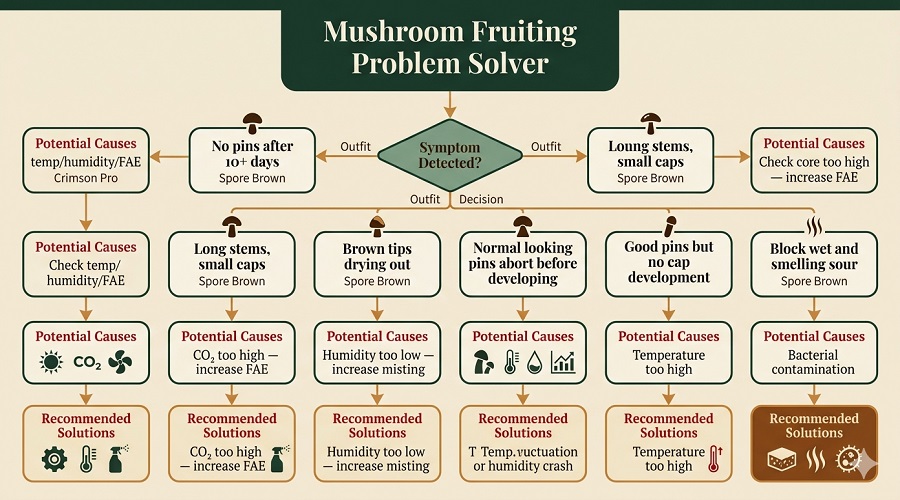
Fruiting Problem Troubleshooter
Frequently Asked Questions
What is the ideal temperature for mushroom fruiting?
There is no single ideal temperature — it varies by species. For the most common beginner species: pearl oyster mushrooms fruit best at 15–22°C (59–72°F); lion’s mane at 18–22°C; shiitake at 12–21°C. The general principle is that most edible species prefer cooler conditions than humans typically maintain indoors during summer, which is why many home growers find fruiting easier in autumn and spring.
How do I raise humidity in my fruiting chamber without overwatering?
The key is to mist the walls and air of the chamber — never directly onto the mushrooms or exposed substrate. Damp perlite in the base of your chamber acts as a humidity buffer, releasing moisture slowly rather than creating surface wetness. For consistent results without manual effort, a small ultrasonic humidifier connected to an Inkbird IHC-200 humidity controller will automatically maintain your target RH without over-saturating the environment.
Can I grow different mushroom species in the same fruiting chamber?
Yes, as long as their fruiting parameters are compatible. Pearl oyster, pink oyster, and lion’s mane all fruit well at 85–95% humidity — they can share a chamber. However, combining species with very different temperature requirements (e.g., blue oyster at 10–18°C and pink oyster at 18–30°C) in the same chamber will compromise one or both. Refer to the species table above to check compatibility before sharing fruiting space.
How many times a day should I fan my fruiting chamber?
For most species in a Shotgun Fruiting Chamber (SGFC): 2–4 times daily is the standard. For lion’s mane, which is highly CO₂-sensitive: 4–6 times daily or continuous low-level ventilation. For shiitake, which is more CO₂-tolerant: 2 times daily is often sufficient. With a Martha Tent and a fan on a timer, 30 seconds of air circulation every 2–4 hours replicates what manual fanning achieves. The visual indicator: if your stems are growing long before caps develop, fan more frequently.
Disclosure: This article contains Amazon affiliate links. We earn a small commission at no extra cost to you. See our full disclosure.