Written by the MyceliumNest Team · Equipment Tested
We have processed 500+ bags across six brands over four years. Rankings are based on filter patch integrity, bag wall durability under repeated pressure cycling, and correlation with contamination rates in our operation.
Quick Verdict
Unicorn Bags (specifically the 10B and T3 series) remain the industry standard for a reason — the filter patches are reliably consistent, the bag wall is the thickest in the market, and they survive multiple autoclave cycles without developing pinholes. For growers watching cost, Amazon Basics-style polypropylene bags from established sellers perform acceptably for single-use applications. What to absolutely avoid: any bag without a specified filter patch micron rating on the listing.
Why Bag Quality Directly Affects Your Contamination Rate
Most cultivation guides treat bags as a commodity — any polypropylene bag will do. This is wrong, and it’s responsible for a significant proportion of contamination that growers incorrectly attribute to sterilisation failure or inoculation technique. We ranked the best mushroom growing bags in this guide based on filter patch and contamination data.
There are three specific ways a low-quality bag causes contamination that a quality bag prevents:
1. Pinhole Formation in Thin Walls
Thin bags (under 4 mil / 0.10mm wall thickness) develop microscopic pinholes when the bag is folded, when it expands under pressure cooker heat and then contracts on cooling, or when it’s handled roughly before or during inoculation. Each pinhole is a direct contamination entry point during the colonisation period. You won’t see these pinholes by eye — but your contamination rate will tell you they’re there.
2. Filter Patch Collapse or Delamination
Low-quality filter patches are heat-sealed to the bag rather than ultrasonically welded, or use a thinner filtration media. Under repeated pressure cycling, the seal at the patch-to-bag interface can delaminate — creating gaps that admit unfiltered air. This typically shows as contamination originating at the filter patch location rather than distributed throughout the bag.
3. Inconsistent Filter Ratings Between Batches
Budget bags from inconsistent manufacturers have variable filter patch ratings within the same bulk purchase. You may get bags with 0.2 micron patches alongside bags with 0.5 micron patches — which provides adequate protection for bacteria but allows larger fungal spores through. Reputable manufacturers maintain consistent specifications batch to batch.
Filter Patch Science: What the Micron Number Actually Means
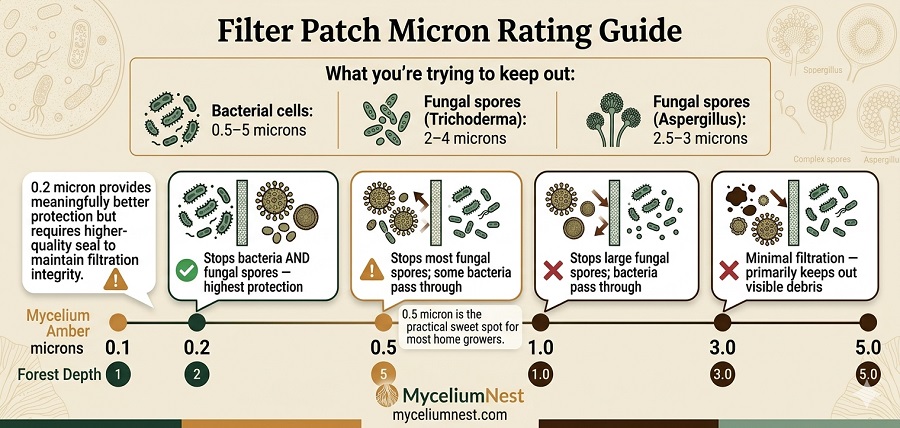
The micron rating on a mushroom bag filter patch is one of the most important and least understood numbers in home cultivation. Here’s what it actually means:
Micron Rating
What It Blocks
What Passes Through
Best For
0.2 micron
Bacteria + all fungal spores
Gas exchange only
High-value or temperature-sensitive species
0.5 micron (most common)
Most fungal spores + large bacteria
Smaller bacteria, gases
General grain spawn and substrate bags — the practical standard
1.0–2.0 micron
Larger fungal spores only
Bacteria, smaller spores
Not recommended for high-nutrition substrate
The real-world caveat: A 0.2 micron rating is only meaningful if the filter-to-bag seal is of equal quality. A 0.2 micron patch with a poor seal performs worse than a 0.5 micron patch with a perfect seal. This is why Unicorn bags — which use ultrasonic welding rather than heat-sealing — consistently outperform cheaper bags with ostensibly equivalent micron ratings.
The 4 Specifications That Determine Bag Quality
1. Wall Thickness
Minimum 4 mil (0.10mm) for single-use autoclavable bags. 6 mil (0.15mm) for bags intended for multiple sterilisation cycles. Unicorn bags are specified at 2.5 mil, but their polypropylene formulation is denser than standard PP — testing required.
2. Filter Patch Attachment Method
Ultrasonic welding (higher cost, better seal) vs. heat sealing (lower cost, more variable). To test: try to peel back the edge of a filter patch — heat-sealed patches will show delamination potential; ultrasonically welded patches will tear the bag wall before releasing.
3. Temperature Rating
Must be rated for 121°C (250°F) for pressure cooker sterilisation. Standard polyethylene bags (like regular zip-lock bags) melt at these temperatures. Only polypropylene (PP) or certified autoclave bags should be used. Check product descriptions for explicit temperature ratings.
4. Self-Healing Injection Port (for certain applications)
Some bags include a self-healing silicone injection port that allows needle inoculation without opening the bag. These are excellent for liquid culture work but add cost. For grain-to-grain transfers where you need to open and shake the bag, standard filter patch bags are sufficient.
Top 5 Mushroom Growing Bags Ranked
🥇 #1 Best Overall — Professional Standard★★★★★ 5.0/5
Filter: 0.5 micron · Material: PP · Multiple sizes · Good value-to-quality ratio
A strong value option that consistently delivers 0.5 micron filtration with reliable seals. Notably thinner than Unicorn bags so single-use is preferred over multiple autoclave cycling, but for growers sterilising large batches the per-bag cost makes this the right economic choice. Available in multiple sizes including small bags ideal for grain spawn jars and large bags for bulk blocks. We used these bags for grain spawn production throughout 2024.
#3 Best with Self-Healing Injection Port★★★★☆ 4.4/5
Midwest Grow Kits Spawn Bags with Injection Port
Filter: 0.2 micron · Self-healing silicone injection port · Quart-size · For LC and spore syringe inoculation
The injection port eliminates the need to open bags for needle inoculation — you inject directly through the silicone port which reseals after the needle withdraws. This is a genuine contamination reduction advantage for liquid culture inoculation compared to bags you need to open and reseal. Best used for grain spawn inoculation with LC syringes. Slightly expensive per-unit but the workflow improvement is worth it at moderate volume. Requires a pressure cooker rated for 121°C — verify before purchase.
Amazon and Aliexpress are full of bags marketed as “mushroom grow bags” with no specified micron rating, no wall thickness specification, and no information about filter attachment method. These bags appear identical to quality bags but fail in predictable ways:
Filter patches peel away from the bag wall after 1–2 autoclave cycles
Bag walls develop pinholes at fold points during sterilisation
Inconsistent filter ratings — the patch may be 0.5 micron or it may be 2.0 micron with no way to know
The minimum acceptable listing: Any bag you purchase must specify the filter micron rating, confirm it is polypropylene (PP) material, and confirm it is rated to 121°C / 250°F. If any of these three are absent from the product listing, look elsewhere.
Autoclave Loading: How to Pack Bags for Even Sterilisation
The most common silent failure mode in mushroom bag sterilisation has nothing to do with bag quality or sterilisation time — it’s incorrect loading that physically blocks filter patches from functioning. A filter patch pressed flat against the pressure cooker wall, against another bag, or against the cooker base cannot exchange gas during the sterilisation cycle. The result: those bags don’t fully sterilise regardless of how long you run the pressure cooker, and they develop contamination patterns that baffle growers who can’t understand why their “good” bags keep failing.
Why Filter Patch Position Is Critical During Sterilisation
During pressure sterilisation, steam must be able to both enter and exit the bag through the filter patch to achieve temperature equilibration throughout the substrate. The sterilisation cycle works in three phases:
Heating phase: Steam pressure builds. Air inside the bag must exit through the filter patch as the cooker pressurises. If the patch is blocked, this air is trapped inside the bag.
Sterilisation phase: Steam penetrates the substrate through the filter patch, raising the internal temperature to 121°C. A blocked patch creates a pressure differential — inside the bag stays at a different pressure than the cooker, causing uneven substrate temperature and incomplete sterilisation.
Cooling phase: As the cooker depressurises, air must re-enter the bag through the filter patch. A blocked patch can cause the bag to deform under the suction — or worse, pull in a single concentrated stream of air through any weak point in the seal rather than the filtered patch.
The Correct Loading Method
Step-by-Step Correct Bag Loading Protocol
1
Place a wire rack or trivet in the base of the cooker
The rack elevates bags from the base, allowing steam to circulate beneath them and preventing the bag bottom from sitting in boiling water. A canning rack works perfectly; folded kitchen towels are an acceptable substitute. Never rest bags directly on the bare cooker base.
2
Stand bags upright — never lay them flat
Upright bags distribute substrate weight evenly, maintain the filter patch in the correct orientation, and allow steam circulation between bags. Flat bags stack on top of each other, pressing filter patches together and preventing steam penetration through the substrate mass.
3
Orient filter patches toward the centre — not against walls
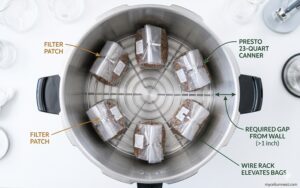
This is the most critical step. If your bags have side-mounted filter patches, position those patches facing inward — toward the centre of the cooker — rather than pressed against the cooker wall. A filter patch in direct contact with the stainless steel cooker wall is effectively sealed shut. Steam cannot pass through it in either direction. Leave at least 1–2 cm clearance between any filter patch and any solid surface.
4
Maintain spacing between bags
Allow 1–2 cm of space between bags where possible. For a Presto 23-quart cooker, load bags in a single ring around the outside of the rack with 1–2 bags in the centre. Do not stack bags. If you need to sterilise more bags than fit in one layer, run two separate sterilisation cycles rather than stacking.
5
Fold and loosely secure the bag top before loading — not heat sealed
Bags should be closed but not hermetically sealed during sterilisation. A loose fold secured with a zip tie or clip allows the gas exchange that sterilisation requires. If you heat-seal a bag completely before sterilisation, the internal pressure build-up can rupture the bag wall or delaminate the filter patch seal. Heat seal after sterilisation and cooling, never before.
Signs Your Loading Was Incorrect
Bags that appear vacuum-sealed or deformed after cooling
Filter patches that are discoloured, flattened, or wrinkled
Contamination developing at the filter patch location specifically
Inconsistent contamination rate between batches in the same pressure cooker
Signs Your Loading Was Correct
Bags look the same after sterilisation as before — no deformation
Filter patches remain flat, pale, and visually intact
Bag walls feel uniformly warm throughout when removed from cooker
Consistent contamination rate between batches
Full Comparison Table
Brand / Type
Filter
Wall
Autoclave Cycles
Best Use
Rating
Unicorn 10B
0.2 micron ✓
Thick PP
5–8+ ✓
All applications
★★★★★
Myyorganic (0.5µm)
0.5 micron ✓
Standard PP
2–3
Grain spawn, bulk
★★★★★
Injection Port Bags
0.2 micron ✓
Standard PP
2–3
LC inoculation
★★★★☆
No-spec budget bags
Unknown / variable ✗
Thin / variable
1 (if that)
Avoid
✗ Not rated
How to Seal Bags Without a Bag Sealer
A heat sealer is the professional standard for closing mushroom bags, but it’s an additional $30–$80 equipment investment. Here are the three best alternatives that work reliably:
1
Zip Ties + Fold Over
Fold the top of the bag over 3–4 times tightly and secure with a heavy-duty zip tie pulled very tight. This works reliably for most applications. Not suitable for supplemented substrate bags where gas pressure builds during colonisation (the fold can loosen).
2
Clothes Iron (No Steam)
Fold the bag top flat, then press with a hot iron (no steam, medium heat setting) for 3–5 seconds. Test the seal by pulling apart gently — it should hold with substantial force. Practice on scraps before sealing production bags. Works best on flatter, thinner-walled bags.
3
Autoclave Tape + Fold (for pre-sterilisation)
Fold the top over and secure with autoclave indicator tape before sterilisation. The tape withstands pressure cooking and the fold holds the bag closed. After sterilisation, fold and tape again before inoculation. Two layers of tape at the fold creates a reliable seal for the colonisation period.
Frequently Asked Questions
Can I use regular oven bags or plastic food bags instead?
No. Standard oven bags are made from nylon or polyester, not polypropylene, and are not rated for 121°C / 15 PSI sterilisation. Regular food storage bags will melt in a pressure cooker. Autoclave-rated polypropylene is not substitutable for this application — it’s the specific polymer formulation that allows the bags to survive sterilisation without off-gassing or deforming. The product must explicitly state it is polypropylene and rated for autoclave / pressure cooker sterilisation.
Why is my contamination happening at the filter patch specifically?
Contamination originating at or near the filter patch points to one of three causes: (1) The filter patch has delaminated at the edge — examine the bag in good light; a delaminated patch will show a gap at the seal line. (2) The bag was stored in a contaminated environment during colonisation where the patch was in contact with contaminated surfaces or water. (3) You misted water directly onto the filter patch during fruiting — surface moisture on the outside of the filter creates a wicking pathway for contaminants. Always mist the fruiting chamber walls, never the bag surface directly.
Can I reuse mushroom growing bags?
Only quality bags rated for multiple autoclave cycles — specifically Unicorn bags and a few other premium brands. After each use, inspect the bag carefully: hold it up to light and look for pinholes (any point where light passes through the bag wall that isn’t the filter patch). If pinholes are present, discard. If intact, wash with hot water and dish soap, rinse thoroughly, and re-sterilise. Maximum recommended reuse even for quality bags: 5–8 cycles after which the filter patch attachment begins to show wear. Budget bags should be treated as single-use only.
Written by the MyceliumNest Team Master Mix is the substrate we use for lion’s mane and high-yield oyster production in our own grows. The ratio modifications, contamination risk gradient, and species adaptations in this guide come from direct testing across 80+ Master Mix blocks. Master Mix Mushroom Substrate: The Master Mix Formula 50% Hardwood Fuel…
Written by the MyceliumNest Team Mushroom growing for beginners – We started exactly where you are. This guide distils 4+ years of cultivation experience — including the failures that most beginner guides pretend don’t happen — into the clearest possible pathway from zero to your first harvest. The Honest Starting Point Start with a grow…
Written by the MyceliumNest Team Portobello cultivation is genuinely more demanding than any oyster or lion’s mane grow. This guide doesn’t oversimplify it — it explains why, and gives you the specific protocol that produces consistent results once you’ve built the foundational experience. The Truth About Portobello Growing How to grow Portobello Mushrooms – Agaricus…
Written by the MyceliumNest Team Fruiting condition data in this guide comes from 4+ years of direct cultivation experience across 12+ species, cross-referenced with published mycological literature. Species parameters have been verified across multiple grow cycles. Quick Reference Most edible mushrooms fruit best at 15–22°C (59–72°F), 85–95% relative humidity, with fresh air exchange 4–6 times…
Written by the MyceliumNest Team 4+ years cultivating 12+ mushroom species · Active member, North American Mycological Association · Every technique in this guide has been personally tested and validated. Oyster mushrooms (Pleurotus ostreatus) are the single best mushroom for any first-time home grower — and it’s not even close. They colonise faster than almost…
Written by the MyceliumNest Team PF Tek was the first cultivation technique we learned — and the one we’ve used to troubleshoot every contamination scenario imaginable. This guide is built from that direct experience. The PF Tek method is the most widely used mushroom cultivation technique among hobby growers worldwide — and for good reason. Developed by…