Best Humidifier for Mushroom Growing (2026): Tested, With the White Dust Warning Nobody Gives You

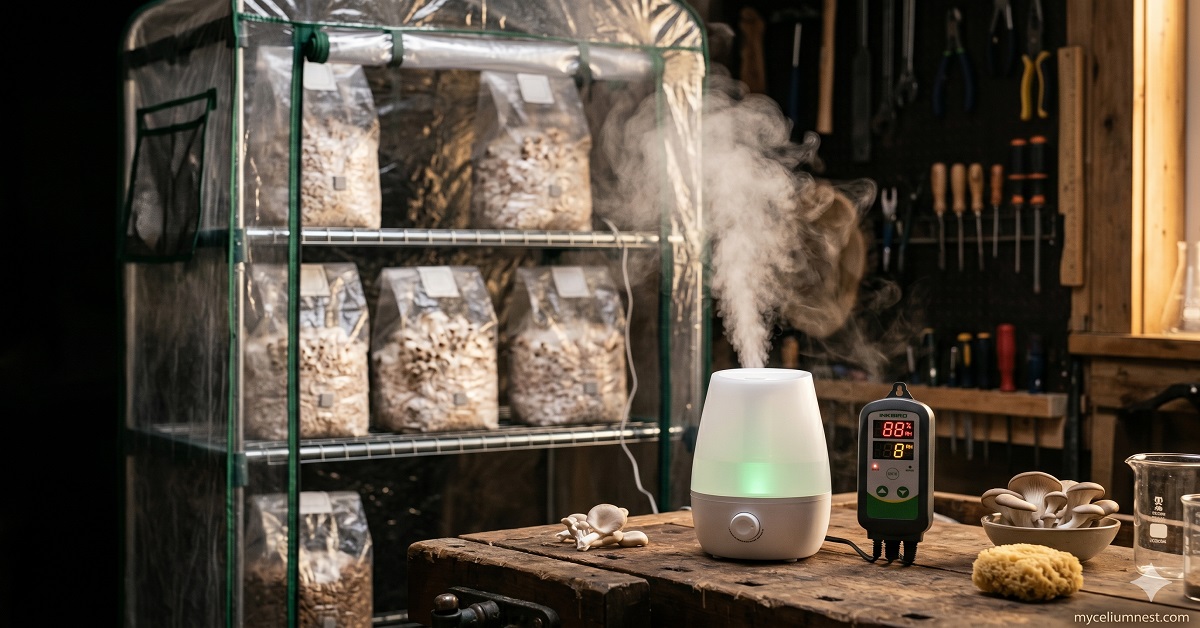
The Levoit Classic 300S Ultrasonic paired with an Inkbird IHC-200 humidity controller is the combination we run in our own operation — accurate, reliable, and automatable. The critical companion purchase: distilled or filtered water — without it, ultrasonic humidifiers deposit mineral dust on your mushrooms that reduces quality and can create surface contamination pathways.
Humidifier Types: What Works in a Fruiting Chamber
Not all humidifiers work equally for mushroom cultivation. The three main types have fundamentally different mechanisms that produce meaningfully different results:
| Humidifier Type | Tank Capacity | Best Tent Size | Water Requirement | Auto-Shutoff | Price |
|---|---|---|---|---|---|
| Ultrasonic Cool Mist | 4–6 litres | 2–4 tier Martha tent | Distilled only (white dust risk) | Yes | $30–60 |
| Evaporative | 3–5 litres | Single tote, small chamber | Tap water fine | Varies | $25–45 |
| Warm Mist | 2–4 litres | Small tent, cold rooms | Tap water fine | Varies | $35–55 |
| Commercial Fogger | 10+ litres reservoir | 6-tier+ or grow room | Distilled recommended | Yes | $120–250 |
The White Dust Problem Nobody Warns You About
This is the section that should be in every humidifier guide for mushroom growers — and almost none include it.
Ultrasonic humidifiers work by vibrating water molecules into fine droplets. When those droplets evaporate in the air, any dissolved minerals (calcium, magnesium — the compounds that cause “hard water”) are left behind as microscopic white particles. These particles:
- Deposit on mushroom caps and stems as a fine white coating — reducing visual quality and potentially affecting flavour
- Coat the inside surfaces of your fruiting chamber, filter patches, and bag openings with mineral residue that can create sticky spots where contamination organisms accumulate
- Build up on your hygrometer sensor over time, causing inaccurate RH readings — a silent problem that leads to either over or under-humidification
- Accumulate in your humidifier’s internal components, reducing output efficiency over 3–6 months of use
The Solution Is Simple: Use Distilled or Demineralised Water
Distilled water contains no dissolved minerals. Used in an ultrasonic humidifier, it produces a completely mineral-free mist — no white dust, no mineral accumulation on sensors, no coating on mushroom surfaces. The cost: approximately $1–2 per gallon from most grocery stores.
Alternatively: a countertop reverse osmosis system ($50–120) produces near-distilled water from your tap, paying for itself within a growing season for those running humidifiers daily. This is our setup — it eliminates the white dust problem permanently.
The Dead Zone: Why Your Humidifier Can’t Keep Up
The “dead zone” is a failure mode that affects virtually every automated humidity system at some point — the humidifier runs continuously but RH still won’t reach the target. Understanding why prevents hours of troubleshooting frustration.
Dead Zone Causes and Solutions
Humidity Controllers: Why Manual Management Fails
Running a humidifier without a dedicated humidity controller is like running an oven without a thermostat — you’re guessing, and mushrooms don’t tolerate guessing well. A controller reads your current RH and switches the humidifier on only when RH drops below your target, maintaining a precise humidity band automatically.
The controller we use in every fruiting chamber in our operation: the Inkbird IHC-200. It plugs between your wall outlet and the humidifier, reads RH from an external probe, and switches power on/off to maintain your target. Set it, walk away. It has operated in 90%+ humidity environments for 2+ years in our setup without a single failure.
- ±3% RH accuracy — adequate for mushroom work
- External probe on a 1.5m cable
- Outlet-style plug-in, no wiring
- Works as a humidistat (turn on below target) or dehumidistat (turn on above target)
- Bluetooth-connected — reads on your phone
- ±3% RH accuracy
- Battery powered — no outlet required for the sensor
- Does not switch the humidifier on/off — monitoring only
Choosing the Right Size: Humidifier Capacity-to-Space Guide
Humidifier manufacturers rate their products for room humidification — typically targeting 40–60% RH in a standard bedroom or living room. Mushroom cultivation requires 85–95% RH, which is dramatically higher than these ratings were designed for. A humidifier rated for a 40m² room will not maintain 90% RH in a 4-tier Martha tent. Choosing the wrong size means your humidifier runs constantly, burns out prematurely, and still fails to reach target humidity.
The table below is based on our direct testing — matching humidifier output capacity to actual grow space volumes to achieve and maintain 88–92% RH with an Inkbird IHC-200 controller at a typical home temperature of 20–22°C.
| Grow Space | Volume (approx) | Min. Tank Size | Min. Output Rate | Refill Frequency | Our Recommendation |
|---|---|---|---|---|---|
| Shotgun FC (SGFC) Single block or 2–3 PF cakes |
~60–100 litres (0.06–0.1 m³) |
0.5L | 100–150 ml/hr | Every 3–5 days | Pure Enrichment MistAire Mini or similar compact unit |
| Mini Tent (60×60×120cm) 2–4 blocks |
~430 litres (0.43 m³) |
1.5L | 200–250 ml/hr | Every 1–2 days | Levoit 200S or equivalent 1.5–2L ultrasonic |
| 2-Tier Martha Tent (60×60×140cm) 4–8 blocks |
~500 litres (0.5 m³) |
3L | 300–350 ml/hr | Every 12–24 hours | Levoit Classic 200S or Vicks V745 warm mist |
| 4-Tier Martha Tent (60×60×170cm) ⭐ 8–16 blocks — Most common home setup |
~610 litres (0.61 m³) |
4L minimum · 6L recommended | 400–500 ml/hr | Every 12–16 hours (6L tank) | Levoit Classic 300S (6L) — our top pick for this exact setup |
| Walk-in Grow Room (1×1×2m) Commercial home scale, 20+ blocks |
~2,000 litres (2 m³) |
6L minimum · 10L+ recommended | 600+ ml/hr | Every 10–14 hours (6L) · Consider dual units | Two Levoit 300S units OR a commercial-grade ultrasonic fogger |
| Dedicated Grow Room (2×2×2m+) Semi-commercial operation |
8,000+ litres (8+ m³) |
Multiple units or commercial fogger | 1,000+ ml/hr | Commercial inline fogger with reservoir — not consumer units | Inline ultrasonic fogger with external 20L reservoir and Inkbird IHC-200 controller |
Best Humidifier For Mushroom Growing
Water Quality: The Variable Everyone Ignores
The humidifier is not the only variable in your humidity system. The water you put into it determines whether mineral dust becomes a problem, how often you need to clean the transducer, and whether your hygrometer sensor degrades over time.
Frequently Asked Questions
Can I just mist manually instead of using a humidifier?
Yes, and for small setups (1–3 blocks) manual misting is entirely viable — growers did it this way for decades before affordable humidifiers existed. The tradeoffs: humidity crashes between mistings (most chambers drop from 90% to 60–70% within 1–2 hours in dry conditions), which creates stress cycles that can cause pin abort and reduce yield quality. Manual misting 4–6 times daily is workable but labour-intensive. For consistent, high-quality results across multiple flushes — particularly for sensitive species like lion’s mane — an automated system produces noticeably better results. See our fruiting conditions guide for species-specific humidity requirements.
My hygrometer reads 95% but my pins are still drying out — why?
Two likely causes: (1) Your hygrometer sensor is coated in mineral deposits from tap water use, causing artificially high readings — the actual RH is lower than displayed. Clean the sensor probe carefully with a slightly damp cloth and allow to fully dry. (2) The sensor is positioned in a “humidity pocket” near the humidifier output rather than at mushroom level — humidity stratifies in an enclosed space, and the sensor position matters. Place the sensor at the same height as your mushrooms, not near the humidifier. Also check that airflow from your FAE fan isn’t drawing moisture away from developing pins.
What humidity level should I target for different species?
Our complete species-by-species humidity guide is in the mushroom fruiting conditions guide. Brief summary: pearl oyster (85–95%), pink oyster (85–95%), blue oyster (85–95%), lion’s mane (85–95% — most sensitive), shiitake (80–90%), reishi (85–95%), king oyster (85–95%). For all species: 88–93% is the practical target range that balances adequate hydration of developing fruit bodies against the surface moisture problems that occur above 95–97%.
Disclosure: This article contains Amazon affiliate links. Commission rates do not influence rankings. See our full disclosure.