Turkey Tail Tincture: How to Make a Dual Extract at Home

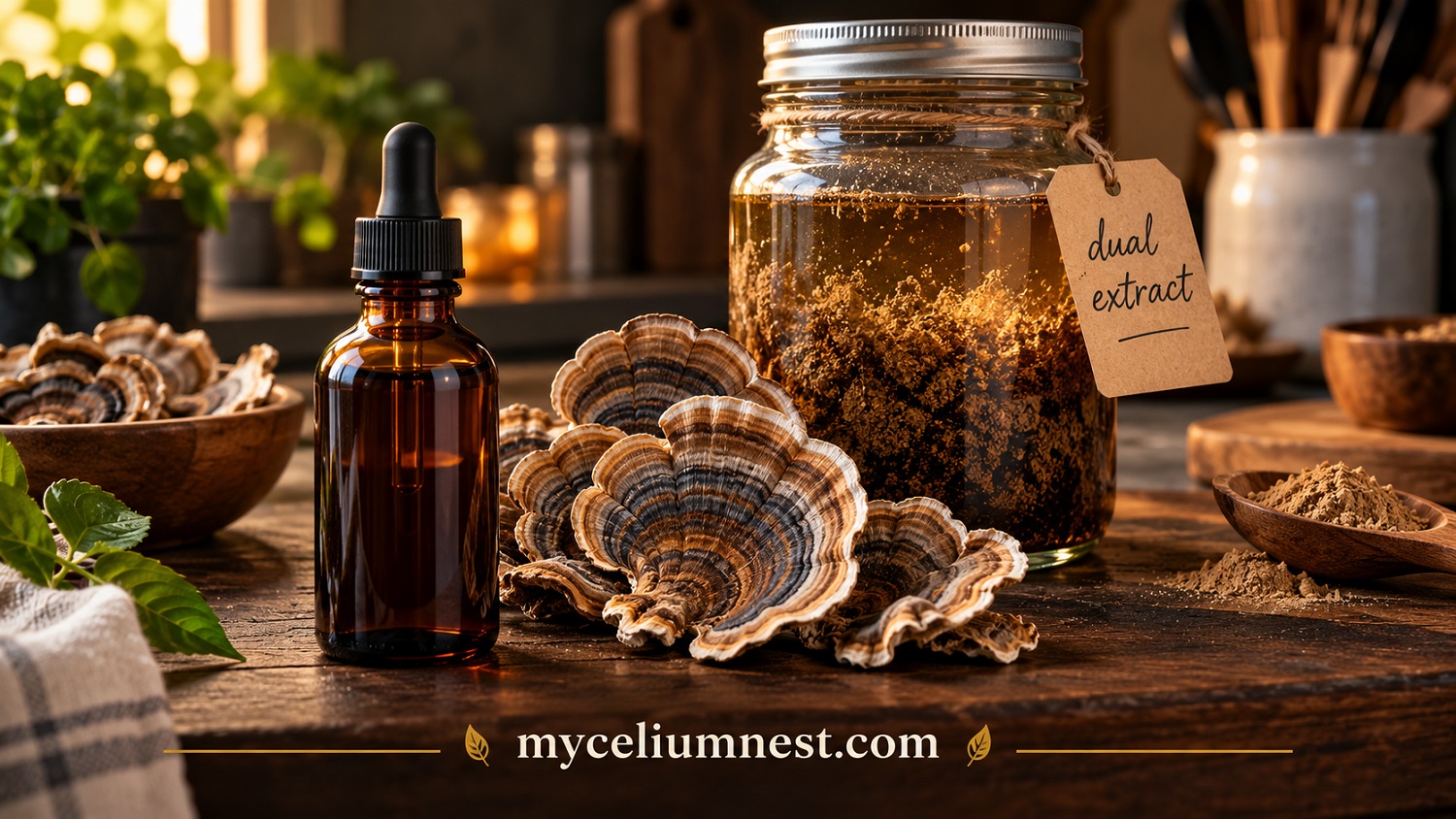
Turkey Tail Tincture: A plain alcohol tincture is the weakest way to prepare turkey tail. The compounds it is best known for, the polysaccharides PSK and PSP, are water-soluble, and the product used in clinical research in Japan is a purified hot-water extract. So hot water is the essential step here, not the optional one. Alcohol earns its place in a second phase: it pulls out fat-soluble compounds that water leaves behind, and it preserves the finished product. That combination is a dual extract, and this guide shows you how to make one, with the alcohol math worked out so you can check your own batch.
- Before You Make Anything: Confirm It’s Turkey Tail
- What Water and Alcohol Each Do for Turkey Tail
- Your Three Paths: Decoction, Dual Extract, or Capsule
- Supplies You Need
- The Dual Extraction, Step by Step
- The Alcohol Math: Checking Your Final Strength
- Serving Size and Storage
- Safety: Who Should Skip This or Ask First
- Frequently Asked Questions
Before You Make Anything: Confirm It’s Turkey Tail
If you are working with foraged material, identification comes first, because a tincture concentrates whatever you put in it. Turkey tail (Trametes versicolor) is a thin, flexible bracket with concentric bands of colour that grows in overlapping rosettes on dead hardwood. The single most useful field check is the underside: true turkey tail has a pale surface covered in tiny pores, while its best-known look-alike, false turkey tail (Stereum ostrea), is smooth underneath.
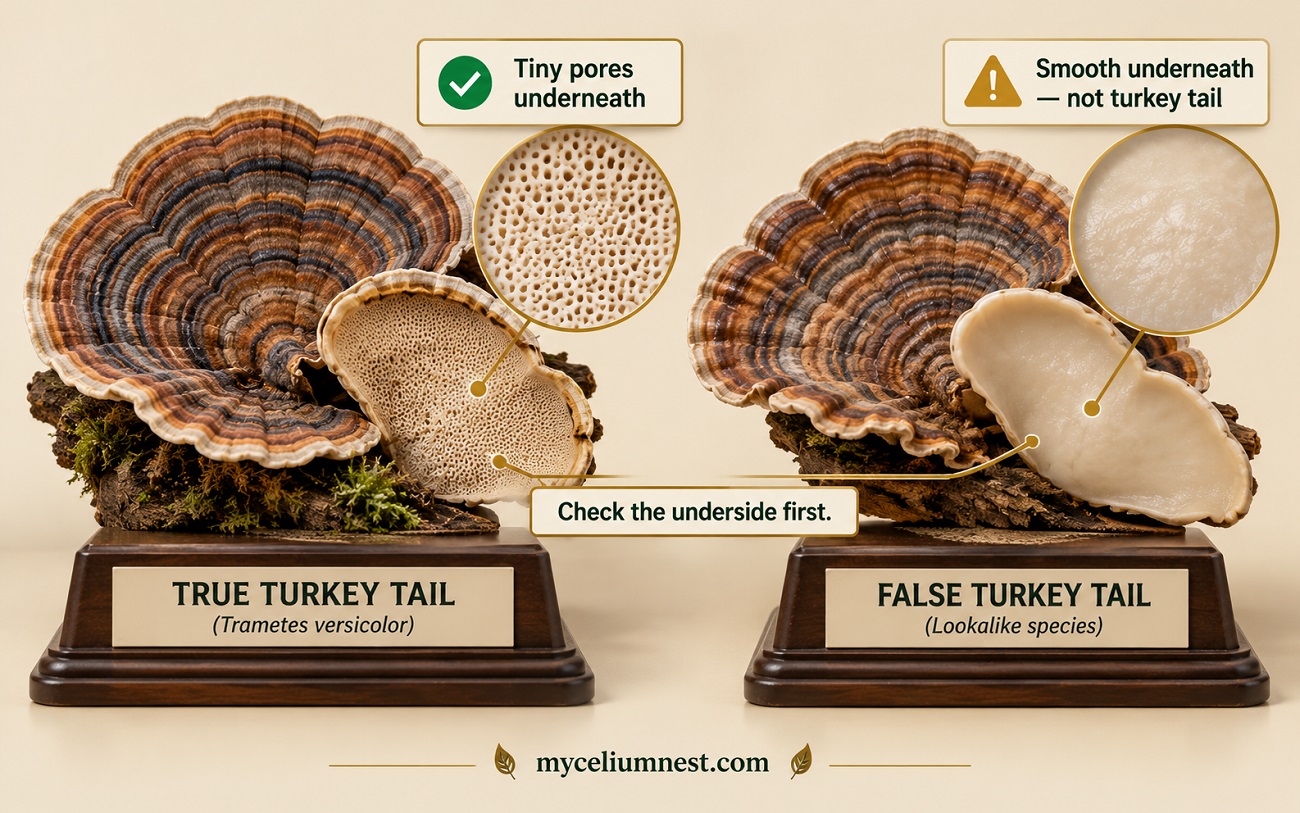
One feature is never enough. The underside is the fastest check, not the only one, and other look-alikes exist. Work through the full checklist in our turkey tail identification guide, and see our foraging safety framework for the general rules. Harvest from clean, unpolluted woodland well away from roadsides and industrial sites, since mushrooms can concentrate contaminants from their surroundings. Take only what you need, and dry it thoroughly (cracker-dry, in a dehydrator or a warm, airy spot) before storing or extracting.
Not foraging? Dried, cut turkey tail is sold for exactly this purpose, and the method below works identically with it.
What Water and Alcohol Each Do for Turkey Tail
Turkey tail is woody and far too tough to eat, which is why it has always been prepared as a hot-water decoction or extract. Memorial Sloan Kettering’s About Herbs entry identifies PSK and PSP as the products believed to be responsible for turkey tail’s immune effects, and the National Cancer Institute’s medicinal mushrooms summary describes the Japanese PSK product as a purified hot-water extract. That is the basis for treating the water phase as essential.
| Solvent | What It Mainly Pulls Out | Why It Matters for Turkey Tail |
|---|---|---|
| Hot water (decoction) | Beta-glucans and the protein-bound polysaccharides PSK and PSP | Essential. These are the compounds the species is known for |
| Alcohol (tincture phase) | Triterpenes, sterols and some phenolic compounds that water does not dissolve | Optional but useful for a fuller profile, and it preserves the finished product |
| Alcohol only | Fat-soluble compounds only | Misses the main polysaccharides. The weakest option |
Practitioner sources are not unanimous. Some supplement makers argue the alcohol step “adds little” for turkey tail because its key compounds are water-soluble. Many herbalists still make dual extracts as the standard fuller-spectrum preparation, and a few guides describe PSK and PSP as soluble in both solvents. We lean on what the clinical product actually is (hot water) and treat alcohol as an additive step rather than a requirement. This is the same logic we applied to chaga and reishi in our chaga tea guide and supplement brand comparison, where alcohol mattered more because those species’ key compounds are alcohol-soluble.
Your Three Paths: Decoction, Dual Extract, or Capsule
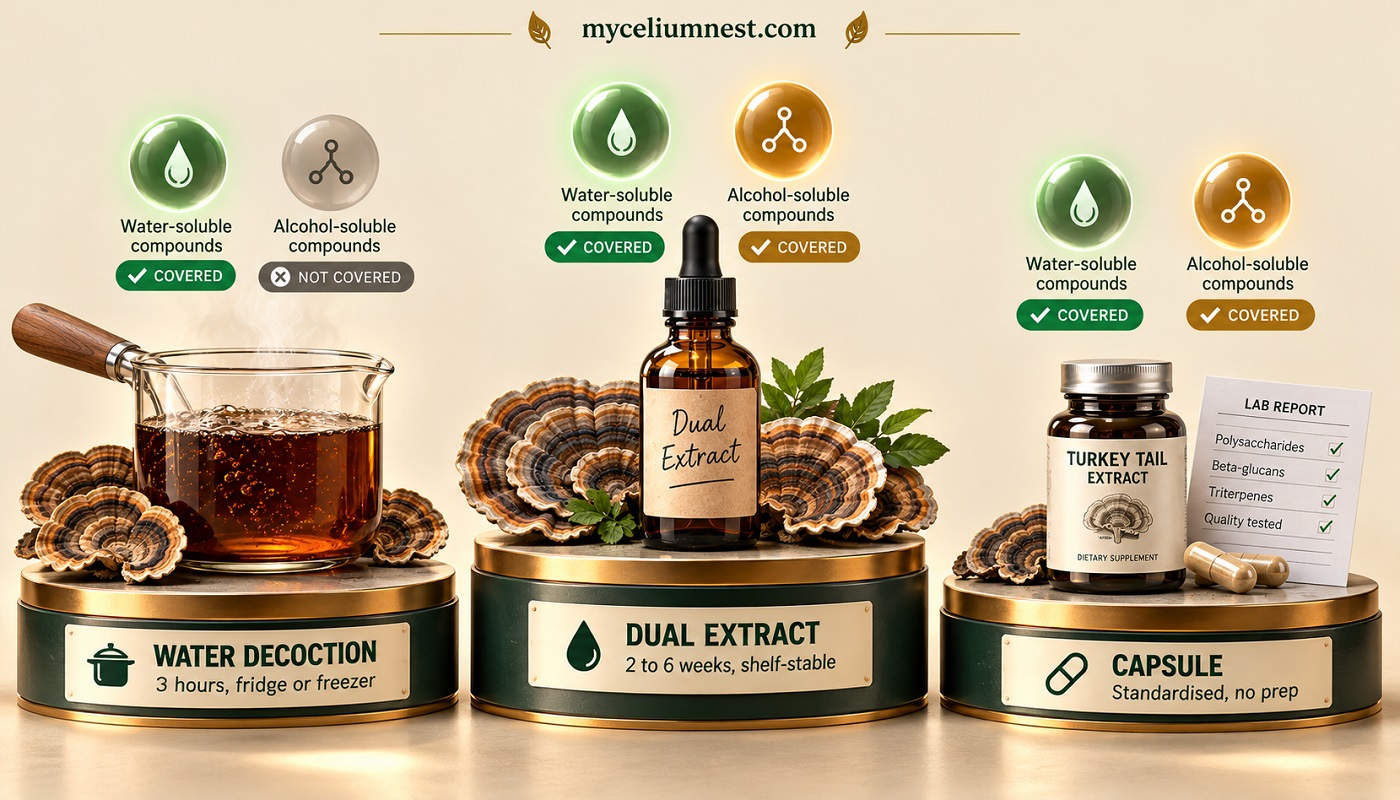
| Path | Effort | Covers | Keeps | Best For |
|---|---|---|---|---|
| Water decoction only | One afternoon | Polysaccharides (PSK, PSP, beta-glucans) | Days in the fridge, months frozen | Anyone avoiding alcohol, and the simplest start |
| Dual extract | 2 to 6 weeks, mostly passive | Polysaccharides plus alcohol-soluble compounds | Years, if final strength is 25%+ | Foragers who want a shelf-stable, fuller-profile extract |
| Capsule | None | Depends on the product, check the label and COA | Per label | Measured, repeatable servings without the prep |
Supplies You Need
- 100 g dried turkey tail, ground to a coarse powder (buy dried turkey tail → if you don’t forage)
- About 400 ml vodka at 40% ABV (80 proof), from your local shop
- About 800 ml filtered water
- Quart mason jar with a tight lid →
- Fine-mesh nut milk bag → for pressing
- Digital kitchen scale →
- Small slow cooker → or a heavy saucepan, for a steady gentle simmer
- Amber dropper bottles →
- Spice grinder → to powder the dried brackets
We use standard 40% vodka on purpose: it is easy to buy, safe to handle, and the maths below is simple. Very high-proof spirits are flammable and not necessary here.
The Dual Extraction, Step by Step
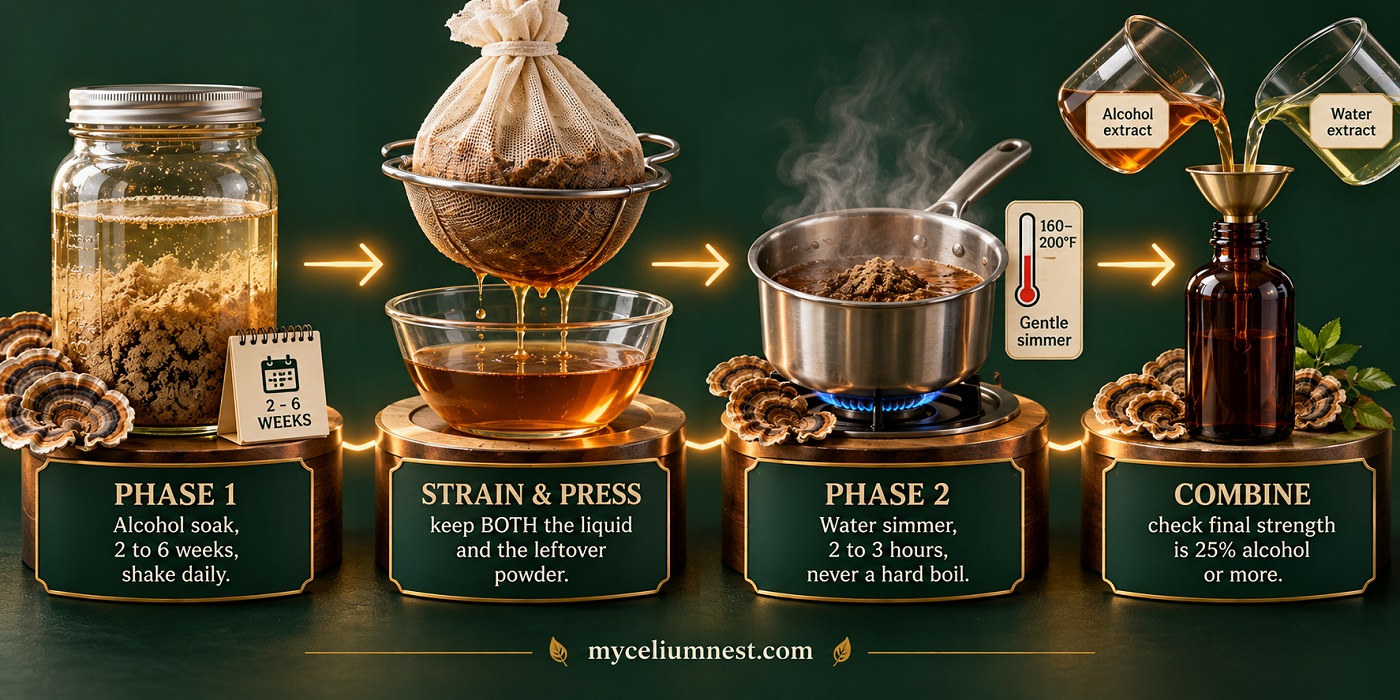
- Weigh out 100 g of dried, coarsely powdered turkey tail into the jar.
- Pour in about 400 ml of 40% vodka, enough to submerge everything with 2 to 3 cm of liquid above the powder. The powder will swell and absorb some liquid.
- Seal, label with the date, and keep it in a cool, dark place. Shake once a day.
- Leave for at least 2 weeks. Several herbalists and makers leave it 4 to 6 weeks, and the longer soak is a reasonable choice because the work is passive.
- Strain through the nut milk bag and press firmly to recover as much liquid as possible. Measure the volume you recover and write it down (call it A). Keep the pressed powder.
Equipment tip: protect the lid. Alcohol and its vapour can corrode a bare metal canning lid over time. Herbalists use two common fixes: a plastic storage cap, or a square of parchment paper between the jar and a metal lid before screwing on the ring. Over a 2 to 6 week soak the risk is modest, and it matters more for long storage, but the fix costs almost nothing. Sources do disagree on plastic, because strongly aromatic herbs can soften it, but that is not a concern with a plain mushroom soak in 40% vodka.
Keep the jar well filled so there is little air under the lid, and check that the powder stays submerged, topping up with a little vodka if it does not.
- Put the pressed powder from Phase 1 in a slow cooker or saucepan with 800 ml of filtered water.
- Bring it slowly to a gentle simmer, not a hard boil, and keep it there with the lid slightly ajar for 2 to 3 hours.
- Strain and press again.
- Reduce in a wide, shallow pan (stainless steel or enamel) rather than a tall saucepan: pour the strained liquid in and simmer on low until about 100 to 150 ml remains. Measure it (call it W).
- Let it cool completely before combining. Adding hot liquid to alcohol drives off some of the alcohol and skews your final strength.
Why the wide pan: evaporation scales with surface area, so a skillet or sauté pan reduces the liquid noticeably faster than a deep, narrow pot. A slow cooker with its lid on is good for the steady 2 to 3 hour simmer but will barely reduce anything, which is why this step moves to a pan. Stir now and then, and stay close near the end: a small volume of concentrated extract can scorch quickly.
- Mix the alcohol extract (A) and the cooled decoction (W) in a clean jar.
- Check the final strength with the formula in the next section. You are aiming for 25% alcohol or more.
- Pour into amber dropper bottles, and label each with the date, “turkey tail dual extract”, the rough ratio, and the alcohol percentage.
- Expect some cloudiness or sediment. Commercial makers describe this as normal. Shake before each use.
Haze or sediment after combining is common, and the likeliest cause is simple chemistry. Large polysaccharides dissolve well in water but become less soluble as alcohol is added. This is how laboratories isolate them: adding ethanol to a water extract makes them clump and drop out, a technique called ethanol precipitation. Labs usually use 70 to 80% ethanol, but the largest molecules start to come out at much lower strengths.
One study of mushroom polysaccharides collected a very high-molecular-weight fraction at just 20% ethanol, so some of the biggest polysaccharides in your extract may well settle out at 25 to 35%.
Proteins, phenolic compounds and fine particles can also cause haze, so we cannot say exactly what is in your jar. In practice: shake before each use rather than filtering the sediment out, and expect it to settle again. There is a trade-off here. A lower alcohol percentage would precipitate less, but below about 25% the extract stores less reliably.
Order is flexible. Some makers simmer the water phase first and then soak the powder in alcohol; the result is a combined extract either way. We put alcohol first because it keeps the water phase at the end, where you can reduce it to the exact volume you need. Compare against another method in the Herbal Reality dual extraction recipe, which uses larger quantities.
The Alcohol Math: Checking Your Final Strength
Alcohol needs to stay above roughly 25% for the finished extract to be stable on a shelf. Herbalists commonly aim for 25 to 35%. Because you reduce the decoction by an unpredictable amount, measure rather than guess:
Final strength (%) = (A × 40) ÷ (A + W)
A = ml of alcohol extract recovered. W = ml of reduced decoction. The 40 is your vodka’s strength in percent.
| Recovered Alcohol (A) | Reduced Decoction (W) | Total | Final Strength |
|---|---|---|---|
| 300 ml | 100 ml | 400 ml | 30% |
| 300 ml | 150 ml | 450 ml | 26.7% |
| 300 ml | 250 ml | 550 ml | 21.8% (too low, reduce further) |
If your result comes out under 25%, simmer the decoction down further, or top up with more 40% vodka and recalculate. A batch from 100 g of powder typically yields a little over 400 ml, roughly 1 g of mushroom per 4 ml of liquid. Note that this is an estimate for labelling, not a lab-verified potency.
Serving Size and Storage
There is no established dose for a homemade extract. Potency varies with your mushrooms, your yield and your ratios, and nothing about a kitchen batch is standardised. For reference only, one commercial dual-extract sells a 1 oz (30 ml) bottle as a one-month supply, which works out to roughly 1 ml (a standard dropperful) a day. Start with less than that, take it diluted in a drink, and increase only if it suits you. If you want a measured serving, a capsule with a published beta-glucan percentage is the more reliable choice.
- Dual extract at 25%+ alcohol: store in dark glass, away from heat and sunlight. Herbalists report a shelf life of years at this strength.
- Water decoction only: treat it like homemade stock. Refrigerate and use within about 4 to 5 days, or freeze it in ice-cube portions.
- Dried turkey tail: keep in a sealed jar, dry and dark. Whole dried brackets last far longer than powder.
Safety: Who Should Skip This or Ask First
- Pregnant or breastfeeding. There is no safety data, and the common recommendation, including from Memorial Sloan Kettering, is to avoid it.
- Taking immunosuppressants, or living with an autoimmune condition. Turkey tail modulates immune activity, so interactions are a theoretical concern.
- In cancer treatment. Turkey tail is widely used alongside treatment in some countries, but discuss it with your oncology team first. Do not substitute a homemade extract for care.
- On blood thinners or diabetes medication. Some sources list these as possible interactions. Evidence is limited, so ask your pharmacist.
- Mushroom allergy. Reactions are rare but possible.
A dual extract is 25 to 35% alcohol. It is unsuitable for children, anyone avoiding alcohol, people with liver disease, and anyone taking a medication that interacts with alcohol. If any of those apply, use the water decoction path instead, since it carries the compounds turkey tail is best known for without the alcohol. Reported side effects of turkey tail itself are generally mild: occasional digestive upset, dark stools, and, rarely, darkened nails.
Frequently Asked Questions
Is a turkey tail tincture better than a hot-water extract?
Not on its own. An alcohol-only tincture misses the water-soluble polysaccharides (PSK, PSP, beta-glucans) that turkey tail is best known for, and the clinically studied PSK product is a hot-water extract. A dual extract combines both and is the fuller preparation, but the water phase is the one that cannot be skipped.
How long does turkey tail need to soak in alcohol?
A minimum of about 2 weeks, with many herbalists and makers soaking 4 to 6 weeks, shaking daily. The soak is passive, so the longer window costs nothing but patience.
Why is my finished tincture cloudy?
Cloudiness and sediment are common in a dual extract. The likeliest cause is that some large polysaccharides become less soluble when the water decoction meets the alcohol, the same effect laboratories use to isolate them (ethanol precipitation). Proteins, phenolics and fine particles can contribute too. Commercial makers describe sediment as normal.
Shake the bottle before each use rather than filtering it out. If it smells sour or you see mould, discard it. That should not happen at 25%+ alcohol, but it can in a water-only batch kept too long.
Is homemade turkey tail extract the same as PSK?
No. PSK is a standardised, purified product made from cultivated mycelium by a specific manufacturer, and it is the form studied in Japanese clinical research. A home decoction contains turkey tail’s water-soluble polysaccharides but is neither purified nor standardised, so research on PSK cannot be assumed to apply to it.
Can I just drink turkey tail tea instead?
A long simmer is the traditional preparation and is the same water extraction as Phase 2 above. A quick steep of a tea bag is much weaker, because turkey tail is tough and woody and needs a long, gentle simmer to release its compounds. If you want the water extract without alcohol, simmer powdered turkey tail for 2 to 3 hours and keep it refrigerated or frozen.
A capsule gives you a measured serving with a published beta-glucan percentage and a batch lab report, which a kitchen batch cannot. These are the brands we recommend, and why:
See our best turkey tail supplement guide for the full comparison, and our fruiting body vs mycelium analysis for how to read a label.
This article contains affiliate links, including Amazon links for equipment. We earn a commission on qualifying purchases at no extra cost to you. Product recommendations are independent. See our full disclosure.