How to Make Chaga Tea: Traditional Method vs Extract Powder

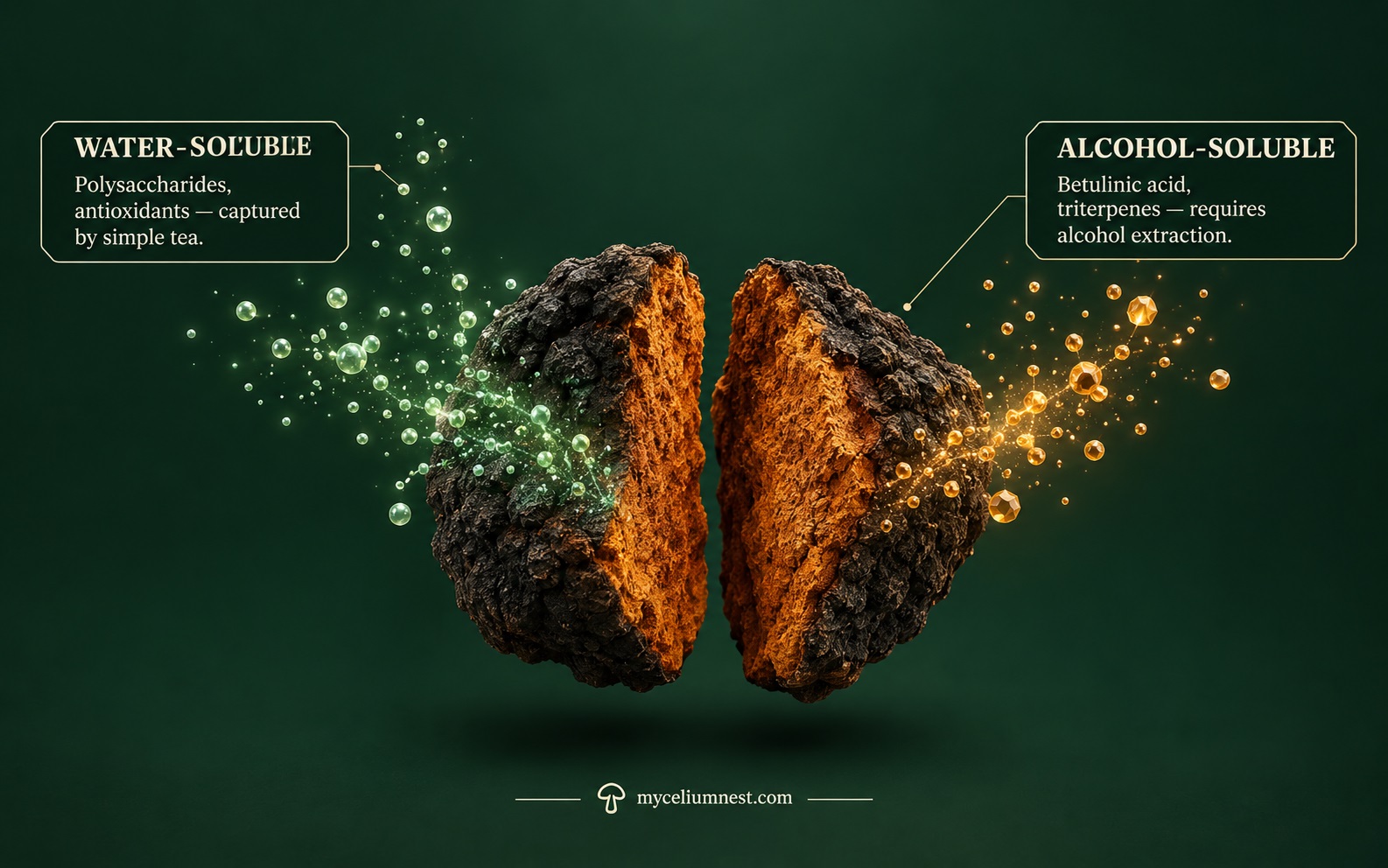
How to make Chaga Tea: Plain hot water only extracts half of what chaga actually offers. Water pulls out the water-soluble polysaccharides and antioxidants — the compounds a simple simmered tea captures well. But betulinic acid and the triterpenes, some of chaga’s most talked-about compounds, are fat-soluble and require alcohol to extract at all. This isn’t a minor technicality — it’s the entire reason a “just steep it” approach to chaga leaves real value on the table, and why the dual extraction method further down this guide exists.
- Why Chaga Preparation Is Different From Every Other Mushroom Here
- The Temperature Rule Most Guides Get Half-Right
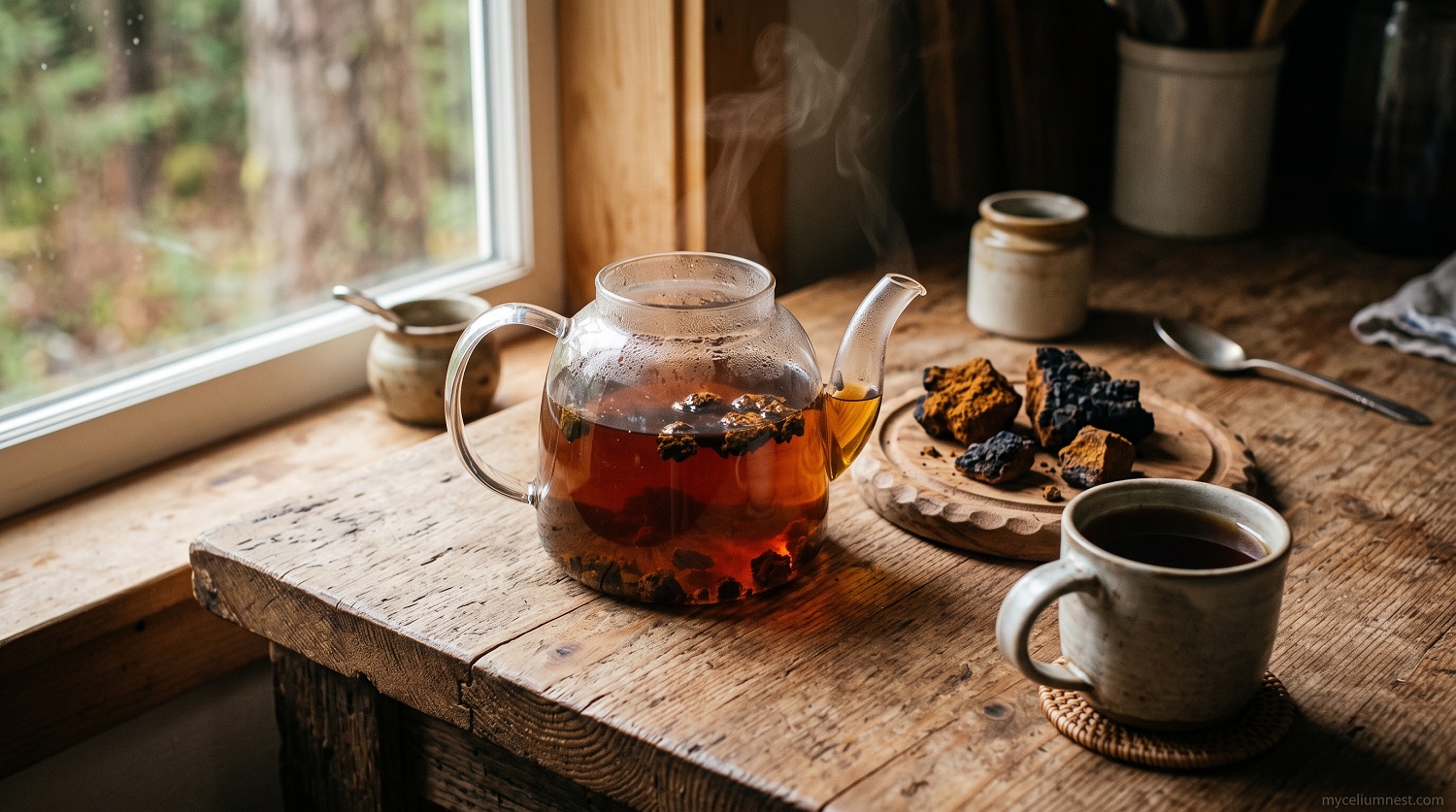
- Method 1 — Traditional Simmered Chunk Tea
- Method 2 — Quick Powder Method
- Method 3 — Dual Extraction (Complete-Spectrum)
- The Efficiency Comparison — Which Method Actually Extracts More?
- Storage — Chunks vs Powder
- When Tea Isn’t Enough — Comparing to Supplement Capsules
- Frequently Asked Questions
Why Chaga Preparation Is Different From Every Other Mushroom Here
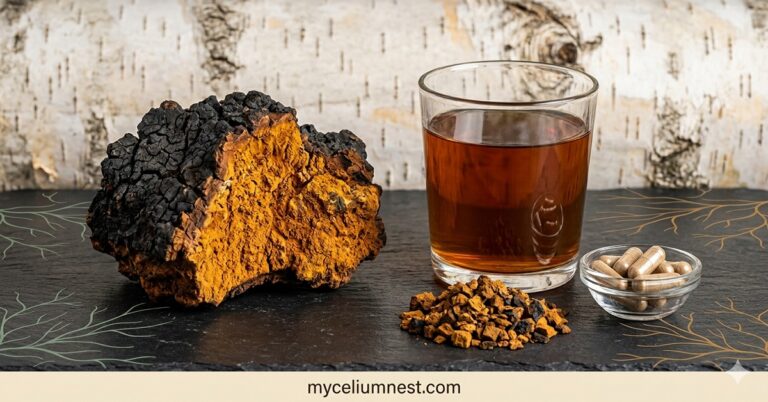
Every other species covered on MyceliumNest — oyster, lion’s mane, shiitake — is a fruiting body: the reproductive structure a mushroom sends up to release spores, and the part you’d sauté in a pan in minutes. Chaga isn’t a fruiting body at all. It’s a sclerotium — a dense, hardened mass the fungus builds up over years inside a living birch tree, packed tight with concentrated compounds precisely because it isn’t a soft, fast-growing structure.
That density is exactly why chaga can’t be quickly pan-cooked like a fresh mushroom, and why it needs a long, patient extraction process instead. It’s also why chaga sits outside the usual fruiting body vs mycelium distinction that governs quality for every other supplement on this site — chaga is neither; it’s its own structural category entirely, and it cannot currently be commercially cultivated at scale the way oyster or shiitake can. Every gram of real chaga was wild-harvested from a birch tree.
Why birch sourcing matters: Betulinic acid takes its name from Betula, the birch genus itself. Foragers and mycologists have hypothesised that chaga concentrates this compound from its host tree during the years it spends growing inside living birch bark — though this remains a working hypothesis in the foraging and mycology community rather than a definitively settled mechanism. What’s well established regardless of the exact “why”: wild birch-sourced chaga is the only source that has been studied for these compounds. Chaga cannot currently be commercially cultivated on grain the way oyster or shiitake can, so there’s no cultivated equivalent to compare it against.
The Temperature Rule Most Guides Get Half-Right
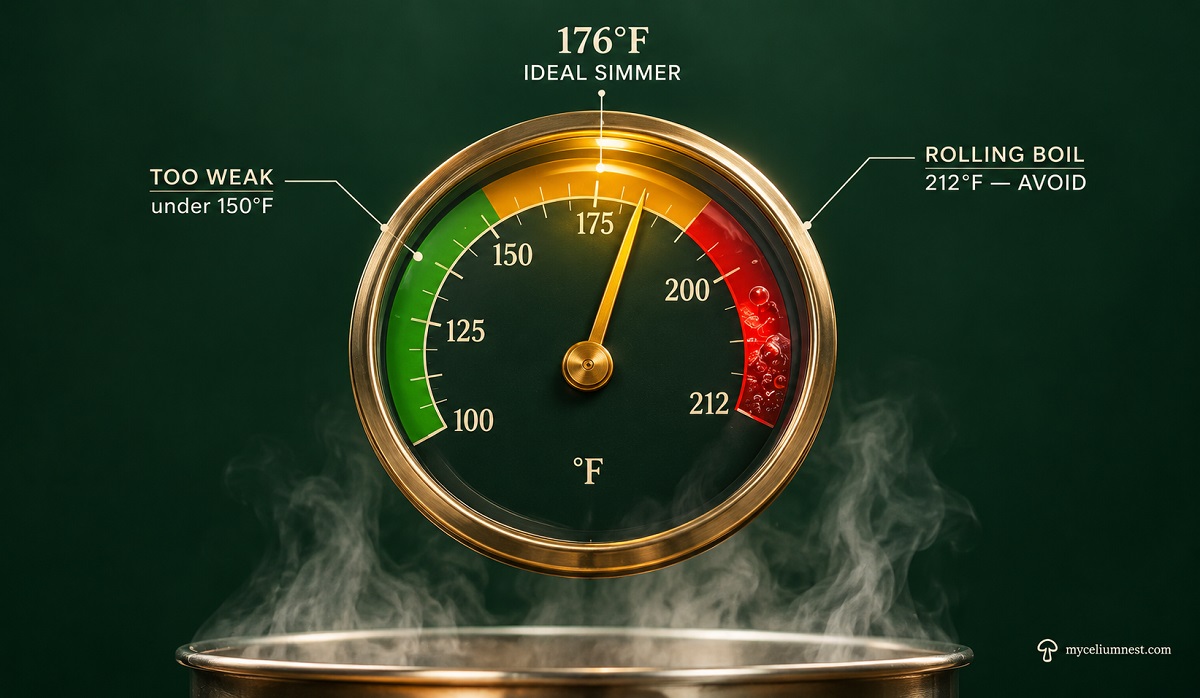
Nearly every chaga preparation guide agrees on one non-negotiable rule: never let the water reach a rolling boil. Keep it at a gentle simmer, roughly 80°C (176°F) — hot enough to extract efficiently, but below the point where prolonged high heat begins degrading some of the more heat-sensitive beneficial compounds. This is consistently repeated across independent foraging and preparation sources, and it’s the single most common mistake beginners make: they treat chaga like a regular tea and pour boiling water straight over it, or let a pot roll at a full boil for hours.
Method 1 — Traditional Simmered Chunk Tea
The Method Chaga Has Been Prepared By For Centuries
- 1 oz (about 4–5 chunks) dried chaga
- 4–6 cups filtered water
- A pot with a lid
- Combine chaga chunks and water in the pot
- Bring slowly to a gentle simmer — never a rolling boil
- Cover and simmer 30 minutes minimum, up to several hours for a darker, more concentrated brew
- Strain and serve; the tea should be a deep reddish-brown, like black tea
Keep it food-safe: Store damp, used chunks in the refrigerator for no more than 3–4 days between brews. If you won’t be brewing again that soon, freeze the chunks instead of leaving them damp in the fridge. Check for any surface mold before re-simmering — discard rather than risk it.
This isn’t a vague caution — it’s documented in peer-reviewed medical literature. Chaga has an unusually high oxalate content, measured in one case report at 14.2g per 100g. Multiple published case reports describe patients developing oxalate nephropathy (kidney damage from calcium oxalate crystal deposits) after sustained high-dose chaga consumption — one case involved 10–15g of chaga powder daily for three months; a 2026 experimental study in a rat model went further and confirmed the causal mechanism directly, not just correlation.
The documented cases involved doses well above typical daily tea serving sizes, and isolated case reports don’t establish that normal moderate consumption carries the same risk. Still, the sensible practice is real: keep daily intake moderate (roughly 1–2 cups of prepared tea), stay well hydrated, and if you have a personal or family history of kidney stones, renal disease, or you’re on blood thinners or diabetes medication, talk to your doctor before making chaga tea a daily habit.
Method 2 — Quick Powder Method
For mornings when a multi-hour simmer isn’t realistic, finely ground chaga powder extracts far faster than whole chunks simply because of surface area — more of the material is directly exposed to hot water at once.
Add 2–3 teaspoons of ground chaga powder to a tea ball, infuser, or French press. Heat water to just below boiling (never a hard boil), pour over the powder, and steep 5–10 minutes. This won’t reach the same concentration as a long chunk simmer, but it’s a genuinely workable everyday option, and pairs easily with coffee or smoothies the way our mushroom coffee guide covers for other species.
Check chaga powder on Amazon → Check tea infusers on Amazon →Method 3 — Dual Extraction (Complete-Spectrum)
This is the method that actually captures both compound classes — the water-soluble polysaccharides and antioxidants, and the alcohol-soluble betulinic acid and triterpenes that plain tea leaves behind entirely.
- Alcohol phase first: Cover chaga chunks or coarse powder with 40–50% alcohol (vodka or grain alcohol) in a sealed jar. Store away from light, shaking daily, for 2–4 weeks.
- Strain and reserve the alcohol extract, keeping the spent chaga solids.
- Water phase second: Transfer the alcohol-soaked chaga solids to a pot with an equal volume of water to the alcohol used. Simmer gently (never boiling) until the volume reduces by roughly half — this is your water decoction.
- Combine both liquids — the alcohol extract and the water decoction — into one jar. This is your finished dual-extraction tincture, now carrying both compound classes.
- Dose small. A dual-extraction tincture is concentrated — 1 teaspoon in a glass of water or tea is a typical serving, not a cup at a time.
The Efficiency Comparison — Which Method Actually Extracts More?
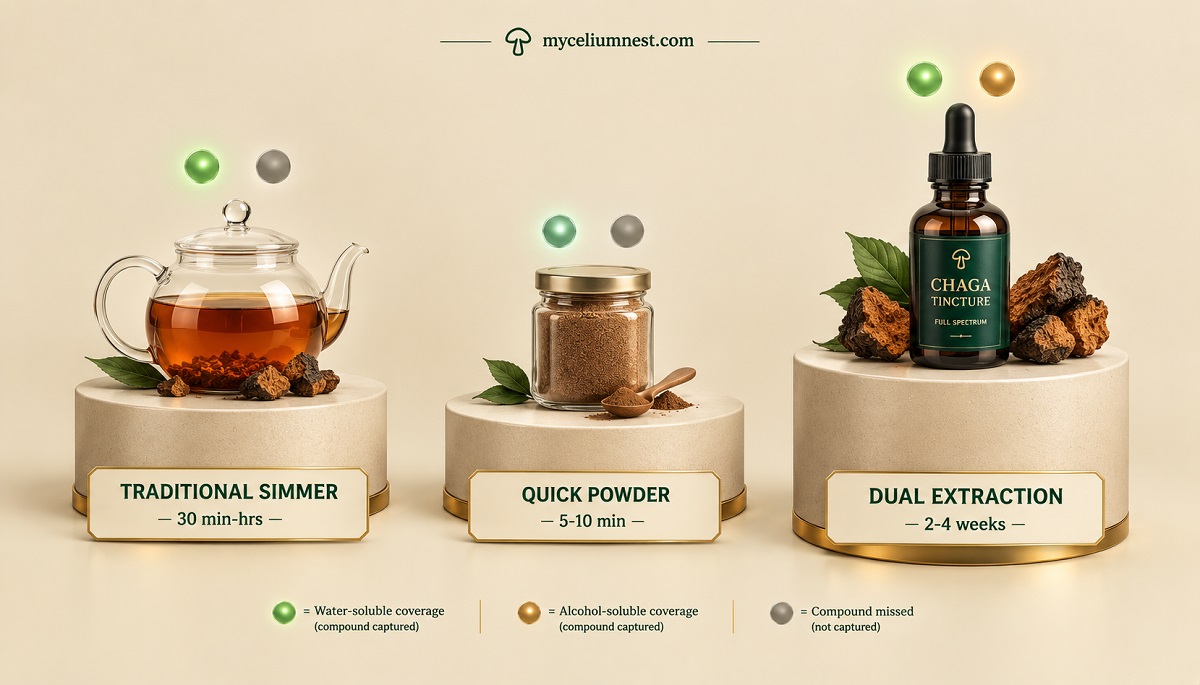
| Method | Time Investment | Water-Soluble Compounds | Alcohol-Soluble Compounds | Best For |
|---|---|---|---|---|
| Traditional Chunk Simmer | 30 min–several hrs | Good — improves with longer simmer | None captured | Daily ritual, lowest cost, most traditional |
| Quick Powder Method | 5–10 min | Moderate — shorter contact time than long simmer | None captured | Weekday mornings, coffee/smoothie mix-ins |
| Dual Extraction | 2–4 weeks (mostly passive) | Full — via the water decoction phase | Full — via the alcohol phase | Maximum compound coverage, concentrated daily dose |
Neither plain tea method captures the alcohol-soluble compounds at all, regardless of how long you simmer — no amount of extra water-simmer time substitutes for the alcohol phase, because it’s a solubility limitation, not a time limitation. If maximum compound coverage matters more to you than convenience, dual extraction is the only method of the three that delivers it. If you want the full mechanism behind why solvent choice determines which compounds you extract, see the water-soluble vs alcohol-soluble breakdown in our supplement brand comparison guide.
Storage — Chunks vs Powder
When Tea Isn’t Enough — Comparing to Supplement Capsules
Homemade chaga tea and dual-extraction tinctures are genuinely rewarding to prepare, but they’re difficult to dose with precision — you’re relying on chunk size, simmer time, and personal brew strength rather than a standardised, lab-verified beta-glucan or compound percentage. For anyone who wants consistent, measurable dosing without the multi-week extraction process, a properly sourced fruiting-body-equivalent chaga capsule is the more practical daily option. See our Best Chaga Mushroom Supplement guide for COA-verified brand recommendations, or our supplement stacks guide for combining chaga with other species toward a specific goal.
Frequently Asked Questions
Why shouldn’t I just boil chaga tea like regular tea?
A rolling boil, sustained over the long extraction time chaga needs, is more likely to degrade some of the more heat-sensitive compounds compared to a gentle simmer around 80°C (176°F). This is why every established preparation guide, regardless of source, consistently recommends a slow simmer rather than a hard boil — it’s one of the few points of genuine consensus across otherwise varied preparation instructions.
Can I reuse the same chaga chunks more than once?
Yes — this is standard practice, not a shortcut. Refrigerate the used chunks in a sealed jar and reuse for 2–3 additional batches, simmering fresh water each time. You’ll know the chunks are spent when the water no longer darkens noticeably during simmering. A single ounce of chaga chunks can reasonably produce a week or more of tea this way.
Is chaga tea alone as effective as a chaga supplement?
Plain water-based chaga tea only extracts the water-soluble compound class — it misses betulinic acid and the triterpenes entirely, since those require alcohol to extract. A quality fruiting-body or sclerotium-sourced capsule with a published extraction method may capture a broader compound profile than a simple simmered tea, depending on how that specific product was processed. If maximum coverage matters to you and you don’t want to prepare a dual extraction yourself, see our chaga supplement guide for verified options.
How much chaga should I use per cup?
Preparation guides vary somewhat, but a reasonable standard is roughly 1 ounce (4–5 chunks) of dried chaga per 4–6 cups of water for a full pot, or about 1 tablespoon of chunks per 2–3 cups for a smaller single-pot batch. The tea should end up a deep reddish-brown, similar in depth to black tea — a pale, weak color usually means either too little chaga or too short a simmer time.
This article contains Amazon affiliate links. See our full disclosure.