Best Chaga Mushroom Supplement (2025): Wild vs Cultivated, Betulinic Acid & The Sustainability Problem

Chaga (Inonotus obliquus) is not a mushroom in the traditional sense — it is a sclerotium, a hardened mass of mycelium that grows parasitically on birch trees. This distinction matters profoundly for supplement quality because chaga’s most unique bioactive compound — betulinic acid — comes directly from the birch tree, not from the fungus itself. Cultivated chaga grown on artificial substrate cannot contain betulinic acid. This single fact should guide every chaga supplement purchase. We ranked the best chaga mushroom supplements based factors highlighted in this guide and proven results.
What Chaga Actually Is — and Why the Biology Changes Everything
Understanding chaga’s biology is the foundation of understanding why supplement quality varies so dramatically and why “wild chaga” is not just a marketing claim — it is a genuine quality distinction with chemical consequences.
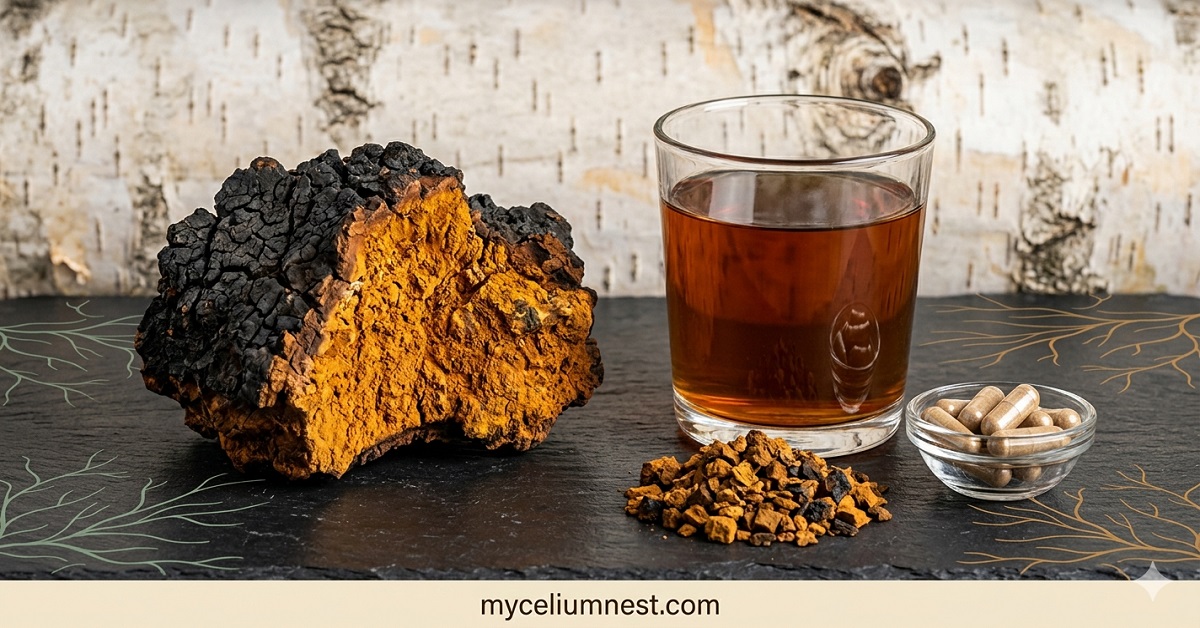
Chaga grows exclusively on living birch trees in boreal forests across Northern Europe, Russia, Canada, and the Northern United States. It is a parasitic organism — it infects the birch tree through wounds and grows for decades inside and on the tree’s trunk, forming a large irregular black mass (the sclerotium) on the outside of the bark. Inside the black exterior is the characteristic orange-rust flesh that chaga supplements are made from.
The critical ecological relationship: as chaga grows inside the birch tree, it metabolises compounds from the birch itself — particularly betulin and betulinic acid, derived from the birch bark’s outer layer. These compounds accumulate in the chaga sclerotium over years of growth. This process cannot be replicated in cultivation because cultivated chaga grows on artificial substrate (grain, hardwood sawdust, agar) that contains no betulin source.
Chaga’s Key Bioactive Compounds Explained
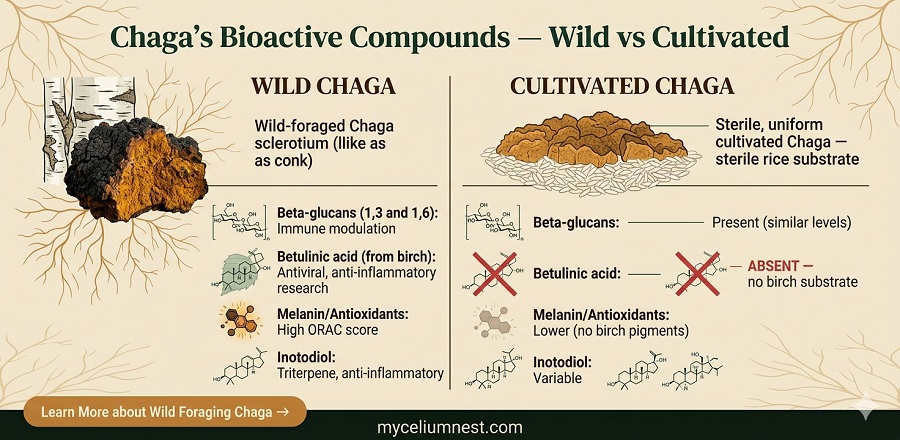
| Compound | Source | In Wild Chaga? | In Cultivated Chaga? | Research Focus |
|---|---|---|---|---|
| Beta-glucans | Fungal cell walls | ✓ Yes | ✓ Yes | Immune modulation, anti-inflammatory |
| Betulinic acid | Birch bark (absorbed by chaga) | ✓ High concentration | ✗ Absent | Antiviral, anti-inflammatory, antitumour (research stage) |
| Melanin / Antioxidants | Chaga sclerotium + birch pigments | ✓ Very high ORAC | ⚠ Lower | Free radical scavenging, antioxidant activity |
| Inotodiol | Chaga-specific triterpene | ✓ Present | ⚠ Variable | Anti-inflammatory, antiviral |
The peer-reviewed research on Inonotus obliquus bioactive compounds — including betulinic acid, beta-glucans, and triterpenoids — is comprehensively reviewed in PubMed PMID 30699059. This is the reference standard for understanding what the science actually shows about chaga’s compounds.
Wild vs Cultivated Chaga: The Quality Debate Settled
For chaga specifically — unlike most mushroom species where cultivation can produce quality equivalent to wild — the wild vs. cultivated distinction is chemically meaningful:
- Betulinic acid from birch bark ✓
- Decades-accumulated bioactive compounds ✓
- High melanin and antioxidant content ✓
- Complete compound profile as researched ✓
- Typically more expensive and harder to source
- Beta-glucans present ✓
- No betulinic acid ✗
- Lower overall antioxidant content
- Consistent, scalable supply
- Less expensive but genuinely less complete
Our recommendation: for beta-glucan immune support alone, cultivated chaga is adequate and more sustainable. For the complete chaga compound profile — including betulinic acid — wild-sourced is required. Choose based on your specific intention.
The Oxalate Warning Nobody Mentions
This is the section that most chaga supplement reviews — even comprehensive ones — omit entirely. Chaga contains extremely high levels of oxalates — significantly higher than spinach, beets, or most other high-oxalate foods. For individuals prone to kidney stones (particularly calcium oxalate stones, the most common type), high-dose regular chaga consumption can meaningfully increase kidney stone risk.
- Anyone with a history of calcium oxalate kidney stones
- Those with chronic kidney disease or compromised renal function
- Anyone consuming very high doses (above 2,000mg extract daily) for extended periods
- Individuals on oxalate-restricted diets for any medical reason
The Chaga Sustainability Crisis
Wild chaga takes decades to develop — a large harvestable chaga conk represents 10–20+ years of growth on a birch tree. The dramatic increase in global demand for chaga supplements over the last decade has driven overharvesting across Northern Europe, Russia, and Canada that is genuinely threatening wild chaga populations in accessible forest areas.
Responsible harvesting guidelines for those who forage their own chaga:
- Never harvest more than 1/3 of a chaga conk — leave the majority attached to the tree so the organism can regenerate
- Only harvest from living birch trees — chaga on a dead birch has no remaining birch compound transfer
- Do not harvest conks smaller than 15–20cm — these are too young to harvest sustainably
- Mark your trees and space harvests at least 3 years apart
For supplement buyers: choose brands that can verify sustainable wild-harvest sourcing with documentation — not just marketing claims. Increasingly, responsible chaga brands partner with certified ethical harvesters in Finland, Scandinavia, or Canada with documented harvest limits.
Top 3 Chaga Supplements Ranked
Frequently Asked Questions
What does chaga tea taste like?
Chaga tea has a mild, slightly earthy flavour with a subtle vanilla-like undertone and a faint bitterness. It is one of the most palatable of all medicinal mushroom teas — far less bitter than reishi and less grassy than green tea. The dark amber colour resembles strong black tea. Many people drink it as a coffee substitute or alongside morning coffee. The flavour is naturally subtle enough that it pairs well with oat milk and honey without masking the underlying mushroom character.
Is there chaga in North America or only in Russia?
Chaga grows abundantly across the boreal forests of Canada and the Northern United States — particularly in Minnesota, Wisconsin, Michigan, Maine, Vermont, and New Hampshire, and throughout most of Canada’s forested regions. The northern Minnesota-Wisconsin lake country is one of the most accessible and productive chaga habitats in North America. Chaga in Russia and Siberia is more famous historically but North American wild chaga from birch-rich boreal forest is chemically equivalent. When buying supplements, Canadian or American wild-harvested chaga avoids the supply chain and quality control challenges of some Russian imports.
This article contains Amazon affiliate links. Rankings are not influenced by commission rates. See our full disclosure.