Master Mix Mushroom Substrate: The Complete Recipe, Science & Species Guide

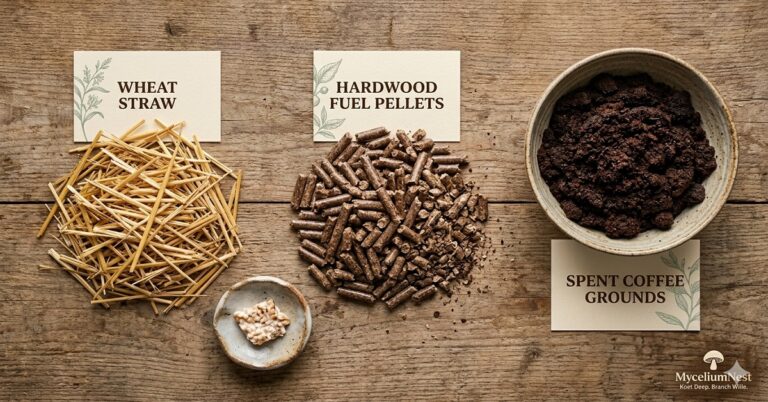
50% Hardwood Fuel Pellets (HWFP) + 50% Soybean Hulls by dry weight, hydrated to 65% moisture content (field capacity). This ratio was developed by commercial cultivators and popularised in home mycology communities as the highest-yielding general-purpose supplemented substrate. But 50/50 is the starting point — not the optimum for every species or application.
Why Master Mix Works: The C:N Ratio Science
Understanding why Master Mix outperforms plain hardwood substrate helps you make intelligent modifications for different species and conditions — rather than blindly following a recipe.
Carbon:Nitrogen (C:N) Ratio
Mushroom mycelium uses carbon as its primary energy source and nitrogen for building proteins and enzymes. The relationship between available carbon and nitrogen — the C:N ratio — determines how efficiently mycelium colonises and how productive the resulting fruiting bodies are.
- Plain hardwood sawdust: Very high C:N ratio (~400:1) — abundant carbon, minimal nitrogen. Good for mycelium spread but limits fruit body development because nitrogen is the limiting factor for reproductive tissue.
- Soybean hulls: C:N ratio of approximately 30:1 — much higher nitrogen content. Adding soybean hulls dramatically lowers the overall substrate C:N ratio, removing the nitrogen limitation.
- 50/50 Master Mix: Combined C:N ratio of approximately 100:1 — the sweet spot that provides sufficient carbon for long-term colonisation fuel while ensuring enough nitrogen for dense, heavy fruit body formation.
Water Holding Capacity
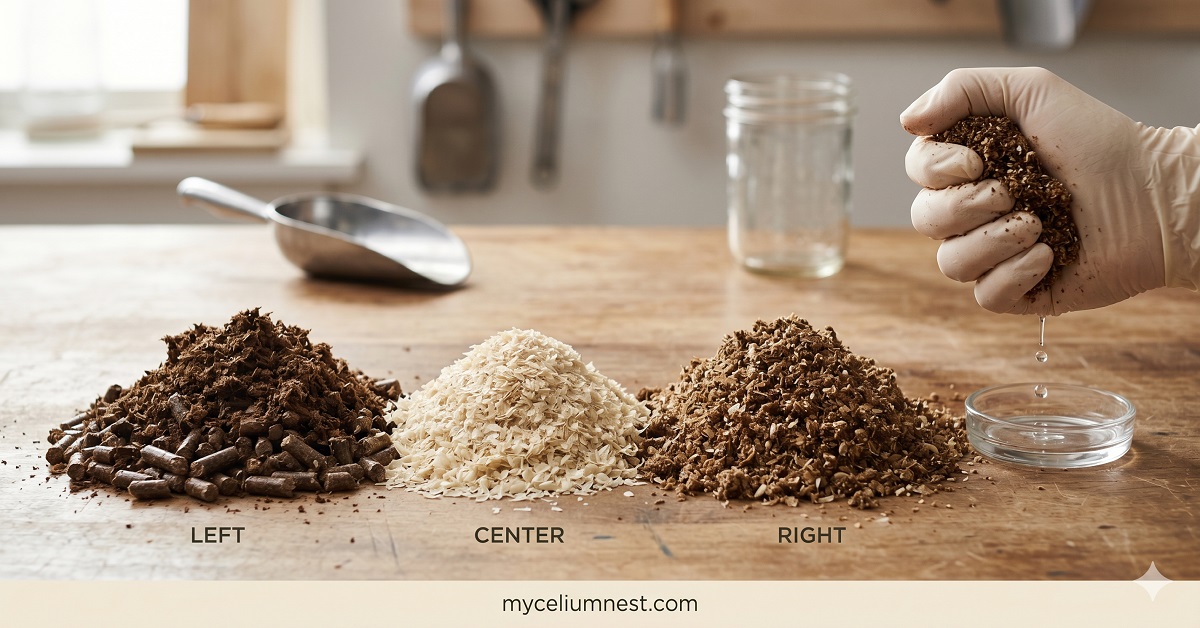
HWFP (hardwood fuel pellets — pure compressed hardwood sawdust with no binders) have excellent water-holding capacity. When hydrated, they expand 3–4× in volume and form a fluffy, moisture-retentive matrix. The pellet format also makes pre-hydration straightforward — you simply add water and wait, rather than trying to uniformly hydrate loose sawdust.
Biological Efficiency on Master Mix vs. Plain Hardwood
Ingredient Guide: HWFP, Soybean Hulls & Substitutes
Hardwood Fuel Pellets (HWFP)
The HWFP used in Master Mix must be 100% hardwood with no binders, softwood, or accelerants. Read every label. The specific type sold for pellet stoves and wood-burning furnaces at hardware stores is what you want. Traeger, Pit Boss, and BBQ pellets must be avoided — these contain flavour additives (hickory, apple, mesquite, etc.) that are antifungal at the concentrations present. The safest choice is unflavoured hardwood pellets specifically sold for heating.
Soybean Hulls
Soybean hulls (also sold as soy hulls or soy hull pellets for animal feed) are the outer coating of the soybean kernel — high in nitrogen, moderate in carbohydrates, and exceptionally well-suited as a mushroom substrate supplement. They are available from farm supply stores and online in 25–50lb bags. A 50lb bag costs approximately $20–30 and provides substrate for dozens of blocks.
Substitutes When Soybean Hulls Are Unavailable
Global Sourcing Guide: Finding Soybean Hulls (or the Best Alternative) in Your Region
Soybean hulls are widely available in North America — they’re a common livestock feed supplement sold at farm supply chains (Tractor Supply Co., Southern States, local co-ops) and online. Outside North America, they range from easily available to nearly impossible to find. Here’s where to look and what to use when you can’t find them:
Universal principle: Whatever nitrogen supplement you use, the target C:N ratio of your finished substrate should be approximately 80:1–120:1. If your substitute has higher nitrogen content than soy hulls (e.g. wheat bran), use less of it. If lower (e.g. cottonseed hulls, sunflower hulls), you can use a similar ratio to the original 50/50. When uncertain, start conservative — a 60:40 base-to-supplement ratio — and adjust based on your contamination rate in the first batch.
The Step-by-Step Master Mix Recipe
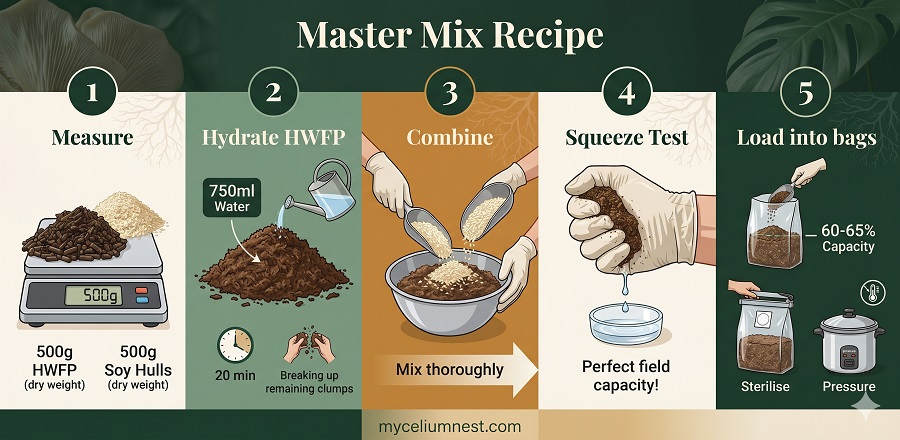
- Measure ingredients (for two 2kg blocks):
- 500g hardwood fuel pellets (HWFP)
- 500g soybean hulls
- 650–700ml water (adjust by squeeze test)
- Hydrate the HWFP first. Place pellets in a large bowl. Pour 500ml of the measured water over them. Allow 15–20 minutes for the pellets to fully absorb and disintegrate into fluffy sawdust. Break up any remaining intact pellets with a fork. The result should be uniformly textured, evenly moist sawdust.
- Add soybean hulls and remaining water. Mix the soy hulls into the hydrated sawdust and pour in the remaining 150–200ml water. Mix thoroughly — the finished substrate should be uniformly brown with no dry patches or pools of free water.
- Perform the squeeze test (see next section). Adjust moisture if needed.
- Load into autoclavable polypropylene bags to 60–65% capacity. Leave adequate headspace and seal.
- Sterilise at 15 PSI for 2.5–3 hours. Supplemented substrate requires longer sterilisation than plain hardwood due to higher available nutrients. 2.5 hours minimum; 3 hours is safer for soy hull ratios above 30%. Use a pressure cooker verified to reach 15 PSI.
- Cool completely (16–20 hours) before inoculation. Inoculate in a still air box or flow hood with colonised grain spawn at a 15–20% spawn rate by weight.
The Squeeze Test: Getting Moisture Content Right
The squeeze test for substrate moisture is the same principle as the grain field capacity test — with a slightly different target. Substrate, unlike grain, should release 1–5 drops when a firm handful is squeezed tightly. One to two drops is ideal; three to five drops is acceptable. Zero drops means substrate is too dry; a stream of water means dangerously wet.
Why the wider range than grain? Substrate is more forgiving because the fibrous structure of sawdust provides better drainage even at higher moisture, and soybean hulls have a structural component that prevents the substrate from becoming anaerobic as easily as wet grain can. However, a stream of water from your squeeze test is still too wet and will create bacterial contamination — particularly problematic with the high nitrogen content of Master Mix.
Species-Specific Ratio Modifications
The 50/50 ratio is ideal for lion’s mane and delivers excellent results for most oyster species. However, specific modifications improve results for other species or in specific growing conditions:
The Contamination Risk Gradient: Why More Isn’t Always Better
One of the most important things to understand about Master Mix is that the soybean hull component creates a proportionally higher contamination risk than plain hardwood substrate. This relationship is linear: double the soy hull ratio and you roughly double the contamination risk.
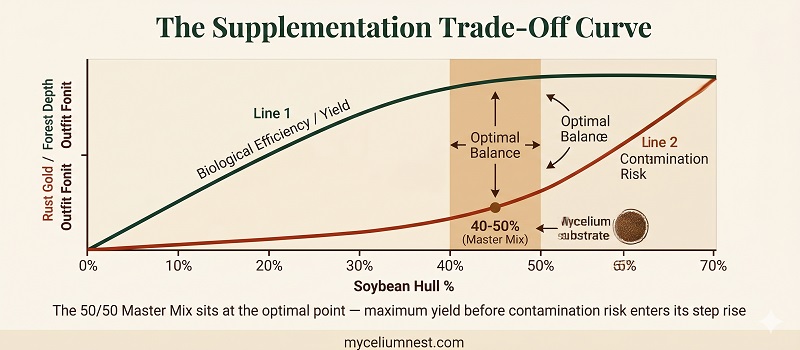
The data shows clearly why 50% soy hulls is the established standard: it captures the majority of the yield benefit from supplementation without entering the steep contamination risk zone that makes higher supplementation counterproductive. Adding more soy hulls beyond 50% produces no additional yield but dramatically increases contamination losses — the net outcome is lower total yield per batch attempted. For growers who understand this gradient, it makes sense to reduce supplementation for slow-colonising species (shiitake, reishi) where the extended incubation period gives contamination organisms more time to establish.
For more detail on managing contamination that can arise from supplemented substrates, see our complete mushroom contamination guide.
Frequently Asked Questions
Can I use BBQ pellets instead of hardwood fuel pellets?
No. BBQ pellets — including Traeger, Pit Boss, Camp Chef, and similar brands — contain added flavour compounds (hickory, apple, mesquite, cherry, etc.) that are antifungal at the concentrations present in the pellets. These compounds inhibit mycelial growth and can prevent colonisation entirely. Only use pellets explicitly sold as wood heating fuel (for pellet stoves and furnaces) that are listed as 100% hardwood with no binders or additives.
Can Master Mix be pasteurised instead of sterilised?
No. The soybean hull component provides a level of nutrition that supports rapid bacterial growth — the same bacteria that pasteurisation (65–82°C) leaves alive. Master Mix and any supplemented substrate must be sterilised at 121°C / 15 PSI to kill heat-resistant bacterial endospores. Pasteurisation is only appropriate for plain, unsupplemented straw (for oyster mushrooms) or plain, unsupplemented hardwood. See our oyster mushroom substrate guide for the pasteurisation method that works for plain straw.
How much spawn do I add to a Master Mix block?
15–20% by weight of the finished substrate is the standard spawn rate for Master Mix. Higher supplementation (more nitrogen) supports higher spawn rates — this is why Master Mix blocks benefit from a slightly higher spawn rate than plain hardwood blocks (which do well at 10–15%). A 2kg Master Mix block should receive 300–400g of colonised grain spawn for optimal colonisation speed. For grain-to-grain transfers, use your freshest spawn possible — Master Mix’s contamination window is shorter than plain hardwood due to higher bacterial competition, and robust, active spawn colonises the block faster than older, slower spawn.
How many flushes can I get from a Master Mix block?
For lion’s mane: 2–3 flushes from a Master Mix block, with the first flush being by far the largest (typically 60–70% of total yield). For oyster mushrooms: 3–5 flushes. Master Mix blocks deplete faster than plain hardwood blocks because the mycelium has access to more readily available nutrition — it grows faster, fruits harder, and exhausts the substrate more quickly. Plain hardwood blocks can sometimes yield 4–8 flushes over a longer period; Master Mix delivers its total yield over fewer, larger flushes. For most growers, fewer large flushes is preferable to many small ones.
Disclosure: This article contains Amazon affiliate links. See our full disclosure.