Best Lion’s Mane Supplement (2025): 7 Brands Ranked by Real Potency

Real Mushrooms Lion’s Mane Extract is our #1 pick — 100% fruiting body, standardised beta-glucans (≥25%), dual-extracted, third-party tested, and completely transparent about what’s in the bottle. It’s the benchmark all other supplements are measured against.
The lion’s mane supplement market is flooded with products that contain more grain starch than actual mushroom. Many products sold as “lion’s mane” are made from mycelium grown on grain substrate that is never separated from the grain — meaning you’re often paying $30–$60 for a product that is 50–70% rice or oat filler.
This guide explains exactly how to identify a genuinely potent lion’s mane supplement, what to look for on the label, and which brands pass our scrutiny. Understanding the science behind why supplement quality varies so dramatically requires reading our deep dive into the research on lion’s mane first — but the practical summary is below.
What Makes a Good Lion’s Mane Supplement?
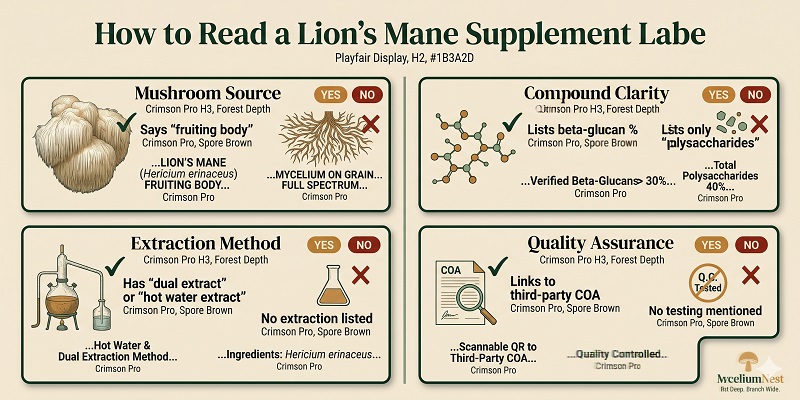
1. Fruiting Body Only (Not Mycelium on Grain)
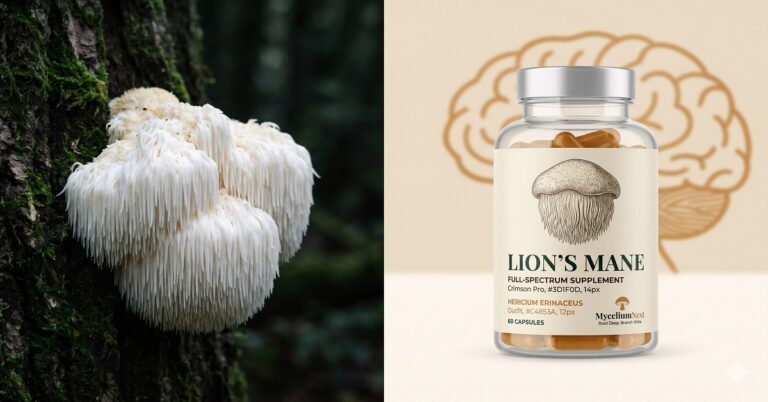
The fruiting body is the actual lion’s mane mushroom — the white, globular structure with cascading spines. It contains hericenones, the primary bioactive compounds studied in human clinical trials. Supplements made from pure fruiting body extract are significantly more potent than those made from mycelium grown on grain.
2. Documented Beta-Glucan Content
Beta-glucans are the primary immunomodulatory polysaccharides in mushrooms and the best available proxy for overall product potency. A quality lion’s mane supplement should specify beta-glucan percentage on the label — look for ≥20% beta-glucans. Products that list “polysaccharides” without specifying beta-glucans are often masking high starch content from grain substrate.
3. Dual Extraction (Water + Alcohol)
Water extraction captures polysaccharides (beta-glucans); alcohol extraction captures terpenoids (hericenones). Dual-extracted products deliver the broadest spectrum of bioactives. Single water-extracted products are acceptable but deliver fewer terpenoids.
4. Third-Party Testing for Purity
Independent lab verification confirms beta-glucan content, absence of heavy metals, and absence of mycotoxins. Any premium supplement should provide a Certificate of Analysis (COA) from an accredited third-party lab on request or publicly on their website.
How to Spot Low-Quality Supplements (Red Flags)
- Lists “mycelium,” “full spectrum mycelium,” or “myceliated grain” as the source — this indicates grain filler
- Lists “polysaccharides” without specifying beta-glucan percentage — starch from grain also registers as polysaccharides
- Does not specify whether it’s fruiting body or mycelium
- Cannot provide a Certificate of Analysis (COA) on request
- Uses phrases like “whole life cycle” or “full spectrum” without clarifying the ratio of fruiting body to mycelium
- Claims to “cure”, “treat”, or “prevent” any medical condition — these claims are illegal under FDA regulations for supplements
Our Top 7 Lion’s Mane Supplements (Ranked)
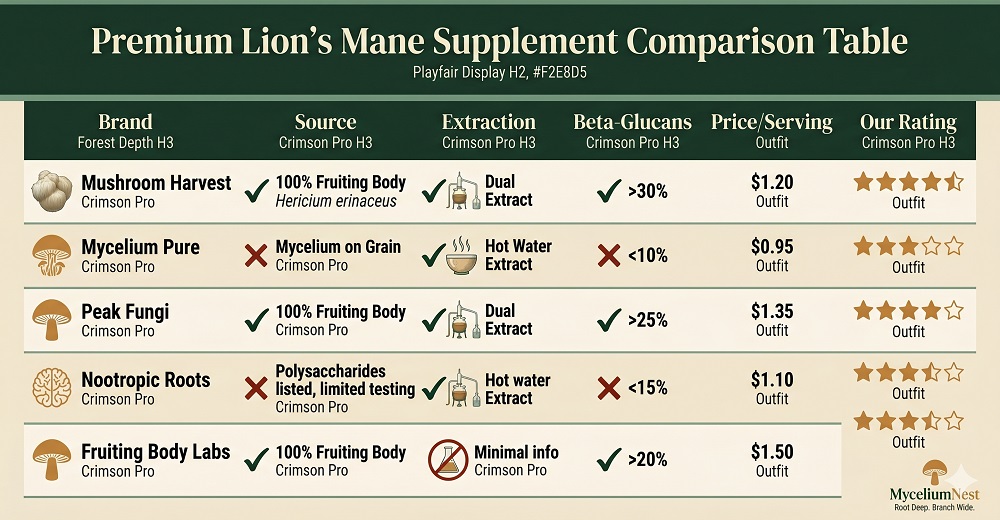
Full Comparison Table
How to Take Lion’s Mane: Dosage Guide
Based on published clinical trials, the effective daily range appears to be 1,000–3,000mg of lion’s mane extract per day. Our specific guidance:
Take with food to minimise any digestive discomfort. Consistency matters more than timing — same time each day is more important than morning vs. evening. A minimum 4-week trial is needed before evaluating whether the supplement is working for you.
Frequently Asked Questions
Is Real Mushrooms the best lion’s mane supplement?
Based on our criteria — fruiting body sourcing, documented beta-glucan content, third-party testing, and price — Real Mushrooms is the best overall value in the lion’s mane category. Freshcap is a close second and may be preferred by those specifically seeking dual-extracted products with higher terpenoid content. Both are significantly superior to most mass-market supplements.
Should I buy lion’s mane powder or capsules?
Both forms deliver the same extract — capsules simply contain pre-measured powder in a gelatin or vegetable cellulose shell. Powder is typically cheaper per serving and can be added to coffee, smoothies, or food. Capsules are more convenient for daily use and have no taste. The extract quality is what matters — not the delivery form. Real Mushrooms offers both, and both test identically for beta-glucan content.
Can I take lion’s mane with other supplements?
Lion’s mane has no known harmful interactions with most common supplements. Some growers take it alongside reishi and cordyceps as a functional mushroom “stack.” If you take blood-thinning medications, anticoagulants, or immunosuppressants, discuss with your healthcare provider before adding any mushroom supplement — theoretical interactions exist, even without documented clinical cases. See our reishi supplement guide and cordyceps guide for other quality options.
How do I know if my lion’s mane supplement is working?
Unlike some supplements with immediate effects, lion’s mane’s proposed mechanisms (NGF synthesis, neuroplasticity support) operate on longer timescales. The most commonly reported subjective improvements — increased mental clarity, reduced brain fog, better focus during cognitively demanding work — typically develop over 4–8 weeks of consistent use. Keep a simple daily log of your focus and cognitive performance for 8 weeks to detect gradual changes that might otherwise be missed. If you experience no change after 8–12 weeks at 2,000–3,000mg/day of a quality fruiting body extract, lion’s mane may simply not be producing a detectable effect for you individually.
Disclosure: This article contains affiliate links to Amazon and brand affiliate programmes. Commission rates do not influence rankings — we have and would recommend Real Mushrooms and Freshcap at 0% commission. See our full disclosure. This is not medical advice.