Does Lion’s Mane Mushroom Really Work? What the Research Actually Shows

The information in this article is for educational purposes only and does not constitute medical advice. Lion’s mane supplements are not approved by the FDA to treat, cure, or prevent any disease. Always consult your healthcare provider before starting any new supplement, especially if you take medication or have a health condition.
The short answer is: promising but preliminary. Human trials on lion’s mane show statistically significant cognitive improvements in older adults with mild cognitive impairment, and some benefits for mood and processing speed in younger adults. The research base is still small (fewer than 10 quality human trials), dosing is not yet standardised, and most studies used specific high-potency extracts — not whole mushroom powder. The evidence is real. The hype is often exaggerated beyond what it supports.
Lion’s mane mushrooms have exploded into mainstream wellness culture with claims ranging from “brain booster” to “natural antidepressant” to “Alzheimer’s prevention.” Some of these claims reflect actual preliminary research. Others are extrapolations, marketing copy, or outright fabrication.
Probably, you want to ask the question, “does lion’s mane mushroom really work?”. This guide reviews what the human clinical trials on Hericium erinaceus actually show — the methodology, the results, the limitations, and what a reasonable person can conclude from the current evidence. We cite every study we reference so you can read the primary sources yourself.
The Biology: How Hericenones and Erinacines in Lion’s Mane May Stimulate NGF
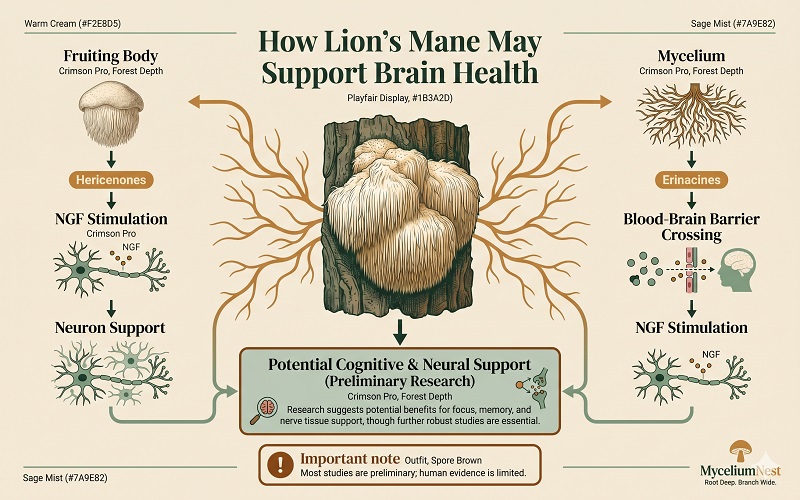
The scientific interest in lion’s mane centres on two classes of bioactive compounds unique to this species:
Hericenones (in Fruiting Bodies)
Hericenones are a group of cyathane diterpenoids found in the fruiting body of H. erinaceus. In laboratory studies, hericenones have demonstrated the ability to stimulate the synthesis of nerve growth factor (NGF) — a protein critically important for the survival, maintenance, and growth of neurons in the brain.
The significance of NGF stimulation, if demonstrated reliably in humans, would be substantial: NGF plays a central role in hippocampal neuroplasticity (the ability of the brain to form and maintain new connections), and declining NGF signalling is associated with age-related cognitive decline and neurodegenerative conditions.
Erinacines (in Mycelium)
Erinacines are found in the mycelium (the vegetative body) of lion’s mane — not the fruiting body. These compounds are low-molecular-weight, highly lipophilic molecules capable of crossing the blood-brain barrier — a property that is relatively rare among natural compounds and that makes erinacines of particular pharmacological interest.
In animal studies, erinacines have shown NGF-inducing effects more potent than those of hericenones in some models. However, most commercial supplements use fruiting body extract — meaning they contain hericenones but minimal erinacines. Products claiming erinacine content typically use mycelium-based extracts.
The Human Trials: What They Actually Found
Trial 1: Mori et al., 2009 — Older Adults With Mild Cognitive Impairment
Double-blind, placebo-controlled
30 adults (50–80 yrs) with MCI
16 weeks, then 4-week washout
Trial 2: Nagano et al., 2010 — Menopause-Related Mood
Double-blind, placebo-controlled
30 women (average age 41.3)
4 weeks
Trial 3: University of Queensland, 2023 — Young Healthy Adults
Randomised, double-blind, crossover
41 adults (18–45 yrs), healthy
28 days
Evidence Summary by Health Claim
Dosage: What the Studies Actually Used
The practical takeaway: studies have used 1.8–3g of lion’s mane daily for 4–16 weeks. Most commercial supplements contain 500–1,000mg per capsule, with typical doses of 1,000–2,000mg/day — within the studied range for the lower end of the dosing spectrum used in trials.
Whole Mushroom vs. Extract: Does It Matter?
This is one of the most important — and most misrepresented — questions in the supplement space. There are three main forms of lion’s mane supplement:
1. Dried Fruiting Body Powder (Whole Mushroom)
Ground dried lion’s mane fruiting body — no extraction. Contains hericenones, beta-glucans, and other naturally occurring compounds, but bioavailability of some compounds (particularly polysaccharides locked in chitin cell walls) may be limited without extraction.
2. Hot Water Extract (Single Extraction)
Water extraction dissolves water-soluble compounds including beta-glucans and some hericenones. More bioavailable than whole powder for polysaccharides. This is the most common extract form and what most “extract” products contain.
3. Dual Extract (Water + Alcohol)
Water extraction captures polysaccharides and beta-glucans; alcohol extraction captures terpenoids (hericenones and potentially related compounds). Dual extraction maximises the spectrum of bioactive compounds and is considered the gold standard by mycologists — though the premium price is only justified if the beta-glucan and hericenone content is documented.
For our complete analysis of which supplement brands deliver proven potency through third-party testing, see our best lion’s mane supplement guide — where we rank brands specifically by fruiting body sourcing, extraction method, and documented beta-glucan content.
Side Effects and Safety
Lion’s mane has an excellent safety profile across all published human trials. No serious adverse effects have been reported at doses up to 3g/day in trials lasting up to 16 weeks.
Reported Minor Side Effects
- Mild gastrointestinal discomfort in a small number of participants in some trials — typically resolves within the first week
- Rare allergic reactions have been reported, primarily in individuals with mushroom allergies
- One case report of respiratory distress in a patient taking very high doses; considered an idiosyncratic reaction
Who Should Exercise Caution
- Individuals with known mushroom allergies
- People on blood-thinning medications (theoretical interaction through platelet effects — no clinical cases reported, but caution warranted)
- Pregnant or breastfeeding women (insufficient safety data)
- Anyone scheduled for surgery (discontinue 2 weeks before)
Label Reading 101: How to Evaluate Any Lion’s Mane Supplement in 60 Seconds
Before spending $30–$60 on a supplement, run through this checklist on any label — in store, on Amazon, or on a brand’s website. A supplement that fails more than one criterion should not be purchased.
Our Verdict
Lion’s mane is one of the most scientifically credible functional mushrooms in research — not because the evidence is conclusive, but because there are published, peer-reviewed, randomised controlled trials in humans showing statistically significant results. This puts it in a different category from many supplements that have zero human clinical evidence.
The key qualifications: most trials are small, short-term, and used specific extract preparations. The cognitive effects observed in MCI populations are the most replicated finding. Effects in healthy young adults for general “brain boost” are less established. The Alzheimer’s prevention claims circulating in wellness media are unsupported by human data.
Frequently Asked Questions
How long does lion’s mane take to work?
In the Mori 2009 trial — the most cited human study — significant improvements were first measurable at 8 weeks of daily supplementation. The UQ 2023 trial found effects at 28 days. Based on published evidence, a minimum trial period of 4–8 weeks at a consistent daily dose is needed before evaluating whether the supplement is providing any benefit. Many people who try lion’s mane for 1–2 weeks and report no effect haven’t given it sufficient time.
Can eating fresh lion’s mane provide the same benefits as a supplement?
Fresh lion’s mane fruiting bodies contain hericenones and beta-glucans, but in lower concentrations than a standardised extract — and with potentially lower bioavailability due to the chitin cell wall structure. Cooking improves digestibility. Eating fresh or well-cooked lion’s mane regularly is genuinely nutritious and delicious, but it’s unlikely to deliver the concentrated doses used in clinical trials. Growing your own lion’s mane is a great complement to supplementation — not a replacement if specific cognitive benefits are the goal. See our lion’s mane growing guide.
Is lion’s mane good for anxiety?
The Nagano 2010 study found reduced anxiety and irritability scores in women taking lion’s mane for 4 weeks. This is a single, small study, but the mechanism is plausible — NGF’s role in regulating neuronal function extends to limbic system areas involved in mood regulation. The evidence for anxiety specifically is preliminary and requires replication. It should not be considered a first-line or standalone approach for anxiety disorders. Please discuss with a healthcare provider.
What’s the difference between fruiting body and mycelium supplements?
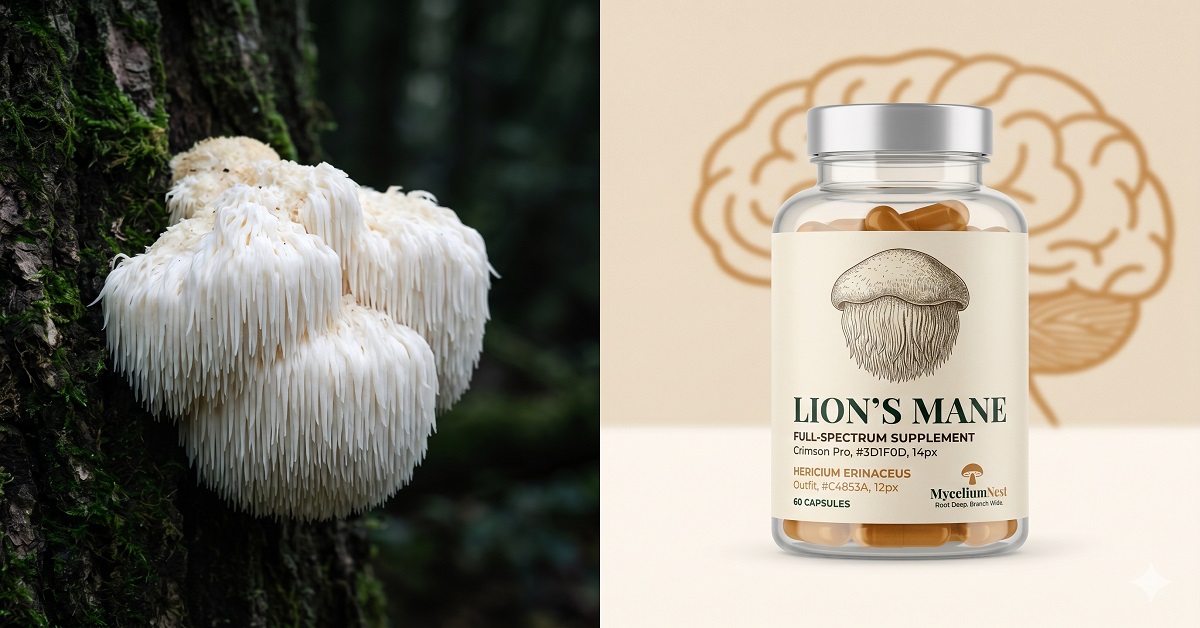
Fruiting body supplements are made from the actual lion’s mane mushroom — the white cascading structure you see in images. These contain hericenones (the primary bioactive terpenoids in published research). Mycelium-on-grain supplements are made from the root-like vegetative body grown on grain; these contain erinacines but also significant amounts of starch from the grain substrate — meaning you’re often paying supplement prices for grain filler. Our fruiting body vs mycelium guide covers this in exhaustive detail.
This article is for informational purposes only and does not constitute medical advice. Always consult a qualified healthcare provider before taking any supplement. See our affiliate disclosure.