Chanterelle Mushroom Identification: Find Them & Avoid the Jack-o’-Lantern
Never consume any wild mushroom based solely on this or any single online source. Always verify with two independent field guides and consult an experienced local forager. The jack-o’-lantern mushroom (Omphalotus olearius / illudens) is poisonous and resembles chanterelles to inexperienced eyes.

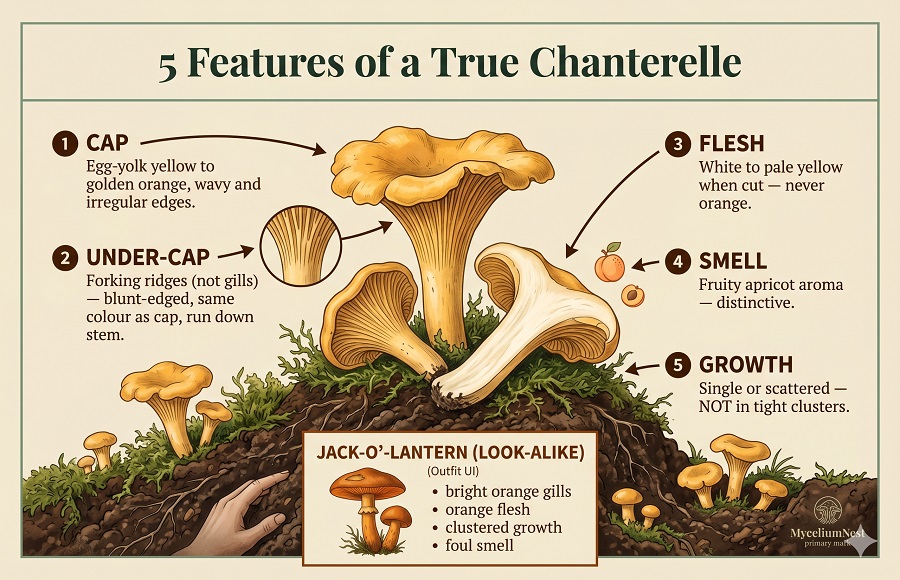
True chanterelles have forked ridges (not true gills) that run down the stem, a fruity apricot aroma, a white interior when cut, and grow singly (not in clusters). Jack-o’-lanterns have true, knife-blade thin gills, a foul-sweet or chemical smell, and grow in dense clusters at the base of trees.
Golden chanterelles are among the most prized edible wild mushrooms in the world — consistently ranking alongside morels, truffles, and porcini as the pinnacle of wild foraging. Their rich, peppery, faintly fruity flavour and firm, meaty texture make them extraordinary in the kitchen. The good news for aspiring foragers: once you truly understand the key identification features, chanterelles are actually one of the more confidently identified wild mushrooms in North America.
The 5-Point Chanterelle Identification System
Feature 1: The False Gills (Forking Ridges)
This is the single most reliable distinguishing feature. True chanterelles do not have gills — they have ridges (sometimes called “false gills”). The difference is fundamental:
- True gills (like those on a jack-o’-lantern): thin, blade-like, sharply defined, closely packed, can be peeled away from the cap relatively easily
- Chanterelle ridges: blunt-edged, forking (bifurcating as they run toward the cap edge), more widely spaced, same colour as the cap, feel like rounded folds of cap flesh — not blade-like
Run your thumb across the underside. On a chanterelle, the ridges feel rounded and blunt. On a true-gilled mushroom, they feel like paper cut edges. This takes only seconds to assess and is definitive.
The Touch Test: Feeling the Difference Between Chanterelle Ridges and True Gills
Visual identification is good. Tactile identification is better. Running your thumb across the underside of a suspect mushroom gives you information that photographs cannot — and it confirms your visual ID with a second sense. This is especially useful in dim forest light where colour differentiation is harder.
Feature 2: The Fruity Apricot Smell
Fresh golden chanterelles have a distinctive, pleasantly fruity aroma — often described as reminiscent of apricots, peaches, or a mild stone-fruit scent. This smell is so consistent and characteristic that it’s used as a confirmation point by experienced foragers. If the mushroom has no distinctive smell or smells unpleasant, chemical, or strongly earthy without any fruity note, reconsider your identification.
Feature 3: White to Pale Yellow Interior When Cut
Slice the chanterelle through the centre. The interior flesh is white to very pale cream or pale yellow. It is never orange. This is critical for distinguishing from jack-o’-lanterns, which have distinctly orange flesh throughout — the same vivid orange as the cap and gills.
Feature 4: Cap Appearance
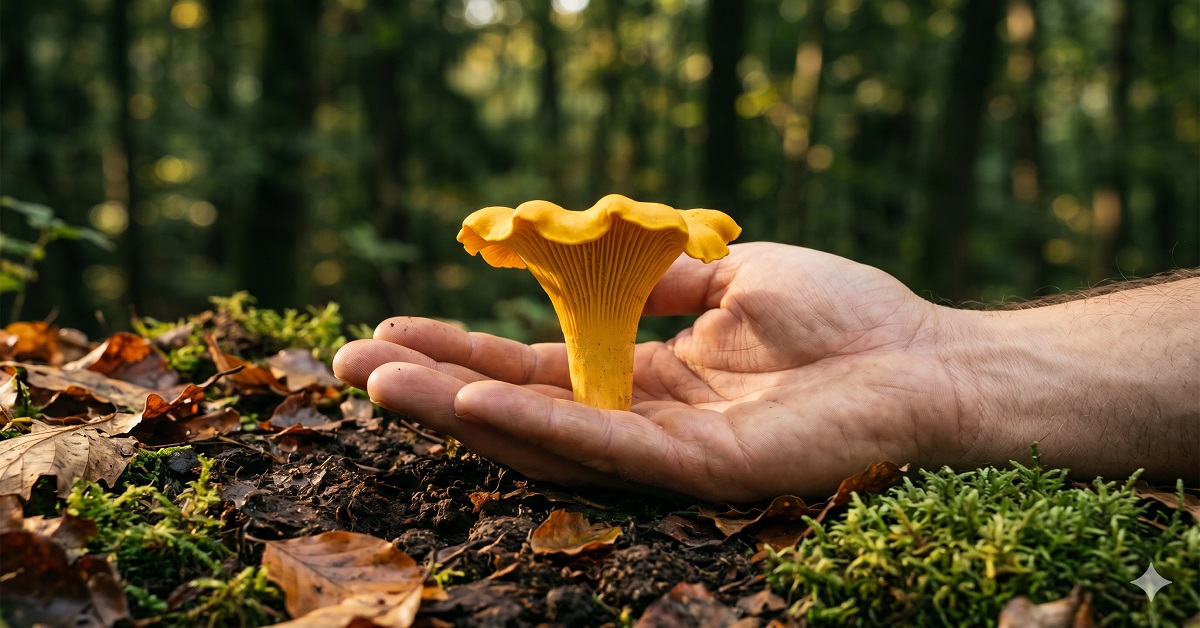
Golden chanterelle caps range from egg-yolk yellow to deep golden orange, often with slightly paler edges. The cap surface is dry, smooth, and irregular — with wavy, lobed, or undulating edges rather than a perfectly circular outline. Young chanterelles have a distinctly convex cap that flattens and develops its characteristic irregular margin as it matures.
Feature 5: Growth Pattern
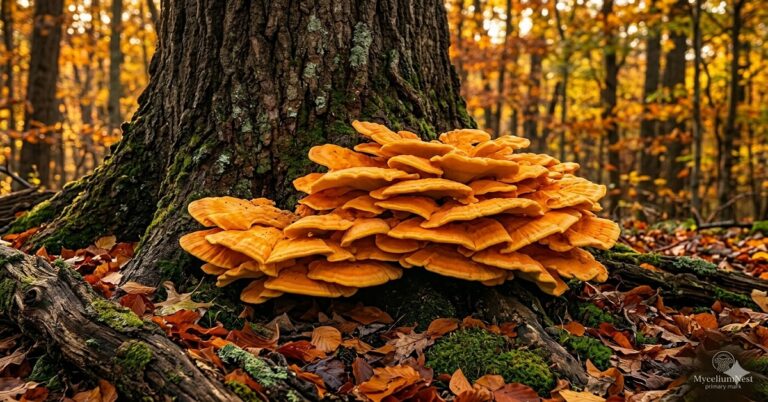
Chanterelles are mycorrhizal — they grow in a symbiotic relationship with the roots of specific trees (mainly oaks, beeches, conifers). They fruit singly or in loose, widely scattered groups of individuals — not in tight clusters from a common base. Jack-o’-lanterns grow in dense clusters at the base of trees or from buried wood, with multiple mushrooms emerging from the same point. Never confused if you know this distinction.
Chanterelle vs. Jack-o’-Lantern: The Full Comparison
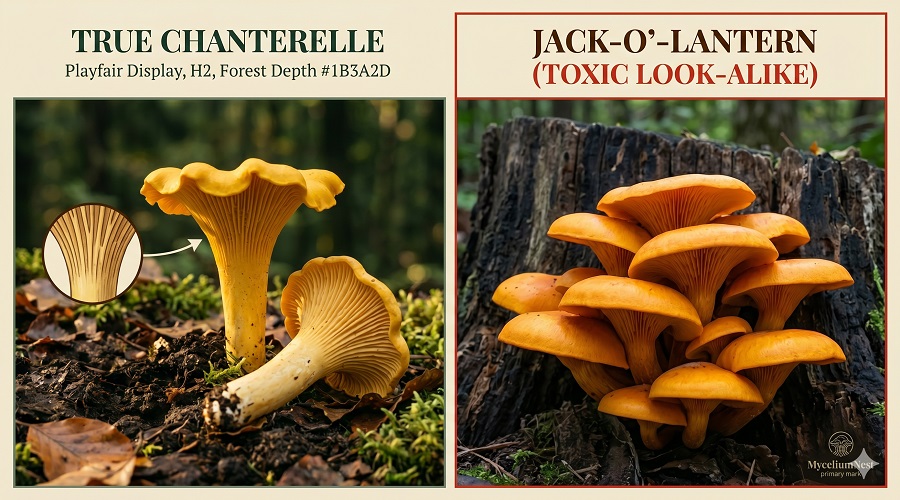
Jack-o’-lantern mushrooms (Omphalotus olearius / illudens) cause severe gastrointestinal symptoms — violent vomiting, diarrhoea, and abdominal cramping — beginning 30 minutes to 2 hours after ingestion. While rarely fatal, hospitalisation is sometimes required. The mushrooms contain illudin toxins that cannot be destroyed by cooking. Never eat any orange mushroom you cannot definitively identify as a chanterelle using all five criteria above.
Chanterelle Species of North America
Where to Find Chanterelle Mushrooms
The Mycorrhizal Partnership
Chanterelles are obligate mycorrhizal fungi — they form mutually beneficial partnerships with the roots of specific trees and cannot be cultivated away from their host trees. This means that if you find chanterelles at a location, they’ll return to the same location year after year as long as the host trees remain healthy. Chanterelle spots are treasured and closely guarded by foragers for exactly this reason.
Prime Habitats by Region
- Eastern US: Mixed hardwood forests with oaks and beech; look particularly in mature oak-hickory-beech forest with well-drained, slightly acidic soils. Rich, mossy, undisturbed forest floor is ideal
- Pacific Northwest: Douglas fir and Sitka spruce forests; chanterelles in this region (C. formosus) are some of the largest and most commercially harvested in North America
- Appalachians: Mixed cove hardwood forests with tulip poplar, beech, and oak — exceptional chanterelle habitat
- Southeast: Longleaf pine forests, mixed pine-oak; the smooth chanterelle (C. lateritius) is a regional specialty here
Microhabitat Clues
Look for chanterelles in spots where the forest floor has a deep, intact layer of leaf litter and the tree canopy is mature and largely closed. Avoid disturbed areas, heavily trafficked paths, or places with compacted soil. After significant rainfall (1–2 inches) followed by 3–5 days of warm, humid weather, check your known chanterelle spots — conditions like these produce the most reliable flushes.
Season & Timing by Region
Harvesting, Cleaning & Storage
Harvesting
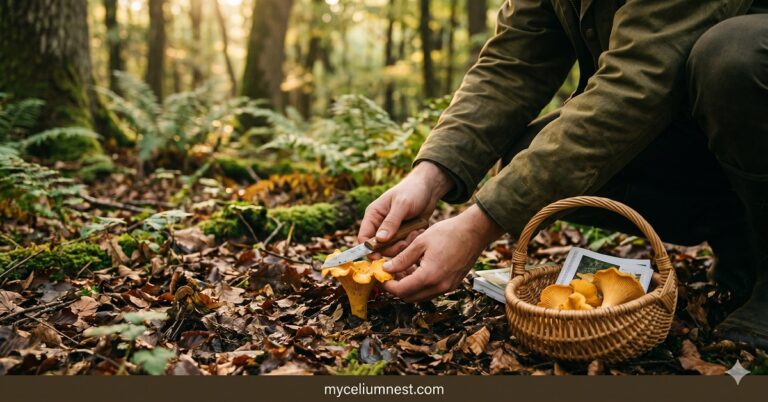
Use a knife to cut chanterelles at the stem base rather than pulling — this preserves the mycelial network and protects the site for future seasons. Carry in a mesh or wicker basket; the porous material allows spore dispersal as you walk, which benefits the habitat. Harvest only what you’ll use within a week — chanterelles don’t dry as well as morels and are best enjoyed fresh.
Cleaning
Brush off debris with a soft pastry brush or barely damp cloth. Chanterelles are more waterlogged than morels when soaked — rinse briefly under cold running water only if needed, then pat dry immediately. The firm flesh holds up well to cleaning without disintegrating.
Storage and Cooking
- Fresh: 5–7 days refrigerated in a paper bag (not plastic)
- Sautéed and frozen: Cook in butter until all moisture evaporates; freeze flat on a tray then transfer to bags. Maintains flavour well for up to 6 months
- Dried: Possible but quality degrades more than most mushrooms — drying works, but fresh or sautéed-and-frozen are preferred
Chanterelles are exceptional simply sautéed in butter with shallots, finished with fresh thyme. Explore our chanterelle recipe collection for more ideas.
Frequently Asked Questions
Can chanterelles be confused with anything dangerous?
The primary dangerous look-alike is the jack-o’-lantern mushroom (Omphalotus illudens / olearius), covered extensively in this guide. An experienced forager who knows the five identification features has virtually no risk of confusion — the differences are clear and multiple. The false chanterelle (Hygrophoropsis aurantiaca) is another look-alike with true gills rather than ridges; while not deadly, it causes gastrointestinal distress and should not be consumed. Always verify using all five identification criteria.
Do chanterelles grow in the same spot every year?
Yes — chanterelles are mycorrhizal and maintain long-term relationships with specific host trees. A productive spot will return year after year as long as the trees and soil conditions remain undisturbed. Many experienced foragers have spots they’ve been visiting for 20+ years. Mark GPS coordinates of any productive site — the mycelium doesn’t move, and neither should you when conditions are right.
What is the best field guide for chanterelle identification?
David Arora’s All That the Rain Promises and More covers chanterelles clearly with good photographic support and is the most field-portable reference. For regional specificity, the Audubon Society Field Guide to Mushrooms and regional mycological society publications are excellent supplements. See our complete field guide ranking for the full breakdown.
⚠ Safety first: never eat any wild mushroom identified solely from this guide. Always use multiple independent sources and consult experienced local foragers. This article contains Amazon affiliate links — see our disclosure.